

Dr. Parneet and Dr. Kiran tell us about a water fort, at Jhalwar, and two desert forts, at Jaisalmer, and Junagarh, that have been mute embodiments of history, in this land of valour. An exclusive for Different Truths.
Apart from the enticing structures of hill forts like Chittorgarh, Ranthanbhore, Kumbhalgarh, and several others at Nagur, Sojat, Mandalgarh, Dausa, Alwar, Jalore, and Bharatpur, Rajasthan is known for its water forts too.
One of these water forts, a UNESCO World Heritage Site, is Gagron Fort located at Jhalawar.
This fort is recorded in the history of Rajasthan concerning the battle between Achal Das Khichi, the ruler of Gagron, and king of Mandu Hoshang Shah, in 1423 AD. This battle is described in the famous Dingal verse “Achal Das Ri Vachanika”, written by famous poet Shiv Das Gasan.
It is the only fort of northern India, which is enveloped by water.
It is the only fort of northern India, which is enveloped by water. It is known for the unique structure of its ramparts. Generally, all forts have two ramparts, but Gagron Fort has three.
Along with, its towers are blended with Mukundara Hills of the Vindhyan mountain ranges where the hill itself acts as the foundation of the fort. Like other forts in Rajasthan, this fort too has several gates – Ganesh Pol, Nakkarkhana, Bhairavi Pol, Kishan Pole, Selekhana are the important ones.
Apart from this, there are other important historical sites in the fort such as Diwan-e-Aam, Diwan-e-Khas, Janaana Mahal, Madhusudan Mandir, Rang Mahal, ‘Sant Naresh Peepa ji Ki Chattari’ (Cenotaph of Saint king Peepa) and shrine of Peer Meetheshah, etc.
Sonar Kella
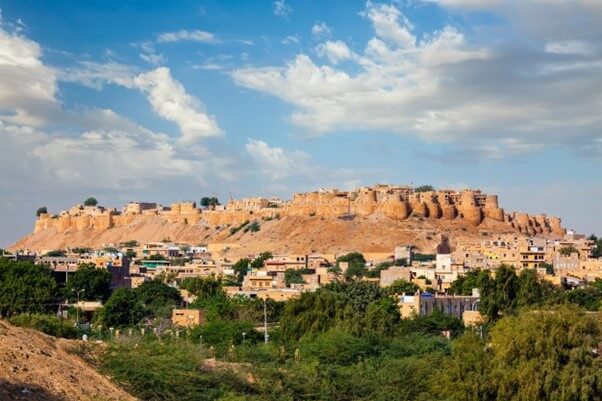
Sonal Kella or Jaisalmer Fort is a world-famous desert fort. Located on the Trikuta Hill, this second oldest fort in Rajasthan. It was built in 1156 AD by the Rajput Rawal, Jaisal.
It is called Sonar Kella or Golden fort because its walls are built with yellow sandstone…
It is called Sonar Kella or Golden fort because its walls are built with yellow sandstone, which turns into tawny lion colour during the day, fading to honey-gold as the sun sets, thereby camouflaging the fort in the yellow desert.
The structure is a fortification consisting of three layers, with the outermost being made entirely out of stone. It has 99 bastions on its strong ramparts.
The entrance gate of the fort is known as Akshay Pol. The other gateways are known as Suraj Pol, Ganesh Pol, Hawa Pol.
There are havelis and temples in the complex.
There are havelis and temples in the complex. The famous temples in the complex include temples of Lakshmi Nath, Ratneshwar Mahadev, Surya Mandir, Aadinath Temple.
This is the fort which provided the plot for Satyajit Ray’s mystery novel and its film adaptation, Sonar Kella.
Junagarh Fort
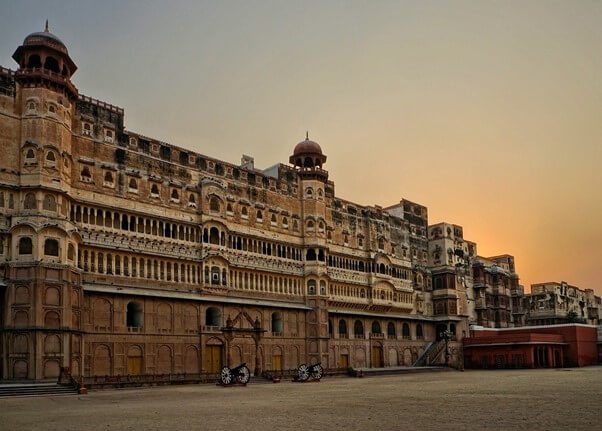
Junagarh Fort at Bikaner is also categorised as a desert fort. This fort was built, in 1478, by Rao Bika who established the city of Bikaner, in 1472.
The fort is well fortified with 37 bastions and seven gates to counter enemy attacks.
The fort is well fortified with 37 bastions and seven gates to counter enemy attacks. The fort complex contains several palaces, pavilions along with Hindu and Jain temples.
The stone carving in red and gold sandstone adorns the walls. It is rectangular covering an area of 63,119 square yards. It was built to protect an older fort built by Rao Bika. The balconies, kiosks, gates, and other structures speak of the taste and culture of those times.
This huge cluster of forts which are categorised into hill forts, desert forts and water forts are scattered across the land of Rajasthan.
These forts are known for their stunning structures with massive ramparts, strong bastions, which holds the palatial buildings, temples and shrines, water reservoirs.
… the cycle of time seems to be frozen in each of their stones.
These forts bear witness to the fact that the historical monuments are not merely the creation of mortar and stones, they are the mute embodiment of history; the cycle of time seems to be frozen in each of their stones.
Visuals sourced by the authors
Co-author

Dr. Kiran Deep is Associate Professor in English at Sri Ganganagar (Rajasthan). Her English translation of eminent Punjabi poet Surjit Patar’s poems has been published by Sahitya Akademi. Her publications include the research book, “Mapping the Creative Terrain: Revisiting George Eliot and Thomas Hardy”, along with several articles in literary journals of national and international repute.

Dr. Parneet Jaggi is Associate Professor of English in Rajasthan, India. She has four collections of poems in English and two research books to her credit. Her historical fiction The Call of the Citadel (2020) is well-acclaimed. Her poems have been anthologised in various journals. Her name appears in the Directory of Writers in America’s famous magazine Poets and Writers. She is Associate Editor of International Journal of Education and English Literature, Montreal, Canada.



 By
By
 By
By
 By
By
 By
By