In this evocative piece for DifferentTruths.com, writer Monika explores Khoda, the deeply symbolic and fading traditional tattoo art of Santal women.
Key Takeaways
- The Body as an Archive: Khoda transformed human skin into a permanent, inseparable repository of ancestry, community belonging, and life milestones.
- Symbol of Resistance: During anti-colonial movements like the Santal Hul, these sacred body markings emerged as powerful expressions of cultural dignity.
- A Fading Heritage: The tradition now survives primarily on the weathered skin of older women, making its preservation an urgent historical challenge.
There are arts that inhabit galleries, arts that survive in temples, arts that travel through manuscripts, and arts that find permanence in stone.
Khoda belonged to none of these worlds.
It lived on human skin.
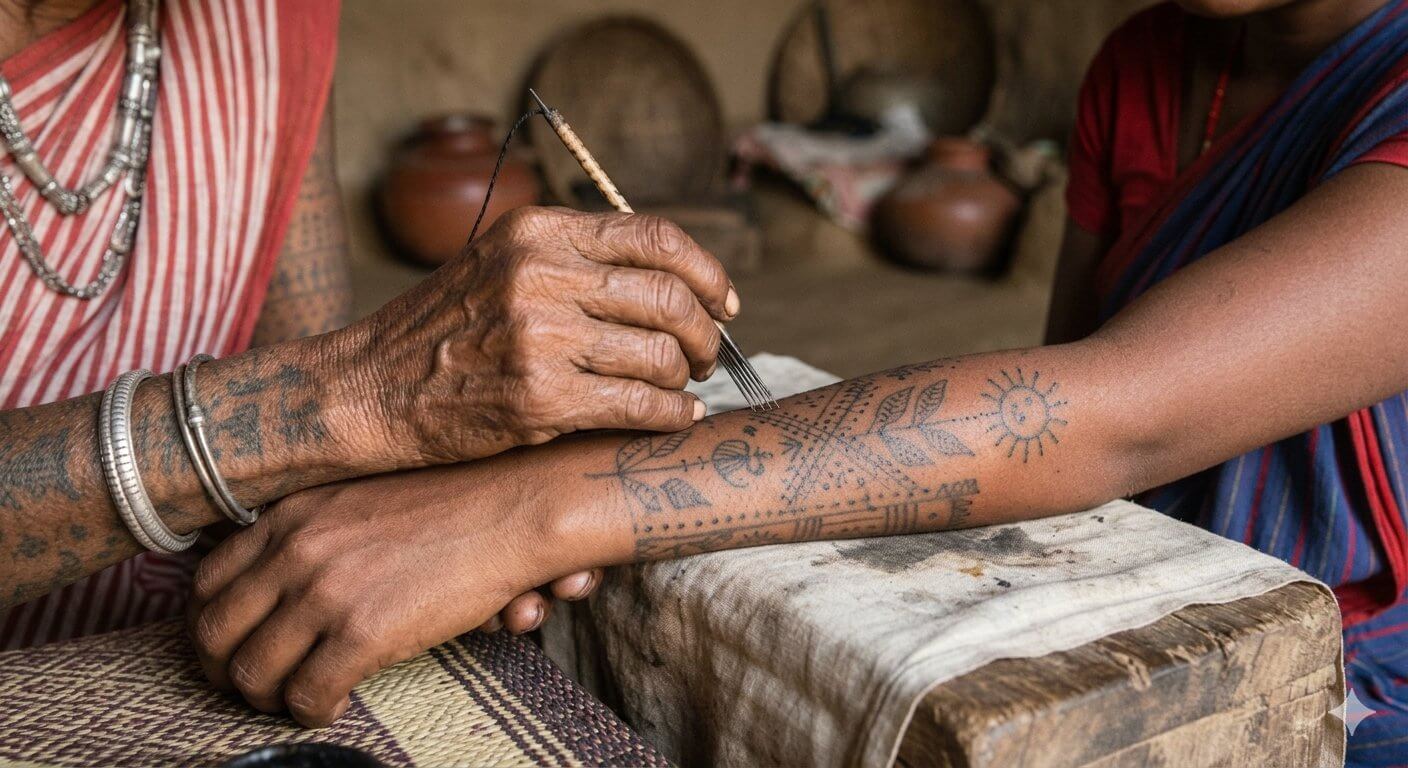
Long before archives, museums, or academic studies took an interest in Indigenous cultures, Santal women carried history upon their bodies. Every line, dot, curve, and motif formed part of a visual language known as Khoda, a traditional tattooing practice that once flourished across Santal communities and among several Indigenous groups of eastern and central India.
Today, Khoda survives only in fragments. One encounters it on the weathered arms of older women, in fading photographs, in scattered ethnographic records, and in memories passed from one generation to another. What was once a living cultural tradition has become an endangered archive.
Yet to describe Khoda merely as tattoo art is to misunderstand its place in Indigenous life. It was not simply ornamentation. It was identity, ritual, memory, beauty, social belonging, and, at crucial moments in history, an act of cultural resistance.
The Skin as an Archive
Most civilisations preserve themselves through objects. The Santals also preserved themselves through the body.
Khoda transformed the skin into a repository of memory. Tattoos marked transitions in life, signified belonging, and affirmed one’s place within the community. Girls were often tattooed during childhood or adolescence, before marriage, while additional motifs could be added later as life unfolded.
These markings were neither random nor purely decorative. They carried inherited meanings. Certain motifs spoke of ancestry, others of community identity, and still others of relationships between human beings, nature, and the sacred.
The body thus became more than flesh. It became a manuscript.
Unlike ornaments that could be sold, lost, or stolen, Khoda remained inseparable from its bearer. A necklace might pass into another’s possession. A tattoo belonged only to the person who carried it.
For many women, this permanence held deep significance. Khoda was often regarded as a form of jewellery that accompanied a person throughout life and beyond it. In communities where material wealth was limited, the body itself became the most enduring site of adornment.
Beauty Without Possession
Modern societies frequently associate beauty with accumulation. Khoda represented a different philosophy.
The tattooed body required no gold, silver, or precious stones. Beauty resided not in ownership but in inscription. The ornament became inseparable from the person wearing it.
Anthropologists who documented these traditions noted how many women viewed their tattoos as more valuable than material adornments. Jewellery could disappear. Khoda could not.
This perspective reveals a remarkable aesthetic worldview. Beauty was not external to the self. It was integrated into the body and therefore into identity itself.
The motifs often appeared on areas traditionally associated with jewellery—arms, wrists, ankles, necks, and foreheads. Yet what emerged was not an imitation of ornament but an entirely different understanding of permanence and value.
The Sacred Geography of the Body
Khoda was also connected to spiritual beliefs.
Among many Santal communities, tattoos were understood as markers that endured beyond earthly existence. They accompanied a person into the ancestral realm and helped preserve identity after death.
The exact beliefs varied across regions and generations, yet a common idea persisted: the marks carried spiritual significance that extended beyond appearance.
In this sense, Khoda occupied a space where aesthetics and metaphysics converged. The tattoo was neither solely art nor solely ritual. It belonged to both domains simultaneously.
The body became a sacred geography, inscribed with signs that connected the living to their ancestors and situated the individual within a larger continuum of existence.
Motifs from a Living World
Khoda drew its imagery from the world immediately surrounding its practitioners.
Geometric forms, floral patterns, birds, animals, sacred horses, ornamental bands, and symbolic motifs appeared repeatedly across regions. The designs reflected relationships with land, forests, rivers, seasons, and community life.
Unlike many classical art traditions preserved through written manuals, Khoda was transmitted through observation and practice. Knowledge moved from elder women to younger generations. The designs lived in memory rather than in books.
This oral and visual transmission gave Khoda an extraordinary fluidity. While certain motifs remained recognisable, local variations flourished. Every region, and often every artist, left subtle distinctions upon the tradition.
Khoda and the Santal Hul
The history of Khoda cannot be separated from the larger history of Santal resistance.
In 1855, the Santals launched one of the most significant anti-colonial uprisings in South Asian history: the Santal Hul. Led by Sidhu Murmu and Kanhu Murmu, the movement arose against exploitation, dispossession, and colonial domination.
During this period, cultural practices acquired new political significance.
Khoda became more than a marker of personal identity. It emerged as a visible expression of collective belonging. At a time when Indigenous communities faced immense pressure from colonial structures, the preservation of traditional customs itself became an assertion of dignity and selfhood.
Colonial administrators and missionaries often viewed Indigenous tattooing traditions through deeply prejudiced frameworks. Such practices were frequently dismissed as primitive or backward.
Yet colonial observers failed to recognise that Khoda was a sophisticated cultural language. It encoded histories, relationships, beliefs, and identities that could not easily be erased.
The tattooed body became a site of memory at precisely the moment when larger forces sought to reshape Indigenous existence.
The Long Decline
Like many Indigenous traditions, Khoda did not disappear suddenly.
Its decline unfolded gradually through a convergence of historical forces.
Colonial interventions disrupted traditional social structures and altered perceptions of Indigenous cultural practices. Missionary influences often discouraged tattooing and other customary forms of expression.
Later, urbanisation, formal education, migration, and economic change accelerated the process. Younger generations increasingly encountered social environments in which traditional tattoos carried stigma rather than prestige.
Changing beauty standards contributed further to the erosion of the practice. Globalised ideals of appearance displaced older aesthetic values that were rooted in community life.
Perhaps most devastating was the disappearance of practitioners themselves. As elder tattoo artists passed away, fewer apprentices remained to inherit their knowledge. A tradition transmitted primarily through memory and practice suddenly found itself without successors.
What had survived centuries began fading within a few generations.
The Last Living Repositories
Today, the most important archives of Khoda are still human beings.
In villages scattered across parts of India and Bangladesh, older women still bear markings created decades ago. Their bodies preserve designs that people may no longer practice, remember, or fully understand.
These women are, in a profound sense, the final custodians of a disappearing visual language.
Museums may preserve photographs. Scholars may preserve descriptions. Yet neither can fully replace the living presence of a tradition carried on the skin.
When one of these women passes away, a portion of that archive disappears with her.
The loss is not merely artistic. It is historical.
Why Khoda Matters
Khoda compels us to reconsider what art can be.
Modern institutions often separate art from life. Paintings belong in galleries. Rituals belong in temples. History belongs in books.
Khoda dissolved these distinctions.
It was art worn upon the body, history carried through generations, spirituality expressed through design, and identity made visible. It united aesthetics with everyday existence in a manner rarely encountered in modern societies.
Its disappearance also raises urgent questions about cultural preservation. What happens when traditions survive primarily through memory? How do we protect forms of knowledge that cannot easily be stored in archives? What is lost when the last practitioners of a tradition are gone?
These questions extend far beyond the Santals. They speak to Indigenous communities across the world whose histories have often been preserved not through monuments but through living practices.
A Fading Script
Khoda is frequently described as a lost art.
Yet perhaps it is more accurate to say that it is an art in danger of becoming unreadable.
The lines remain. The bodies remain. The memories remain.
What is disappearing is the world that gave those marks their meaning.
In the fading tattoos of Santal women resides a history of beauty without possession, identity without documentation, memory without archives, and resilience without proclamation.
The story of Khoda reminds us that cultures are not sustained only by books, monuments, or institutions. Sometimes they survive through something far more fragile: a mark carried upon the skin, passed from one generation to the next, until time itself begins to erase the script.
And when that script fades, humanity loses not merely an art form, but an entire way of understanding what it means to belong.
Reference:
https://en.wikipedia.org/wiki/Godna
https://santals.com/religion/santal-tribal-tattoos-the-wealth-of-afterlife/
Visuals sourced by the author, generated by AI

Born in the breathtakingly beautiful vale of Kashmir, Monika had her schooling there. A postgraduate in Business Management, an academician by profession, she is an art history enthusiast, writes poetry, short stories and paints. An avid reader, mostly biographies and autobiographies. Giving wings to her imagination through beautiful colours and words, she sings and has a following on YouTube.
 By
By
 By
By