
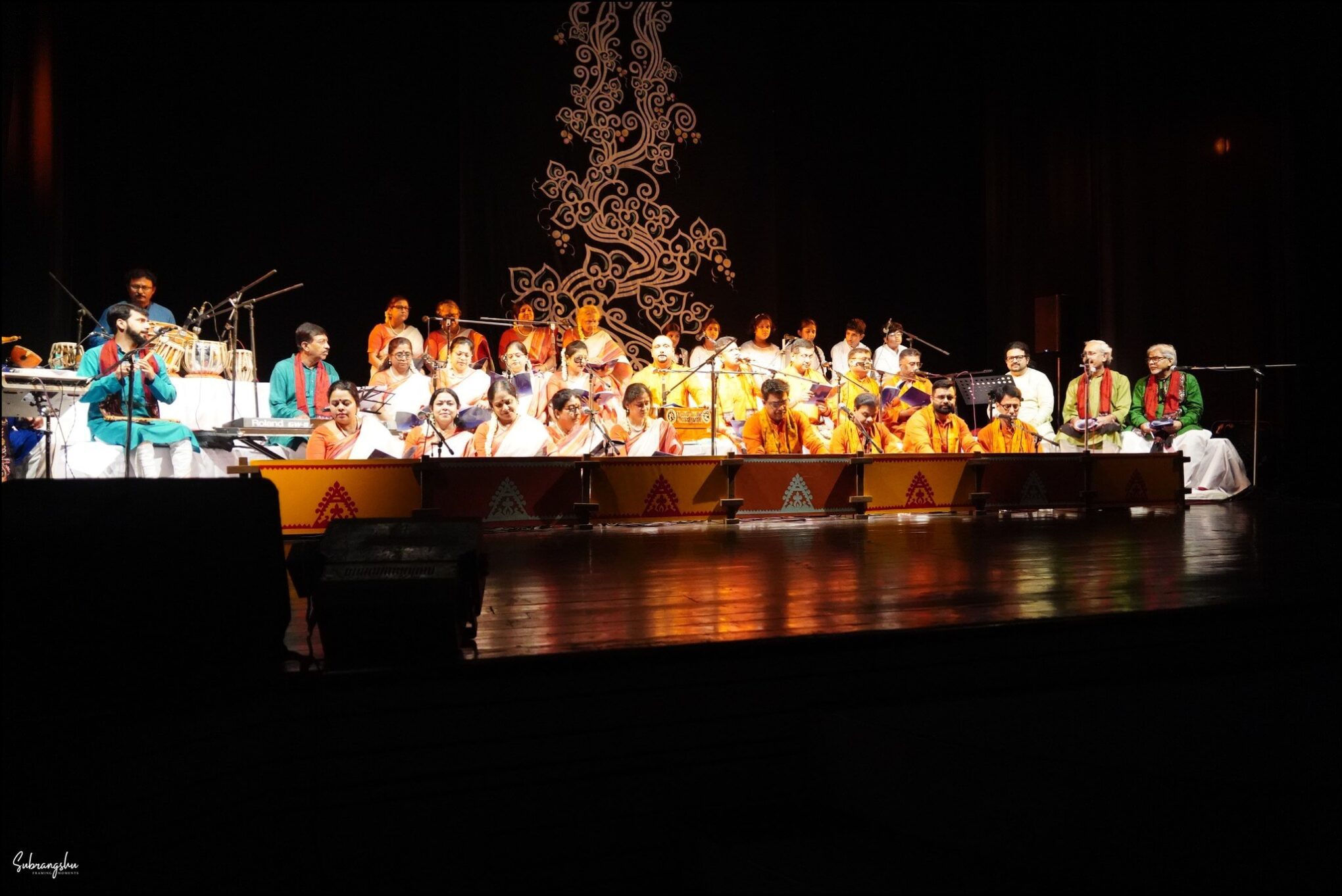

Tagore’s life and work were explored in the event “Aaj Ele Notun Beshe,” revealing his connections to rustic music, Baul traditions, and Sufi philosophy, reports Ruchira, exclusively for Different Truths.

For the vast majority of Bengali cultural aficionados and literature lovers, Rabindranath Tagore continues to be an enigma that can
be completely unravelled, however, hard one might try. It would take one’s entire lifetime to merely scratch the surface.
I was therefore rather obfuscated upon being invited to an event whose pivoting point was Tagore (naturally) a few weeks ago. The
theme and the title were enigmatic, in more ways than one: Aaj Ele Notun Beshe –‘Arabindric’ Rabindranath. I loosely translated,
which means undiscovered aspects of Tagore in a new garb.
The venue for this gala programme was the prestigious Shri Ram Center located in Mandi House, the capital’s very own cultural
district. The conceptualisation and presentation were the brainchild of a Delhi-based musical group named Sanjato. Interesting to note the term signifies consciousness of creativity.
As the show unfolded, the audience delightfully embarked on a journey to discover myriad anecdotes influences and experiences
which crowded the Bard’s long eventful and creative life but, by and large, remained out of the ambit of public knowledge.
The mainstay was the immense variety of rustic music, baul (wandering minstrel) and folk songs, which powerfully impacted
Tagore during his lengthy sojourns—at various points in time—in what is now Bangladesh. There, the fairly young Robi was deputed
to look after their family’s sprawling estates. Legendary artists of that era, viz Gagan Harkara, and Lalan Faqir, figure on the list with
many others.
These poets-singers-artists (all rolled into one) mainly unschooled and often illiterate were nevertheless visionaries who imbibed the lofty human ideals—peace, brotherhood of Man,
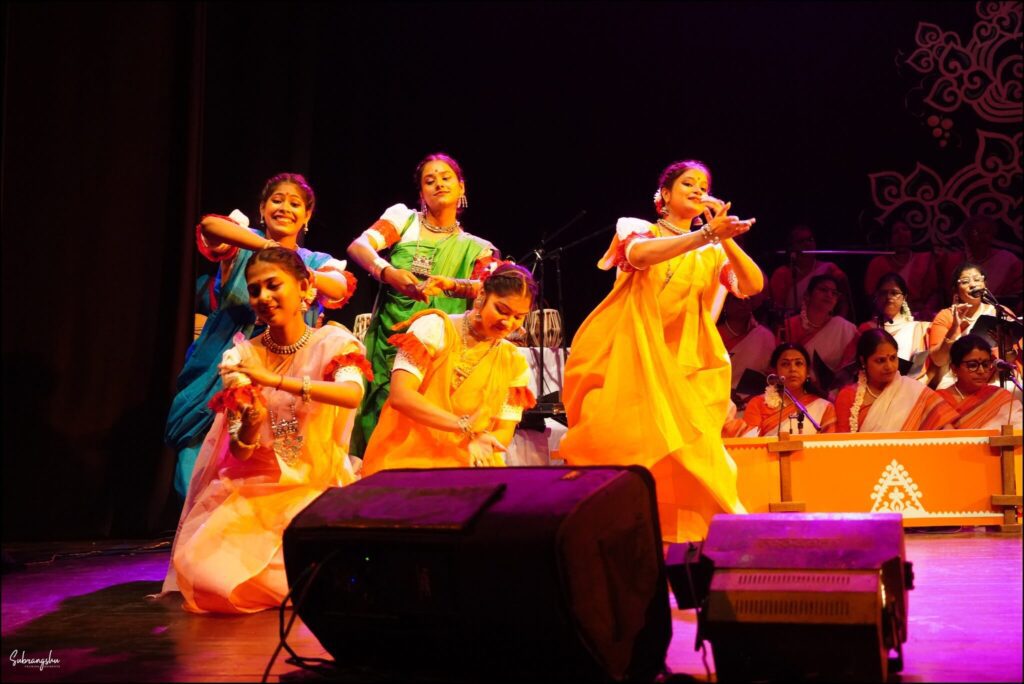
symbiosis of all faiths and social classes into their lives and creations. Viewed from another angle, this table of values is the essence of the Sufi faith. It is therefore not surprising to observe why and how Tagore’s “Prem” and “Puja” parjay songs are heavily ” Sufiana” in content.
Amidst this array of earthy melodies (pre-Tagore in spirit), Lalan’s stood towered above the rest. His outstanding “Tomar ghore basat kore koijona” and “Emon manob jonom r ki hobe” were hugely applauded. Shah Abdul Karim’s Amaar haath bandhibi pa bandhibi too was appreciated. A popular lyric by folk poet Jashimuddin, “O amaar dorodi,” and the centuries old kirtan style Sarbat Mangal Radhe also deserve mention. A few of the numbers had flawless dancing by well-known dance groups in the area, which increased their appeal.
Discerning listeners would agree that the selection of songs was impeccable. Yet another noted country poet-lyricist, Abbasudin
was not overlooked either. His all-time famous ‘‘ Amay dubaili re amay bhashaili re” ( later incorporated into the film Ganga) was
also part of the day’s agenda.
What made the folk songs more appealing and endearing to the listeners is that each of them blended life’s profound philosophy
with vignettes from daily lives of the common people.
“Luchi tomar Manya tribhubane,” a humorous song that Tagore’s contemporaries, “Rasaraj” Amrita Lal Bose, had originally composed,
the viewers in splits The rib-tickling song traces the genealogy of luchi (white flour puri), a staple- and -highly-coveted Bengali food.
The song “Vikramaditya Rajar Chhilo,” written by Tagore, served as a representation of Dwijendra Lal Roy, another literary figure from his time.
There was also a kaleidoscope of reading and recitation of excerpts from Tagore’s autobiography titled Jibon Smriti, besides his innumerable creations—both poetry and prose—for kids, which eventually got compiled in the Sahajpath (easy reader) series. A
few of the passages read out, were also culled from essays and write-ups on a medley of subjects like travel (a memorable train
journey and boat rides included) social life, and the overall ambience of Kolkata in that bygone era.
All said and done, it was a musically and spiritually enriching evening.
Picture procured by the author

Ruchira Adhikari Ghosh brings a liberal, wide-ranging outlook shaped by extensive travel across India and abroad. Educated at Holy Child School, New Delhi, Sacred Heart Convent, Ludhiana, and Panjab University, Chandigarh, she holds a Master’s in English Literature and a postgraduate diploma in Journalism and Mass Communication. With three decades in media, she writes on travel, books, music, performing arts, women’s issues, and especially food, drawing inspiration from rich life experiences. She is our Features Editor.


 By
By
 By
By