
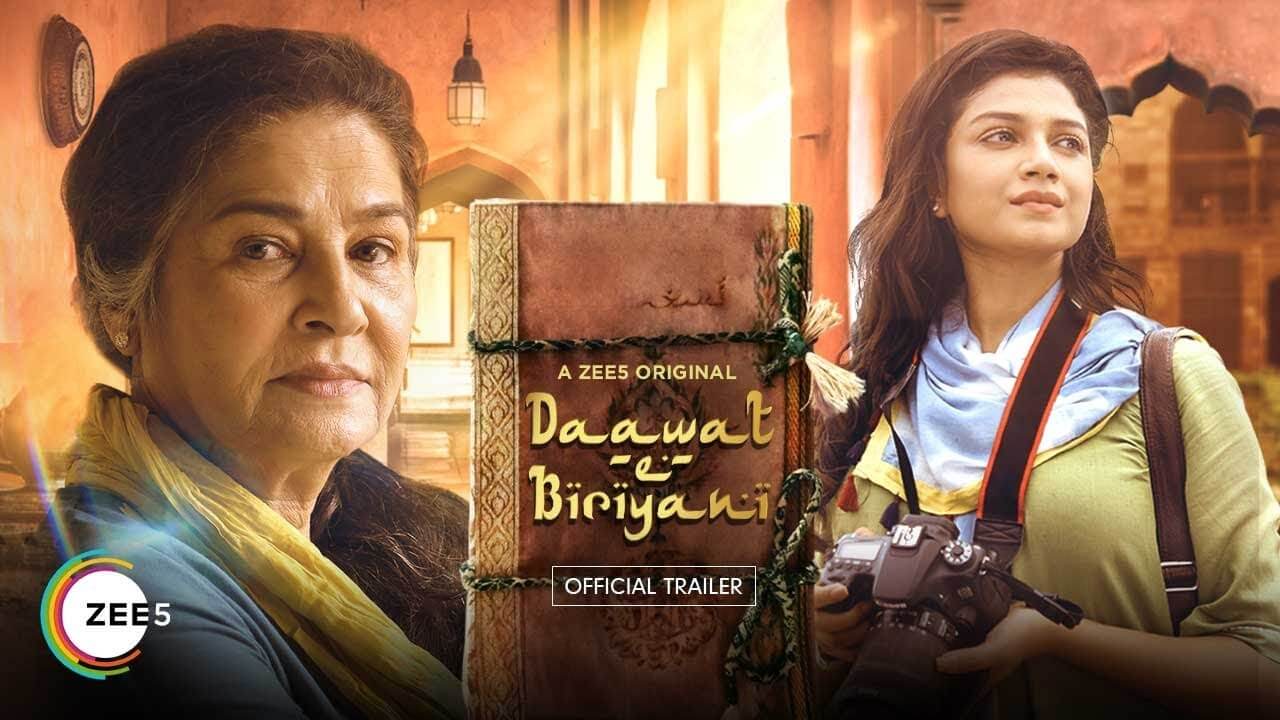

Ruchira reviews a film, exclusively for Different Truths, about a love story between a Hindu boy and a Muslim girl in Lucknow, with their granddaughter embarking on a quest to reunite them.
A few weeks ago, I had the opportunity to watch director Aditi Roy’s brilliant film Daawat-e-Biriyani. Set against the background of Lucknow city during the 1970s, it is the tale of a Bengali young man, Ranajoy Roychoudhury (Sudip Sarkar), who falls in love with Afreen (Anuradha Mukherjee), sister of his best friend Mansoor Ali. Interestingly, Ranajoy’s very first gift to Afreen is a recipe book from Nawab Wajid Ali Shah’s kitchen, containing a secret recipe for the most delicious Biriyani, fit for a royal feast!
Afreen’s affluent family runs a restaurant called Durbar-e-Afreen that serves Biriyani, free of charge, is given to the poor and needy people in the locality every day. Armed with this unique recipe book, Afreen zealously enters a winning mode—winning the hearts of the restaurant’s regular patrons, her kinsfolk, while not forgetting her love interest. The old saying “The way to a man’s heart is through his stomach,” rings so true.
Soon the couple-in-love realises that any liaison between a Muslim girl and a Hindu boy would be disastrous for sure. Hence, Ranajoy and Afreen decide to elope. Unfortunately, their staunch friend, philosopher and guide Mansoor, has been away, pursuing higher studies in London all this while. In a hurry, Afreen leaves behind her precious recipe book, which remains safely concealed in a drawer in her bedroom.
Fast forward to about fifty years later. An aged Ranajoy (Chiranjit) lives with his ageing) wife Afreen (Suhasini Mulay) in Kolkata now but craves the legendary Biriyani that Afreen hasn’t been able to cook for want of the recipe book. She can’t ask for it back because her family has boycotted her completely. At this juncture, their granddaughter, Panchali (Sauraseni Maitra), steps in and hatches a plan to retrieve the book. As the drama unfolds Panchali is seen traveling to Lucknow. Upon landing there, she cooks up a fictitious (though credulous) tale about her research project—reviving old family cooking traditions, thus managing to gain entry and hospitality in Mansoor’s (Jayant Kripalani) household. During her sojourn in the house, Panchali is able to sense the undercurrent of hostility against her naani (maternal grandmother) – harboured by some of the members. Over and above, she gets to savour Lucknow’s delicacies, including biriyani, though not as mind-blowing as her grandmother’s fabled creation. We notice how ‘biriyani’ helps her bond with the family members.
The film ends on a positive and sentimental note: before going back home to Kolkata, Panchali manages to salvage the recipe book. Her mission accomplished, she reveals her true identity and the purpose of the visit to Mansoor. The latter soon follows her to Kolkata, where the siblings reconcile!
All said and done, Daawat-e-Biriyani is a sensitive love story that transcends all barriers of caste, faith and customs. The viewers observe how true love and friendship triumph ultimately. Owing to its soft, humane yet powerful treatment, the film leaves an indelible imprint on our minds. Also, its multilingual content is bound to endear it to biriyani lovers who speak divergent languages.
Picture from IMDb

Ruchira Adhikari Ghosh brings a liberal, wide-ranging outlook shaped by extensive travel across India and abroad. Educated at Holy Child School, New Delhi, Sacred Heart Convent, Ludhiana, and Panjab University, Chandigarh, she holds a Master’s in English Literature and a postgraduate diploma in Journalism and Mass Communication. With three decades in media, she writes on travel, books, music, performing arts, women’s issues, and especially food, drawing inspiration from rich life experiences. She is our Features Editor.



 By
 By

 By
Delightful and original idea, but one complaint: where’s the recipe?
Granted, it’s a device, but then the director/ producers should set up a team of rakabdaars to produce a biryani worthy of the one in the movie. Or hold a competition in a sponsored TV / Youtube programme. It would give further publicity to the movie.