
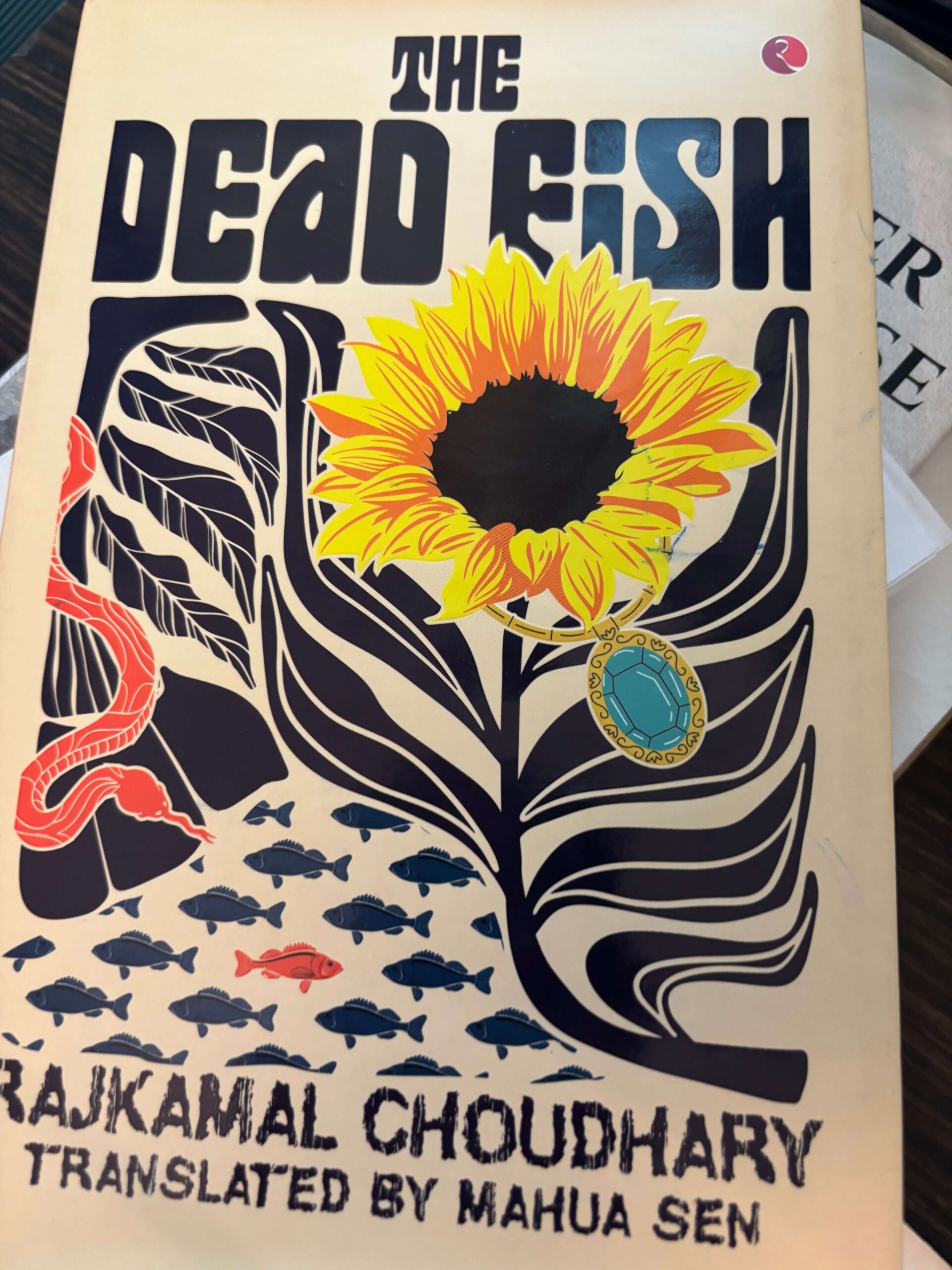
Prof Sanjukta reviews Mahua Sen’s translation of Rajkamal Choudhary’s classic novel, Machhali Mari Hui, as The Dead Fish, on DifferentTruths.com.

Key Takeaways
- Pioneering Translation: Mahua Sen successfully translates a provocative 1960s Hindi masterpiece for a global audience.
- Modern Themes: The narrative anticipates 21st-century capitalist aggression, corruption, and psychological alienation.
- Complex Character Dynamics: The story tackles intense themes of toxic masculinity, trauma, and sexuality through its protagonist, Nirmal Padmavat.
Almost sixty years after its first publication, Rajkamal Choudhary’s landmark 1964 Hindi modernist classic Machhali Mari Hui has been translated into English in 2025 by Mahua Sen. As a debutante in the field of translation from Hindi to English, Sen needs to be congratulated for a seamless translation of a book that was surely considered provocative, if not explosive, in the 1960s.
It is truly noteworthy that Mahua Sen’s English translation of Machhali Mari Hui, as The Dead Fish, will now reach a pan-Indian readership as well as global readers, as this is undoubtedly a path-breaking narrative on multiple levels, in terms of content and style. Rajkamal Choudhary, who died at the age of 38 (1929–67), was an Indian poet, short story writer, novelist, critic and thinker. He wrote in both Maithili and Hindi and was well-versed in Bengali, having translated Shankar’s Chowringhee and Bani Ray’s Chokhhe Amar Trishna into Hindi.
The new wave of literary writing of the 1960s broke free from prevalent stereotypes in terms of subject and narrative technique. There was a pervasive mood of nonconformism; resistance to traditional stereotypes became a normative practice; all institutions were interrogated; and existential crisis and existential dilemma were explored and exposed in a male-dominated, patriarchal social environment.
Rajkamal Choudhary’s novel The Dead Fish falls into the category of new wave experimentation of the 1960s, with literary content that is bold in its representation of fractured and alienated individuals; such subject matter was, in all probability, typically elided in fictional narratives written in regional languages of India. However, it needs to be mentioned that around the same time, the Bengali novelist Samaresh Bose’s novels Bibar and Prajapati, published in 1965 and 1967, had been labelled as transgressive and obscene.
Calcutta of the sixties is the location of Rajkumar Choudhary’s The Dead Fish, and the novel amply proves Choudhary’s familiarity with Bengali culture; moreover, it reflects his own alignment with the Hungry Generation movement led by Bengali intellectuals. Choudhary seems remarkably familiar with Western literature, references to which are replete in his novel. Moreover, the focus on business, love and lust is reminiscent of Scott Fitzgerald’s The Great Gatsby, published in 1926. Intertextuality can be deliberate or accidental, but any semblance of intertextuality enriches literary tradition. Also, the relevance of Choudhary’s novel in the 21st century becomes apparent from certain observations that suggest cyclical progression, such as “Capitalists always try to outshine the government… Honesty had now become a commodity to be traded. Public votes were being bought. MLAS and MPS could be bought. Ministries could be bought. If one had money and wisdom, the entire world could be bought.” Share markets, corporate conspiracies and competition described in Choudhary’s novel anticipate the neoliberal economic aggression that we witness in the 21st century.
Nirmal Padmavat, the protagonist of The Dead Fish, is a successful business magnate, whose investments, sales and profits have hoisted him into the arena of the rich and successful coterie in Calcutta. Padmavat’s thirty-storey skyscraper, Kalyani Mansion, is the tallest building in the city. Chowdhary’s novel foregrounds the protagonist Nirmal Padmavat’s alienation, loneliness, a recurring traumatic childhood memory of his mother eloping with a lorry driver, and his own unfulfilled yearning for unconditional love that remains elusive.
Despite his success as a capitalist, Nirmal Padmavat’s troubled relationship with women invariably led to a deep sense of frustration that did not seem to give him any respite. Noticeably again, male arrogance and hypermasculinity are revealed in various phrases used in the novel that suggest psychological stress, if not sadism and sexual perversion. The intention of violence is obvious in the sweeping generalisation of certain observations such as, “Men are intrinsically drawn towards the flesh. The warmth of flesh pulls like a magnet. Blood attracts. Men are savage. They want to scratch and scuff up flesh and muscle.” Repeatedly, instances of hegemonic masculinity and toxic masculinity, along with homophobia and misogyny, are noticeable in Chowdhary’s novel.
Though the protagonist Nirmal Padmavat’s physique resembled an ebony sculpture, his failed sexual intimacies with his partners, firstly Kalyani, whom he had met in New York, and later on his wife Shirin, whom he married in order to humiliate his business rival Harsh Mehta, exasperated Nirmal Padmavat. This psychic trauma assailed Padmavat to such an extent that when he brutally raped Kalyani’s daughter Priya, it was more about the triumph of a sadist punishing a vulnerable victim than an act of lovemaking. In fact, the novel delves into the existential dilemma of Nirmal Padmavat, who is involuntarily celibate and therefore suffers from low self-esteem and stress.
The primary symbol and metaphor of Choudhary’s novel is the dead fish. Lesbophobia seems to be an overwhelming discourse of the novel. As Shirin had female sex partners or indulged in self-gratification, Choudhary’s derision and sarcasm are inscribed in the metaphor: ‘Shirin was a fish. She was a dead fish.’ Repeatedly, the author comments that as Shirin was a dead fish, she was lifeless, dull, unresponsive and statuesque. Shirin’s relationship with Priya and, earlier in the novel, her lesbian and incestuous relationship with her own elder sister are described in graphic detail. As the novel concludes, Shirin and Nirmal’s lovemaking restores the compatibility of the married couple, and enigmatically the authorial comment suggests that compassion is deathless, unlike the transience of love and lust.
It is interesting to notice that both in the Preface by the author and in chapter 13 of the novel, Rajkamal Chowdhary takes on the role of an instructor and pedagogue of sexuality studies, as he defines the meaning of lesbianism, cites a variety of literary texts and expresses his reservations about same-sex relationships, and also points out that though gay intimacies are censured and punishable by law, lesbianism remains unnoticed in society, though it is prevalent. In a cryptic one-liner, the concluding line of the Preface states, ‘This novel is not about anything – it just hints at something.’ Presumably, the legal recognition of non-binary communities both globally and locally would have troubled the author of The Dead Fish.
Students, researchers and faculty members of gender studies, sexuality studies and masculinity studies will find Rajkamal Chowdhary’s novel The Dead Fish to be a riveting text on multiple levels.
Book cover photo sourced by the reviewer

Dr Sanjukta Dasgupta is a poet, short story writer, critic, and translator. She was a General Council of Sahitya Akademi, New Delhi, member and the Convenor English Advisory Board Sahitya Akademi, New Delhi. She is the President of the Intercultural Poetry and Performance Library, Kolkata and has twenty-six published books. Her poems have been translated into German, Serbian, Bengali, Hindi, Punjabi, Kashmiri, and Tamil.



 By
By
 By
By

 By
By