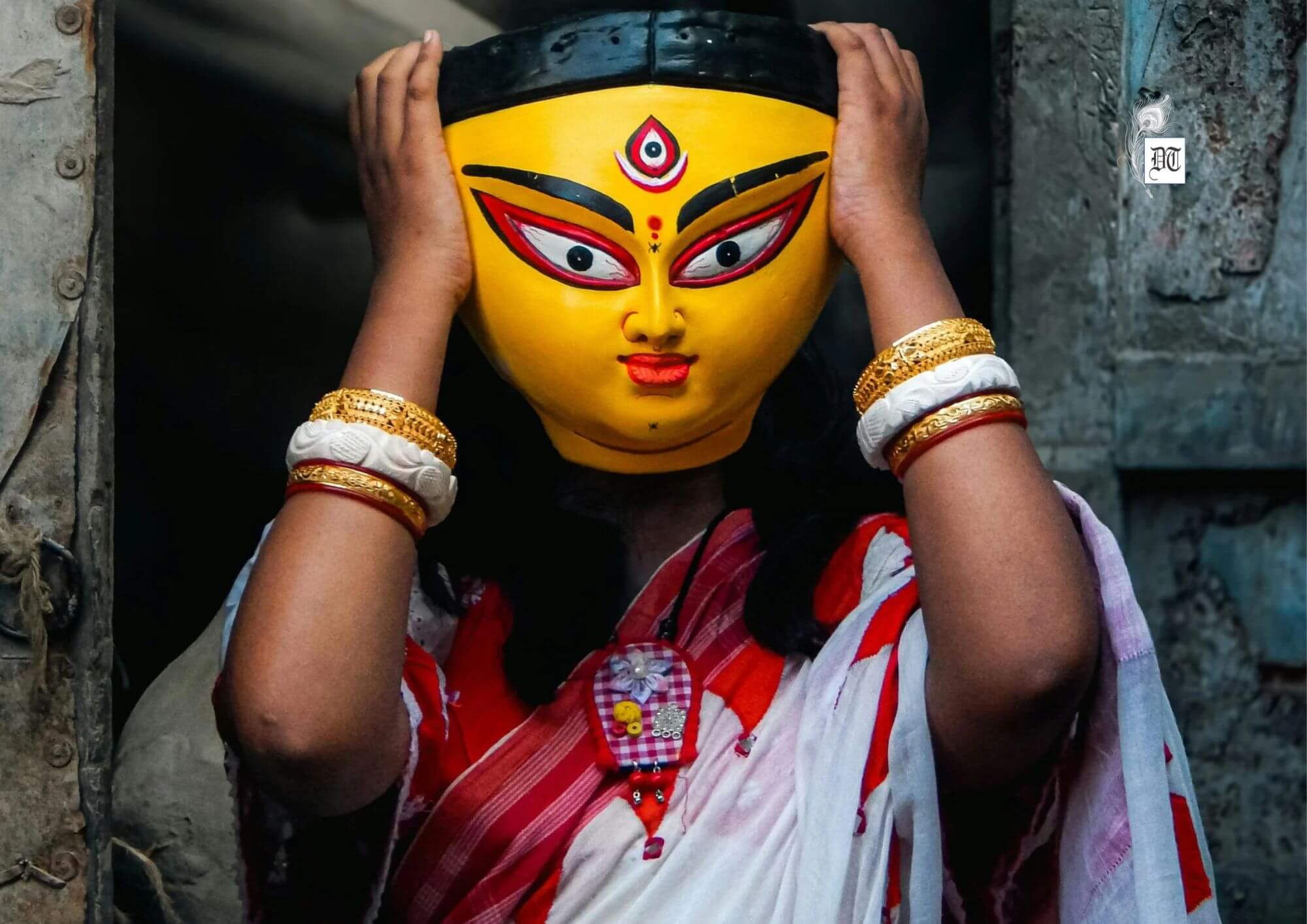

Our Editor-in-Chief, Arindam, shares a profound and moving reflection exploring the true soul of Durga Puja and homecoming on DifferentTruths.com.
Key Takeaways
- Beyond the Divine: The festival thrives on ordinary human sacrifices, from weary fathers and self-silencing mothers to dedicated artisans and quiet acts of resilience.
- Cultural Paradoxes: It uncovers complex societal truths, highlighting historical exclusions, labour inequities, and the sacred dignity found within marginalised communities.
- The Essence of Homecoming: True to Bengal’s emotional landscape, Durga emails are ultimately an annual pilgrimage of memory, love, and belonging that bridges distances and heals time.
Some festivals celebrate gods, some honour kings, and then there’s Durga Puja.
The Goddess, Durga, has long been celebrated within the grand walls of majestic homes, marking a landowner’s social debut. In the past, the impoverished could only watch the festivities from afar. In the village of Guptipara in the 18th century, twelve friends were denied entry to a landlord’s courtyard due to their social standing. Unperturbed, they held their own Puja—Barowari, which means “for the twelve friends”—with a Goddess who needed no formal invitation.
Even today, this spirit of refusal is embedded in the festival, though seldom acknowledged. Each community’s pandal stands quietly as a testament to societal barriers. Durga Puja is for the mother who saves ten rupees each week so her children can have something new on Ashtami. It’s for the father who walks miles behind his family, watching his excited children as his feet ache. It belongs to the elderly mother who struggles with stairs but never misses Anjali, and to the young man who visits the pandal ostensibly for worship while secretly hoping the girl in the red-bordered saree notices him.
The artisan who moulds the Goddess’s face with his own hands, even while his own children might go without new clothes, embodies the festival’s essence. It’s for the electrician who works late into the night to keep the lights shining for others’ devotion. It’s for the expat who travels continents to sit on a simple bench with a childhood friend. It’s for the woman from Nishiddho Palli, who is revered for one day a year and ignored for the rest. It’s for the widow who opens the ancestral home to see her grown daughter, still her little girl.
Perhaps that’s why Durga returns home each autumn—not just because mythology dictates it, but because Bengal understands the bittersweetness of homecoming. While Durga’s tale is one of battle and triumph over evil, Bengal adds a layer of tenderness, portraying her as Uma, the daughter returning to her parents for a few cherished days. Thus, Bengalis say, “Maa eshechhen,” meaning, “Mother has arrived.” And suddenly, doors of memory fly open. In my own experience, having walked through many autumns, I know that this opening is complex. Its joy is intertwined with sorrow, pretending for a few days that they can coexist.
I. Before the Goddess Arrives
In the final days of monsoon, if you wake before dawn, Bengal seems to be in a state of recollection. The air cools, the sky clears, and Shuli flowers fall like stars onto the grass. Somewhere a bicycle bell rings, a conch shell breaks the silence, and the distant, tentative beat of a dhak starts—almost as if asking permission to begin.
Then the preparations begin: bamboos rise, pandal frames appear overnight, electric wires crisscross lanes, and artisans descend upon Kumortuli. Painters, carpenters, and tailors work late into the night. Sweet shops overflow with Sandesh. Hundreds of unseen hands craft the Goddess long before the first dhak is heard.
This is a paradox of Durga Puja: it lasts only a few days, but the labour behind it spans nearly the entire year. In 2021, UNESCO recognised Kolkata’s Durga Puja as intangible cultural heritage, highlighting this intricate blend of craft, religion, public art, and community. It acknowledged what Bengalis have always felt: the festival symbolises homecoming and a return to one’s roots. The images are crafted from unfired Ganga clay and return to the river on the last day.
Yet, statistics can’t capture the anticipation. Anticipation is solitary, unique to each family. In one home, it’s the smell of new cloth; in another, it’s the fear that this might be the last Puja with an ageing parent. Anticipation can also be a plane ticket, booked months in advance, symbolising love that needs a boarding pass to be real.
Some families are home now. The crowds are confident, and the pandals become stages. Some prefer a quieter, smaller celebration in a courtyard, with a plate of bhog and conversation without shouting. That choice is also a devotion. The festival is vast enough to embrace both the night wanderers and those sitting quietly with older people.
II. The Man Who Sees Not the Goddess Aright
Subhashish owned three pairs of shoes: one for the office, one for the rain, and a pair of black sandals that had seen four Durga Pujas. On the morning of Sasthi, he polished them with an old newspaper while his wife watched from the door.
“You could have bought new ones,” she said.
“They’re still good,” he replied.
“They’re four years old.”
“They know my feet.”
She laughed, ending the discussion.
New clothes hung on the wall: Rini wore a pink frock, Tubai had jeans, and Sandhya donned a maroon saree. Subhashish bought nothing new. He had eyed a new Punjabi at Hati Bagan but returned it after paying the electricity bill, Tubai’s school fees, and his mother’s medicines.
Men like Subhashish learn early to put their needs second. For them, caring means staying in the background and keeping the picture intact. On Saptami evening, carrying water bottles, he trailed behind his family—Sandhya with her purse, Tubai with his mobile, and Rini, the princess, unburdened.
They visited pandals: Rini wanted phuchka (golgappa), then Tubai wanted a balloon, and Sandhya wanted a better view of the idol. Rini fell asleep by the fourth pandal. Subhashish carried her, and later, Tubai dozed off on his shoulder.
Someone pushed him in the crowd, but he held his daughter firmly. “Be careful,” Sandhya said. “I’m okay,” he replied, though his back ached, his feet burned, and his shirt was soaked. He hadn’t even glanced at Durga.
That was the humour of his Puja. While others visited the Goddess, he came to be with his family. Once home, Rini slept against him, Tubai snored, and Sandhya removed her earrings.
“Did you enjoy the Puja?” she asked.
Subhashish looked at his sleeping children.
“Very much so.”
He had seen almost nothing, yet he had seen it all. Some fathers live just outside the picture, ensuring everyone else fits in. The Goddess has ten hands, but some men walk as if they have only a spine, tired feet, and a belief that love is about carrying.
III. The Tin Box of Gobindobhog
Sandhya’s kitchen was tiny, with a window facing a narrow shaft. There was no view, just another wall. But she had a tin box. After each Puja, she bought a little Gobindobhog rice, a spoonful of ghee here, another there, until by September she had enough for one special afternoon.
Many Bengali kitchens survive not through abundance but through quiet defiance of scarcity. A woman hides tomorrow in a tin can, doing math not taught in school. She cooked mishti pulao on Nabami with cardamom, cashews, raisins, and ghee. The aroma filled the staircase, the shaft, perhaps another childhood.
Tubai entered the kitchen.
“Ma, why does Puja’s food always taste better?”
“Because you’re hungry.”
“No.”
He paused. “Because you make it.”
Sandhya looked away, hiding her smile. After everyone ate, Subhashish noticed her nearly empty plate.
“You didn’t take any?” he asked.
“I did,” she replied, indicating the pot.
“There’s plenty.”
There wasn’t. There never is. But mothers have a strange calculus, turning one meal into five plates, convincing everyone there is enough.
Psychologists call it self-silencing, a term for those holding households together by disappearing a little each day. In Bengal, we call her Maa. We gild the disappearance, later wondering why the gilding feels heavy.
Durga’s story is one of divine power. Bengali homes are filled with mythological characters like Sandhya. Neither is to be trifled with.
On Agomoni days, as old songs rise—Aay Ma Uma, Ebar Amar Uma Ele—I sometimes think the songs are more than about a Goddess descending from Kailash. They are for every woman sent away and every woman who stayed behind cooking the welcome.
The lyric is: Ramprasad’s mother will not send her daughter back, even if she must dispute with her son-in-law. That denial is not theology; it’s the cry of a family knowing how quickly a daughter’s visit can turn.
Sandhya doesn’t sing those songs aloud. She measures out rice. That is also a song.
IV. The Ice Lolly
Parno, age nine, had a sister, Minu, who was eleven. They fought daily over pencils, TV remotes, and fish portions. Sibling love is rarely civil, a training ground for intimacy and insult. Yet these same children, capable of bickering over a pencil, can, without prompting, show a kindness that shames adults.
The day before Saptami, Parno bought an orange ice-lolly with the five rupees he earned carrying groceries for a neighbour. He didn’t eat it. Instead, he ran across the football field to give it to Minu.
By the time he reached the banyan tree, it had half-melted.
“This,” he said.
Minu looked at it.
“You fool. It’s melting.”
“I know,” he replied.
“Then why did you bring it?”
“For you.”
She took a bite. “Now you eat.”
“No.”
“Why?”
“Because I bought it for you.”
She laughed, reaching into her dupatta’s corner to reveal some chocolate—a gift from a classmate. She had saved it for him. The chocolate had melted, the lolly softened. Their shoes were muddy, clothes dirty. They shared everything equally.
Perhaps this is how civilisation endures: not through grand declarations, but through small acts of love.
Adults build pandals, discuss themes and prizes. Children, if we let them, remember the older rite: a gift is incomplete until it is shared.
V. The Grandmother Who Refused to Take the Stick
Sarala Devi was eighty-two, her knees worn. Her doctor advised minimal walking. So, on Ashtami morning, she declared, “I’m going to Anjali.”
Her son sighed. “You can pray at home, Ma.”
“No.”
“Your knees…”
“My knees aren’t invited to the Puja.”
And that was the end of the argument.
In our cities, old age increasingly feels like a medical sentence—less walking, more sitting, fewer risks. Sarala Devi knew that living cautiously was its own kind of immersion. She wouldn’t let the Goddess see her sitting alone.
She wore a new Taant saree, stiff with starch, and refused the walking stick. Instead, she held her grandchildren’s hands as they walked.
At the entrance, the boy asked, “Thakuma, does Durga kill Mahishasura every year?”
“Yes.”
“Why doesn’t he learn?”
Sarala Devi laughed. “Because demons are hardheaded.”
“Demons?” he asked.
“The ones inside us,” she replied.
I have known women like her in Allahabad, Kolkata, and in houses that exist only in memory. They don’t talk about empowerment. They won’t abandon the year’s burdens. Their determination isn’t born of ego; it’s a glowing declaration: I’m still part of this story.
VI. The Boy Who Forgot the Mantra
Soumyo, nineteen, had spent three weeks tutoring schoolchildren to buy a new blue kurta. He had practiced his Puja persona—hair, neck, wrist, scent. A festival is also a theatre of becoming. Young men don’t only visit the Goddess; they seek glimpses of who they are becoming. The new kurta isn’t mere vanity. It’s a statement: I am not last year’s boy. During Anjali, he stood with flowers cradled in his palms. The priest chanted, “Om Jayanti Mangala Kali…” Soumyo repeated the words, then saw Titas.
She was three rows ahead in a white saree with a red border and a silver pin. Incense smoke drifted between them. She turned; their eyes met.
The Universe didn’t collapse. No thunderbolt struck. No celestial music played. The priest continued chanting. But Soumyo forgot the mantra.
Titas looked away, her ears reddening. He grinned. She pretended not to notice. That was the extent of their interaction. They would remember it twenty, thirty, perhaps forever.
Ritual is kind to the shy. It draws people into shared attention, making it almost permissible. Two people may not speak, yet share the same sacred air.
We often think love begins with words. Sometimes it begins with silence. Years later, when their lives have diverged, they may return to that smoke-filled moment. Memory holds what the mouth was too scared to say.
VII. Habu and the Man from Toronto
Ronnie returned for every Puja from Toronto, despite his friends’ ribbing. “Why fly halfway around the world for five days?” He never found a satisfactory answer.
The question has a practical economic answer and a helpless human one. The economic answer is logical; the human answer is: some friendships transcend passports. They are sustained not through video calls but through midnight park-bench conversations when the city lies honest for a moment.
This year, he brought a suitcase of chocolates, maple syrup, and gifts. On Ashtami night, he found Habu behind the club. Habu, an electrician, was soaked in sweat, hands black with grease, having climbed poles to fix lights for days.
The festival’s brilliance is owed to hands like his. We photograph the lamps, but rarely the person on the pole.
Ronnie sat beside him. Habu offered tea.
“Does Canada have tea?” Habu asked.
“Yes.”
“Then why come here?”
Ronnie chuckled. “Because Canada has no you.”
Habu looked away.
“Your English has worsened.”
“My Bengali, too.”
They laughed, then fell silent. They had grown up together, playing football, stealing guavas, borrowing money they’d never repay. Life had divided them—Toronto and Calcutta, bank accounts, passports, different worlds.
Diaspora is a quiet violence. Love doesn’t always break; it changes the way we speak. Ronnie’s Bengali had frayed; Habu’s world was lanes and fuse boxes. Unease lingered—the uneven luck. Neither mentioned it. Friendship is, at its best, a pact not to sermonise about luck.
It didn’t matter, sitting at midnight on a wooden bench with a clay cup of tea.
Habu nudged him.
“Remember when we pinched that kite?”
“You threw me off the roof.”
“You fell.”
“You pushed me.”
“You survived.”
Ronnie grinned. “Unfortunately.”
Some friendships don’t need constant upkeep. They wait like heritage homes, old songs, or Durga herself.
Ronnie would return to Toronto with Habu’s mother’s nimki, as if a paper packet could preserve childhood through an airport queue. It can’t, but it does other things. It allows a man to think, for a few hours across the Atlantic, that he still belongs to a lane that no longer belongs to him.
VIII. The Potter’s Daughter
For thirty-five years, Gouranga Pal crafted Durga. He knew the Goddess before she had eyes. Bamboo first, then straw, then clay, and the long work of bringing form to the void. His hands knew the curve of the cheek, the rise of the eyebrow, the pressure a clay finger could endure before breaking: the clay’s moisture, the patience in his hands.
Months before Puja, Kumortuli artisans begin shaping figures from clay drawn from the river’s imagination. It’s not just manufacturing; it’s tradition, a craft handed down through generations.
The inheritance is strained. Clay arrives late, prices rise, young men choose other paths. Artisans from rural areas come to the city for three months, sleep where they can, send money home, and vanish when the trucks leave. A million photos capture the Goddess they create, but their names are absent from captions.
When family insisted, Gouranga still mixed a pinch of punya mati with the clay. He loathed the errand and the story more than the errand itself.
“How can people call a woman impure, then call her doorstep holy?” he asked his son once. His son had no answer, nor did the priest or neighbourhood.
Gouranga completed his idol on Mahalaya, painting her eyes last. It was a challenging moment. Until then, she was just clay. Then suddenly—she was looking back.
Every artisan knows this: months of work on the face, then one morning, the face looks at you. You’re no longer the creator; you’re being observed.
Chakshu Daan (drawing the eyes of Durga): The gift of sight, an act of animation, an act of surrender. The maker departs, and the made becomes presence.
On Dashami, the lorry arrived. The committee counted cash. Gouranga recounted it—he needed to pay the electricity bill, his daughter’s college fees, his wife’s medicine.
Outside the workshop, three street children marvelled at the decorated truck. One little girl had no shoes.
Gouranga looked at them, then at the money, and pulled out two notes.
“Come.”
The children followed.
He bought them clothes—nothing fancy, just three cotton dresses and two shirts.
When he returned, his son asked, “Why did you do that?”
Gouranga looked at the vanishing idol.
“Because she’s going home.”
“And?”
He smiled.
“She shouldn’t leave without taking someone with her.”
I’m not romanticising this. Two notes don’t make up a year’s informal wages, a flooded workshop, or a son who might not stay in the trade. Charity isn’t justice. But sometimes a man who’s spent months giving a Mother her face can’t watch children stand barefoot at her departure.
The gesture is modest; the hunger behind it isn’t.
IX. The Soil that Must be Begged
The lane isn’t a holy book. It resembles a driveway, with electric wires, a dripping tap, a schoolgirl stepping over a puddle, clutching her bag as if looking up is dangerous.
This is Nishiddho Palli, the forbidden place, red-light area. The city has other names for it, some vulgar, some official, none adequate. Most of the year, respectable society avoids this address. Then, weeks before the Goddess receives her face, a few men remember it.
They come for the soil.
The story is neat and terrible. A man entering this house leaves virtue at the door, but the soil receiving his discarded goodness becomes pure. Mix that purity with clay, and the Goddess is complete.
The story flatters everyone but the woman behind the door. The man can still be saved; the idol remains holy, but she’s still deemed a drain.
Quietly, historians and Indologists have noted that the Puranas don’t command this. It’s a custom that grew within landlord Pujas and acquired the weight of tradition. Age isn’t synonymous with truth, but a custom, once it poses as eternal, is hard to shed.
The ritual has a redeeming grammar: soil isn’t stolen; it must be asked for. The Kumor (artisan) stands at the door and asks; if the woman refuses, he respects her.
Latika has given soil for nineteen years. She gave it when she was new to the lane, hoping borrowed holiness might ease her daughter’s world. She gave it to men with downcast eyes and to those impatient for their next piety. She gave it because she couldn’t afford to refuse. Then she stopped.
Not abruptly. Like a tap slowing, then stopping. The women of the Palli began asking questions the festival didn’t want to broadcast. “If our threshold is sacred, why is our work unclean? If our soil completes the Mother, why can’t our children complete a school year without shame? If you bow for a handful of dirt, why not when a girl from this lane is beaten, denied a room, or told safety is personal?”
Latika never attended meetings with a microphone. Her daughter was in Class 10. The city used and theorised her body.
This year, she recognised a familiar figure. Not a boy with a mobile, no intermediary. An old artisan from a Bonedi Bari Puja where the old errand persisted. Clay under his nails, a gamcha on his shoulder, he stood on the step as if it were sacred.
“Ma,” he said.
The word was strange here. Men had called her many names, but without appetite, it surprised her.
“We haven’t had soil for a while,” she said.
“I know.”
“Why did you come?”
“Because they sent me. And I didn’t want them to send a boy who would only take.”
Latika glanced at him, then at her daughter’s schoolbag and the crack in the sill where rain pooled and mosquitoes bred.
“You take our dirt and call it virtue,” she said.
“You take our nights and call them sin. Which do you want today?”
The artisan didn’t retreat. He didn’t make a speech; people make speeches to maintain the status quo.
“I want what you’ll give,” he said.
“If nothing, I’ll say nothing was given. The Goddess has other clay.”
A girl laughed from a window. “When did the Goddess become so generous?”
Latika nearly smiled. She invited him inside, not on the step, but on a stool in a shadowed strip. She served him tea in a glass with a faded flower. He drank, and the lane continued around them—a radio, a quarrel, a child urged to finish rice.
This is a truth the city ignores. Nishiddho Palli isn’t just a pollution theory; it’s a neighbourhood. Women raise children, send money to villages, worry about school fees, police, monsoons, landlords. The festival comes to harvest a symbol and flees before the symbol becomes a person.
“My daughter has a math paper,” Latika said, as if part of a ritual.
“What’s her name?” the artisan asked.
She repeated it, carefully, like a mantra one doesn’t want to spoil.
She rose, took a broken coconut shell, and scraped earth from her own doorstep—not a mythical centre of purity, but where her daughter’s shoe left a mark.
“Take it,” she said.
“You don’t have to…”
“I know.”
She extended the shell.
“Don’t expect me to be saintly. I give you proof a house exists here. Mix it if needed, but when you paint her eyes, remember whose door it was.”
The artisan took the shell without touching her fingers, handling the earth as if it might bruise him.
“What do I tell them?” he asked.
“Tell them the earth was begged,” Latika replied.
“At least, that part is true.”
When he left, her daughter returned for a forgotten notebook.
“Who was that, Mamma?”
“The man who makes the Goddess.”
“Did you give him anything?”
Latika looked at the stair space. “A bit of the house.”
“Will Durga recognise us?”
Latika straightened her daughter’s collar.
“If she’s got any kind of mother in her, she does already.”
I don’t offer this as a cleansing parable. A handful of soil isn’t a legal profession, a lane of fear, or a year’s contempt turned into four days of equality. But I believe Durga Puja maps our hypocrisies in clay. We offer the Mother what we can’t keep in daylight—river-mud, labour, hunger, virtues men discard like shoes. We then worship the composition and deny the ingredients.
Some years, Nishiddho Palli women begin withholding the ingredient. That refusal is also Puja, saying: don’t finish your Goddess with my erasure.
When a woman like Latika still gives a little earth, it’s not reverting to the old story but writing a new one upon it. The Goddess can be many soils, recalling a girl with a math exam, leaping over a puddle, trying to leave the lane behind.
X. The House That Waited
The old house lay outside the city—green blinds, cracked walls, a mossy courtyard, a tulsi plant by the veranda, a creaky wooden staircase.
Sharmila hadn’t been there in eleven months. She lived in New Town—glass windows, air conditioning, elevators, security officers, online groceries. All modern, nothing familiar. Modern homes erase the body’s old maps. You forget which stair creaks, where the afternoon light falls. Convenience isn’t sin, just forgetting masked as progress.
On Saptami, Sharmila stopped at the ancestral courtyard entrance. Her mother stood in the doorway, older, less hair, same eyes.
“Mom,” she said.
And that was that. Sharmila let go of her handbag; her mother opened her arms. The corporate manager vanished. The grown woman was gone. The little girl returned. She pressed her face to her mother’s shoulder. It smelled of mustard oil, camphor, old
cotton—home.
What comes back isn’t childhood. We don’t remember it. The return allows us to lay down the performance of competence. For a few days, a woman can be a daughter again, held without earning it by invoice.
Outside, her husband bowed before his uncle. Someone called from the kitchen, “Who wants luchi?”
“Where’s the payesh?” another shouted.
A child ran through the garden. An old aunt complained about fish costs. Someone opened a wooden trunk and found photos. Someone began a story everyone knew.
No one stopped him.
Family stories aren’t repeated because they’re new. They’re repeated to keep memory alive. In the Bengali imagination, every autumn, the Goddess returns to her parental home with her children. This homecoming notion is ingrained in the festival, especially in old Bonedi Bari traditions, where Durga isn’t just a deity but a returning daughter.
That’s why Baper Bari (father’s home, maika) is powerful. You can own a flat, a cottage, a penthouse. You may have lived in London, Dubai, Toronto, or Singapore. But inside, there’s a courtyard with a cracked wall where someone once called your name.
Beware the nostalgia’s sweetness. The old house held rules, women’s labour, rooms not equally kind. We return to mustard oil’s scent, forgetting the silences beside it. Mature love of home has both: unopened doors and welcoming arms.
XI. The Woman Who Arrived by Herself
On Dashami morning, an older woman stood before the idol. Her husband was dead, her son abroad, and her daughter married and moved out. She was alone.
The crowd was large, women laughing, children running, drums beating. She was on the verge.
Sindoor khela is a vibrant rite for married women, a joyous farewell. Widows have long stood outside that red. The festival breaks many barriers, but not all. She knew the rules, didn’t argue, and came for something quieter.
A young volunteer noticed her.
“Ma, do you want to come closer?” he asked.
She hesitated. “May I?”
“Of course.”
He took her hand.
She stepped forward.
The priest finished the service. Women prepared for sindoor khela. The old lady watched.
“Ma, look after my children,” she whispered.
No one heard, except maybe the Goddess, the young volunteer, or herself. Sometimes prayer isn’t asking but acknowledging that we can’t protect everyone we love.
Distance has reshaped that realisation. Children live in time zones; love is a screen, a remittance, a voice after dinner. The older woman wasn’t asking for a miracle. She was giving separation a pair of clay feet.
The volunteer didn’t ask her story. He didn’t need to. Some kindnesses are complete when the hand extends without withdrawing.
XII. Dashami (Day Ten)
Then the last morning. The drums sound odd, louder, and sadder. The Goddess must depart. Those who welcomed her prepare for her leaving. Children gape, women weep, men pretend not to.
Bengali men are schooled in a particular emotional theatre. They organise immersions, carry idols, shout orders. The throat has limits. If grief comes, it must wear duty’s guise.
The idol travels streets that greeted her like a queen five days earlier. The crowd gathers at the river. The clay returns to water, and the Goddess melts.
It’s one of the most remarkable endings imaginable. We build grand things, adorn them, worship them, then return them to the earth. UNESCO notes the same circular symbolism: images crafted from unfired Ganga clay, sunk back into the river.
Bengal understands impermanence. All good things are brief—a pandal, a childhood, a mother, a father, a love, a friendship, a home, a festival. Even the Goddess departs.
Dashami is not just theology; it’s practice. Every year, we practice letting go, our hearts full of people. We learn, imperfectly, that love doesn’t keep its loved ones. It walks to the water, then home.
But she leaves something behind—a memory, a promise, a reason to return.
XIII. What Remains
After immersion, the city oddly looks normal. Bamboo comes down, lights dim, streets quiet, flowers wilt, temporary palaces disappear, clay returns to water.
The men who built palaces pack up tools, some returning to villages, others seeking the next job. The electrician’s hands remain black. They cover the dhak. The city returns to Kumartuli with cameras, but it becomes a lane again.
But something lingers.
Subhashish’s worn sandals, Sandhya’s empty tin, Minu’s chocolate wrapper, Sarala Devi’s starched Taant, Soumyo recalling eyes through incense smoke, Ronnie returning to Toronto with Habu’s mother’s nimki, Gouranga washing clay from his hands, Latika wiping her daughter’s shoes for school, not looking at the sill scrape, Sharmila back in New Town with her mother’s pickle jar, the widow folding her saree, keeping a stranger’s hand’s warmth.
And somewhere, a little boy asks, “When is Puja coming again?”
His mother laughs. “Next year.”
These two words sum up Bengal’s philosophy of hope. Next year means surviving this one.
Perhaps the mother will still be there next year. The father may walk again. The children might grow taller. The friend might return. The old house may stand. The artisan might craft another Goddess. The dhak might beat again. The Shuli might fall again. The sky might be blue again.
Next year isn’t a certainty. Hope is cheaper. Next year is a gamble against sickness, tickets, rent, and time. We bet on it every autumn because admitting some doors won’t open again is harder.
And under autumn clouds, someone will rise before dawn, hearing a conch shell. Then the story will begin again.
Epilogue: Durga of the Ordinary Arms
To understand Durga Puja, don’t start with the tallest idol or the biggest pandal. Don’t start with the prize-winning installation. Don’t even start with the Goddess.
Begin with the father who buys less for himself, the mother saving a handful of rice, the brother running through mud with a melting ice lolly, the sister saving half her chocolate, the grandmother defying arthritis to see the Goddess.
Start with two young people finding love between Sanskrit verses, childhood friends discovering that continents and decades can’t sever their bond. Think of the artisan who spends months creating a divine face, only to see it go. Ask the woman from Nishiddho Palli for sacred soil, and she responds with her home. Begin with the woman who enters her mother’s courtyard and becomes a daughter again. Start with the stranger holding an older woman’s hand. Start with the worker repairing lights while others celebrate below.
Start with the invisible hands—the cook, sweeper, drummer, bamboo worker, painter, electrician, tailor, flower seller, priest, volunteer, driver, street vendor, security guard, balloon seller’s child, the woman wearing her old saree with pride, the man flying thousands of miles to sit on a plastic chair in his local club, the grandmother repeating the same story, the migrant sending money home, the daughter returning, the son finally calling, the forgiving friend, the stranger with an umbrella.
That is the true pandal, the real idol, the actual ritual.
Scriptures crafted Durga Puja as a tale of divine power conquering evil. Bengal made it intimate—a story of return: mothers and daughters, fathers and children, lovers and friends, workers and artisans, the privileged and the forgotten, memories and the living, what we carry and lose.
The festival isn’t harmless. It has been a stage for landlords, for twelve excluded friends. It folds class for a night, unfolds it by morning in the pandal-taker’s wage. It declares a threshold sacred, leaving the woman behind it vulnerable. It folds a mother’s self-erasure into love until she can’t tell the difference.
To truly love the Puja is to hold these contradictions without losing tenderness. That’s why the Goddess has ten hands. Hands are never enough for all that humanity loves. So, we create a Mother to bestow.
One hand to bless the child, another to hold the scared, one for the hungry, one to protect the weak, one to punish cruelty, one to forgive, one to remember, one to release, one to return, and one to say:
“Come home, now.”
Bengal listens for four days. Millions in cities, countries, and continents hear the same impossible call. Come back home. Come back home. “Come home.”
The dhak swells, the Shuli falls, the sky fills with white clouds, the river waits. And then Durga comes.
Not merely to slay Mahishasura, not just to receive flowers, not to dwell in clay alone. She comes to remind us of something we spend the rest of the year forgetting: that in our professions, possessions, passports, ambitions, grievances, and loneliness, we remain someone’s child, someone’s friend, someone’s sibling, someone’s parent. We still wait at familiar doors, hoping for recognition, yearning for a welcome home.
And that’s why Durga Puja isn’t just a festival, not just religion, not merely art, not only nostalgia. It’s the annual rebuilding of a human world where for a few shining days, the city’s ordinary arms can embrace each other.
When the Goddess finally descends into the river, she takes the clay with her. But she leaves
the story.
The story of the father who walked, the mother who saved, the sister who shared, the brother who ran, the grandmother who endured, the lovers who locked eyes, the friends who remembered, the giving artisan, the woman who questioned, the daughter who returned, the stranger who helped, the river that received.
And Bengal, the beautiful, the wounded, the generous Bengal, which every autumn gathers these fragments of ordinary human life and bestows upon them one extraordinary name: “Mother. Durga. Home.”
References and Citations
The people in this narrative — Subhashish, Sandhya, Latika, Gouranga Pal, and the others — are imagined figures, drawn from types long visible in Bengali autumn. The historical, ritual, and social claims beneath them are not. The festival as heritage and homecoming
- UNESCO. “Durga Puja in Kolkata.” Representative List of the Intangible Cultural Heritage of Humanity, inscribed 2021 (16.COM), element no. 00703. Official description: images sculpted from unfired clay pulled from the Ganga; eyes painted
on Mahalaya; immersion on the tenth day in the river from which the clay came; the festival as “homecoming” or a seasonal return to one’s roots; “the best instance of the public performance of religion and art”; during the event “the divides of class,
religion and ethnicities collapse.” https://ich.unesco.org/en/RL/durga-puja-in-kolkata- 00703 - UNESCO Intergovernmental Committee. Decision 16.COM 8.b.15. Bearers named as families, Puja committees, priests, drummers, artists and craftspersons. United Nations in India. “Inclusion, sustainability, and creativity at Durga Puja.” On
the sarbojanin (for all people) spirit of community worship and the festival as living, collaborative heritage. - Guha-Thakurta, Tapati. Account of the UNESCO nomination, emphasising Kolkata’s particular public form of the Puja, its gendered dimensions, and the signatures of idol-makers, Bonedi Bari organisers and neighbourhood committees. The Better India, “Historian Who Got Kolkata’s Durga Puja Its UNESCO Tag.”
Uma, Agomoni, and the daughter’s return
- “Durga Puja: Folklore of ‘Uma’ returning home; human face of the Goddess.” Asianet Newsable, 14 September 2025. On the dual image of the warrior and the daughter visiting Giriraj and Menaka with her children; the allegory of married daughters’ rare natal visits in a patriarchal kinship order; Vijaya Dashami mourned as a daughter’s leaving for her in-laws.
- “Uma’s Homecoming: Why You’ll Love the Durga Puja Festival.” Different Truths, 24 September 2025. On Agomoni songs; Kazi Nazrul Islam’s Aay Ma Uma; Ramprasad Sen’s Ebar amar Uma ele (the mother’s refusal to send Uma back, even if she must quarrel with Shiva); the songs’ origin among wandering minstrels, Hindu and Muslim.
- Chakravarty, Prasanta. “Durga Puja as a Homecoming Metaphor.” Kafila / Hindustan Times, 26 October 2008. On para, public belonging, and the weaving of the Puranic story into a social narrative of return.
- “Durga Puja 2025: Why Bengalis call it Dugga’s homecoming.” News9live, 26 September 2025. On Utsaber Meye, bodhon, sindoor khela and bisorjon as the grammar of a short natal visit.
From the landlord’s courtyard to the street
- Mohta, Nikita. “From kings and landlords to communities and corporates: The changing face of Durga Puja.” The Indian Express, 27 September 2025. On the Guptipara Baroiyari Puja: twelve friends (baro yaar) turned away from a landlord’s
celebration and organised their own; cited with Prof Mrinmoyee Deb, The Making of Goddess Durga in Bengal: Art, Heritage and the Public (2021), on the shift from elitehousehold worship to public participation. - “From myth to reality.” The Telegraph (Calcutta). On Durga Puja as colonial-era status display; Kaliprasanna Singha’s Hutom Pyanchar Naksha and the rise of barowari / subscription Puja in nineteenth-century Calcutta.
- McDermott, Rachel Fell. Work on the political economy of Durga patronage among zamindars, Nawabi authority and Company power, discussed in later historical surveys of the festival.
Kumortuli, clay, and unseen labour
- “From Clay to Canvas: The History, Evolution, and 2026 Reality of Kumartuli’s Durga Puja Artisans.” Durgapujaofkolkata, May 2026. On workspace squeeze, eco-mandates, and the generational break: sons who do not want the work.
- “Kumartuli Artisans Fight Rain, Clay and Labour Hurdles Ahead of Pujas.” The Times of India, 31 August 2026. Delayed clay, monsoon moisture, overtime wages.
- “Durga Puja 2026 Preparations Hit by Clay Shortage.” The Telegraph (Calcutta), 25 June 2026; and related 2026 reports on bamboo-soaking restrictions, doubled clay prices, and migrant rural artisans who come for three months and leave when the
trucks have gone. - “Kumartuli keeps home fires burning for hundreds of rural artisans ahead of Puja.” The Telegraph (Calcutta), 10 September 2025. Seasonal migration into the potters’ quarter; income that must stretch across the uncelebrated months.
- “Invisible workers: Durga Puja artisans face socio-economic deprivation.” Policy Circle, 26 September 2022. Informal daily-rated work, absence of contracts and social security, beneath a festival economy measured in thousands of crores.
- Dey, Disha. “‘Our bodies ache, but there is no rest’: Kolkata Durga Puja pandal makers share stories of plight among the glitz.” The Theorist, 10 September 2025. Seventeen-hour days, health risks, exclusion from the spectacle they build.
Punya Mati and the Nishiddho Palli
- Nandi, Kaushik. Quoted in “Durga Puja Kolkata 2024: Sonagachi red light area soil collecting tradition.” India Today, 6 October 2024. The popular explanation of punya mati: virtue left on the sex worker’s doorstep; the soil begged, not seized; the practice now largely confined to some traditional family Pujas.
- Bhaduri, Nrisingha Prasad. Interview, Aaj Tak Bangla, 23 September 2022. The use of soil from the jounopalli is not enjoined in the Puranas, the Ramayana or the Mahabharata; “custom has the force of law”; the rite grew later in the world of
household and landlord worship. - “The hypocritical tradition of ‘begging’ for soil from brothels for the Durga idol.” The Statesman, 14 October 2024. On the requirement that the earth be requested; the woman may refuse; theatrical respect around a stigmatised life.
- Sex workers of Sonagachi / Durbar Mahila Samanwaya Committee. Reported refusals to part with soil, from about 2019 onward, tied to the demand that sex work be recognised and that women and children in the lanes be given ordinary safety — not seasonal sanctity. The Federal, 22 August 2024; Times Now, 4 September 2024; Eastern Eye, 4 October 2024.
- “You Need Soil from a Sex Worker’s Doorstep to Make Maa Durga’s Idol.” The Quint. On nishiddho palli, the obligation to coax and not to snatch, and the annual remembering of a threshold the city otherwise avoids.
Latika’s door in this story is invented and imaginary. The question she asks is not.
Diaspora, memory, and the psychology of return
- Mohta, Nikita. “A home away from home: The story of prabasi Bengalis and their Durga Puja traditions.” The Indian Express, 9 October 2024. Puja as the making of home in Dehradun, Delhi and elsewhere; nostalgia braided with committee labour.
- Banerji, Arnab. “The Social Drama of Durga Puja: Performing Bengali Identity in the Diaspora.” Ecumenica 12, no. 1 (2019): 1–13. Diaspora Puja as social drama and a performance of Bangaliyana after the rupture of leaving.
- Bhattacharya, Indrajeet. “Pravāsī Bengali Durgā Pujā: Rituals, Culture and Social Aspects.” Sānskritik Pravāh 12, no. 2 (2025). Compressed calendars, symbolic substitution, cultural diplomacy.
- Chakrabortty, Aditya. “I used to shun migrant traditions. Now I find them impossibly moving.” The Guardian, 30 October 2015. The small, stubborn labour of keeping a thread of belonging intact far from Bengal.
Ritual, gender, cohesion — and the limits of the carnival
- “Durga Puja: Rituals, Identity and Cohesion in Bengali Society.” The Asian Age (Bangladesh), 5 October 2025. Durkheimian reading of collective effervescence; Anderson’s “imagined community” in diaspora Pujas; the festival both challenging
and reinforcing gender norms. - McDermott, Rachel Fell, and related ethnographic work on sindoor khela as identification of married daughters with Uma/Parvati, and on the festival as reunion — a warmth that has historically left widows at the edge of the red.
- Sarkar, Rimpa. Quoted in “Choosing peace over pandals — Why some Kolkatans prefer staying at home during Durga Puja.” The Telegraph (Calcutta), 30 September FOMO, overstimulation, and the legitimacy of a quieter devotion.
- Roy, Soumili. “Layers of Social Exclusion in Religious Festivals in India.” On the persistence of gendered and caste-inflected exclusions inside a festival that announces itself as open.
Author’s Note: These sources underwrite the public facts: the UNESCO language of clay and return; the Guptipara origin of Barowari; the strain on Kumortuli; the late, extra-scriptural life of punya mati; the refusals from the Nishiddho Palli; the diaspora’s annual reconstruction of home. The rest – the worn sandals, the tin of Gobindobhog, the melting ice-lolly, the tea in a glass – belongs to the older method of this craft: bearing witness to lives that do not enter the archive unless someone sits long enough to see them.
Picture design Anumita Roy

Arindam Roy has over four decades of experience in various newsrooms of renowned media houses. He is the Founder, Publishing Director, Editor-in-Chief of Different Truths, and Kavya Kumbh Publishing Consultant (KKPC). He has co-authored ten chapters in six Coffee Table Books (CTBs) of national and international repute and is the sole author of four forthcoming CTBs (Times Group). He has also published four international poetry anthologies as the Publisher and Editor-in-Chief, participated in several poetry and literary festivals, and won awards and accolades. Arindam co-authored the novel Rivers Run Back with an American writer. He stays in Bangalore and Prayagraj.
 By
By
 By
By