
Arindam at DifferentTruths.com analyses how India forged a historic consensus on the New Delhi Declaration at the BRICS summit.
Key Takeaways
- Historic Consensus Forged: India successfully navigated deep geopolitical divisions among eleven nations to adopt the 140-paragraph New Delhi Declaration by consensus.
- Middle East and Terror Compromise: The summit balanced delicate diplomacy on West Asian conflicts alongside a strong, specific condemnation of cross-border terrorism.
- Global South Leadership: The gathering advanced local-currency trade frameworks and pushed for vital structural reforms in major international institutions like the UN.
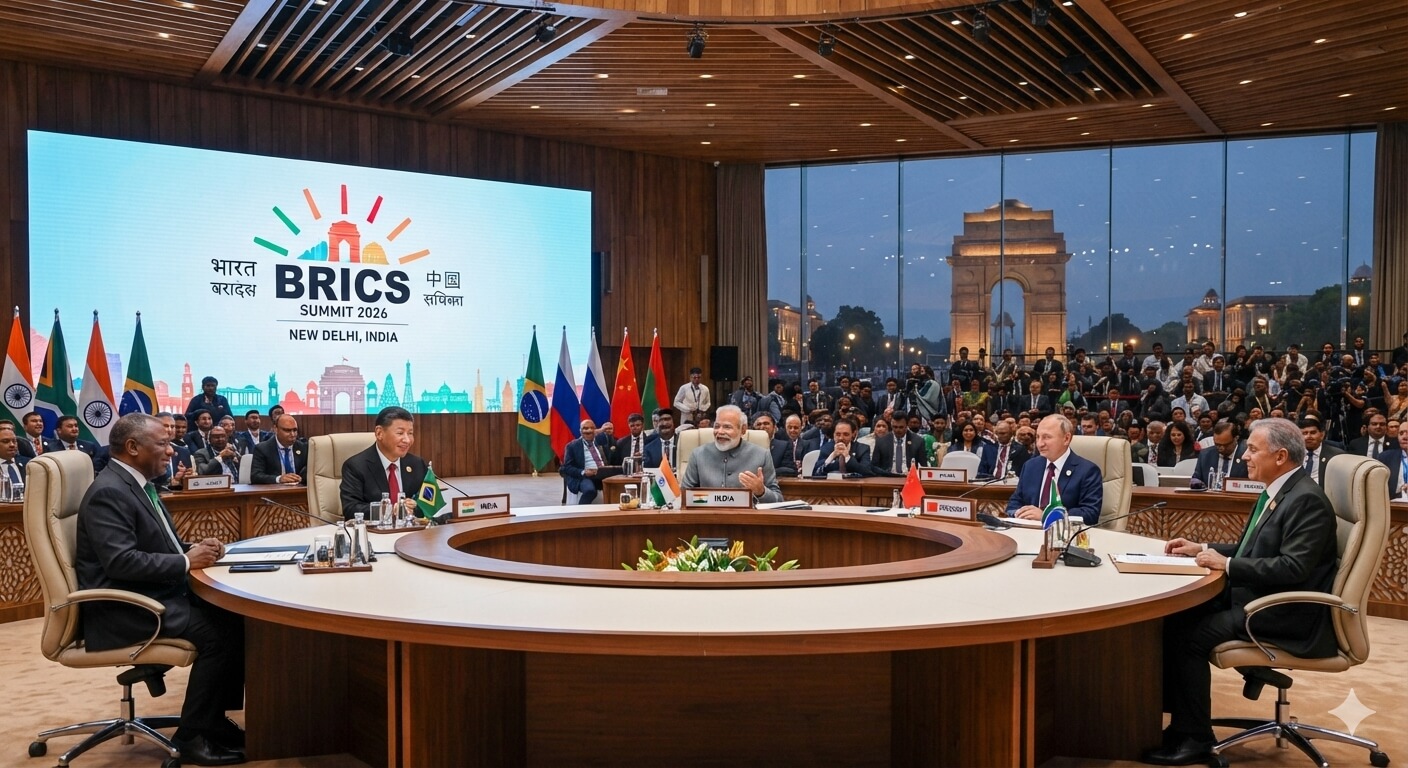
Bharat Mandapam doesn’t seem the sort of place where wars are argued into commas. And that’s exactly what happened on September 12 and 13, 2026. India, in its fourth BRICS chairmanship and on the grouping’s twentieth anniversary, brought an expanded table into a hall built for exhibitions and turned it, for forty-eight hours, into a workshop for language. The official theme “Building for Resilience, Innovation, Cooperation and Sustainability” was on every backdrop. The real task was more limited: could eleven governments, which distrusted one another on the same files, still sign one document before Sunday’s outreach session started?
They did. No member had objected, Prime Minister Narendra Modi told the closed session on Saturday evening. Adopted by consensus, the New Delhi Declaration is about 140 paragraphs and about forty-five pages in the versions circulating among reporters. The room had Russian President Vladimir Putin, Chinese President Xi Jinping, Iranian President Masoud Pezeshkian, South African President Cyril Ramaphosa, Indonesian President Prabowo Subianto, Egyptian President Abdel Fattah el-Sisi and Ethiopian Prime Minister Abiy Ahmed. Brazil and the United Arab Emirates sent senior representatives. Saudi Arabia, invited in 2024 but still not a full formal member, sent Foreign Minister Prince Faisal bin Farhan Al Saud. The grouping now accounts for around half the world’s population and around two-fifths of its output. These numbers explain why the night before lasted until four in the morning.
Three years ago, India drew a consensus declaration from a fractured table at the G20 in this very city. That memory kept returning to the people involved in the BRICS process, not as vanity but as method. Here consensus is not heat. It’s the decision not to let one quarrel veto every other sentence. The May meeting of foreign ministers in New Delhi had already failed that test. Iran and the UAE do not agree on a joint statement on West Asia. The sherpas spent the week before the leaders’ summit doing what sherpas do: stripping out adjectives, parking names, and keeping the verbs. Before the adoption, NDTV reported the draft would “deplore” aggression without naming a country and would say dialogue and diplomacy were the way forward. Later, The Hindu reported that Modi had overnight talks with leaders of Iran, Russia and the UAE. The Times of India set its clock at 4 am. What a night like that produces is the document that emerged: long where the pain is shared, careful where it is not.
The photographs did their work. Modi between Xi and Putin. Chinese president’s first visit to India in seven years, followed by an hour-long bilateral. Day One, as framed by NDTV, was a reset: Modi–Xi meets, Modi–Putin–Xi reunion, the Declaration. Indian papers went all-in on ‘car diplomacy’ — Modi and Putin riding around the complex together. Xi said China will take over the presidency in 2027 and called BRICS the most influential platform for cooperation among emerging markets and developing countries after the session. India has no permanent BRICS secretariat, so it proposed a continuity mechanism, a troika to chase decisions after the gavel passes. To clarify, this isn’t a security deal. It’s institutional housekeeping with a camera.
The file that could have wiped the table clean was West Asia. It was all there, in the hall: the war that started with strikes on Iran, the counter-strikes that hit Gulf territory and shipping, the pressure on Hormuz, the oil spike, and the fear for crews. Tehran wanted language similar to what other forums had said about the United States and Israel. Abu Dhabi sought recognition that its neighbours and trade routes were under attack. Neither a full member nor a bystander, Riyadh watched the language. The compromise did not name a capital. It expressed “deep concern” over the escalation in the Middle East and West Asia, noted that members have their own national positions, and urged “maximum restraint” and actions that would not worsen the situation. The group said it would protect civilians and civilian infrastructure. The group said it would respect sovereignty and territorial integrity. Trade, supply chains, energy and maritime security were to continue to function in accordance with relevant international law. Another paragraph expressed “grave concern” about deliberate attacks on civilian infrastructure and on peaceful nuclear facilities under IAEA safeguards. “The text said nuclear safety is not on holiday during war.”
On the margins, in the same complex, a meeting that would have been unthinkable in the spring. Pezeshkian met with Abu Dhabi’s Crown Prince, Sheikh Khaled bin Mohamed bin Zayed Al Nahyan. Reuters said it was the highest-level Iran-UAE contact since the fighting began. The two men then joined the others in backing the restraint language, NDTV said, adding that India was the peacemaker on the sidelines. Abu Dhabi’s readout spoke of de-escalation, stability and regional peace, without calling for a settlement.” Saudi Arabia’s foreign minister stayed in the wider program. Reports of Riyadh’s support for a Gulf conversation with Iran followed an earlier BRICS national security advisers’ gathering in Delhi. Delhi did not play a mediating role. It provided a building where people trading accusations could sit without a communiqué collapsing first. That is a less ambitious claim than peace. It’s still a claim.
The Declaration mentions Palestine for more lines than many expected from a room that also includes close partners of Israel. The text cites Security Council Resolution 2803, urges a ceasefire and unhindered aid to Gaza, and expresses concern at ongoing violence beyond the October 2025 ceasefire language. It is against forced displacement, temporary or permanent, and any geographic or demographic redesign of Gaza. It reiterates the 1967 borders, East Jerusalem as the capital, the Arab Peace Initiative, and full United Nations membership for Palestine. It backs UNRWA and the potency of ICJ provisional measures for humanitarian access. The Hindu noted the group’s criticism of Israel’s bombing and support for South Africa’s case in international courts. Al Jazeera led on restraint in the Middle East and “firm opposition” to the forced displacement of Palestinians. Readers in different capitals will notice different lines. And that’s how consensus documents are.
Terrorism is where the Declaration is no longer cautious and is specific. The backbone of what New Delhi wanted from this chairmanship is the four movements of that file.
The first is appellation. The leaders say, “Whatever the motivation, whenever, wherever and by whoever committed it, terrorism is criminal and unjustifiable. Then the sentence India has sought in every multilateral room since April last year: they condemn “in the strongest terms” the terrorist attack in Jammu and Kashmir on April 22, 2025, which killed 26 and injured many more. NDTV quoted that passage in full, and China’s signature was treated as a political fact rather than a legal fact. Pakistan will be watching, former foreign secretary Kanwal Sibal told India Today. China has spent years blocking certain listings at the UN. Calling its name Pahalgam does not change that history. It does change how the expanded BRICS can be quoted as having publicly addressed a particular Indian sore.
The second movement is the operational list that Indian briefs have carried for a generation: cross-border movement of terrorists, terrorism financing and safe havens. No tolerance. No double standards. Those who commit acts of terrorism and those who support them will be held to account under national and international law. The primary duty lies with states. International action must remain within the UN Charter and the relevant bodies of human rights, refugee and humanitarian law. Both the Telegraph and NDTV stressed the same triad: networks, money, sanctuary, and the refusal of a second vocabulary for the same crime. It’s also the paragraph that will be tested the next time a listing is blocked or a haven is renamed as politics.
The third movement is the old debate against the old smear. Terrorism has no connection with any religion, nationality, civilisation or ethnic group. The leaders want the UN to finish the Comprehensive Convention on International Terrorism, a text that has been languishing in committee because ambiguity has patrons. They want coordinated action against every entity the UN has already designated. They welcome the BRICS Counter-Terrorism Working Group, its sub-groups, its strategy and its action plan. The Indian Express and Forbes India read the same 140 paragraphs and noted how often the rest of the Declaration refuses to name countries—and how little it refuses here. Specificity is the scarce good in a veto-by-silence-run club.
The fourth movement looks down the pipe, not at the last crater. A common problem identified is extremism and radicalisation among young people. Members are asked to share what really works. Illicit finance – laundering, trafficking, abuse of virtual assets – is infrastructure, not colour. Customs, intelligence and police cooperation belong to the same family of paragraphs as the anti-corruption work and the drug agenda that produced a Guwahati text earlier in the Indian chairmanship. Nearby lines on Sudan, Syria and foreign terrorist fighters make the same point in another geography: violence travels when money, ideology and neglected young men are allowed to travel together. When you’re a bloc that claims half of humanity, you don’t file that under someone else’s interior ministry.
None of this makes BRICS an alliance. The Hindu and NDTV carried the line that Washington has a habit of calling the club anti-American. Modi said the grouping was not against anyone and wanted to take everyone along. On that charge, Donald Trump threatened members with additional tariffs last year. The Declaration answers in the only register it has. It condemns unilateral coercive measures which violate international law. It frets about tariffs and non-tariff walls that snatch supply chains and widen the gap between rich tables and the rest. It wants the WTO fixed, with scope for accessions such as Ethiopia and Iran. It wants the Bretton Woods institutions to reform quotas, leadership and priorities so that growth-leading countries help to write the rules. China and Russia, the two permanent members present, reiterated support for India and Brazil to have a larger role at the United Nations, including the Security Council. In the closed session, Modi said the Global South should be a rule-shaper, not a rule-taker. (Familiar sentence.) This weekend was not for the crowd.
Money has its own chapter, written to sound technical and meant to be political. More trade within BRICS is to be in local currencies. A Payments Task Force will continue to work on faster, cheaper and safer cross-border settlement. It says no template exists. That line is how the club avoids a phantom common currency while still chipping away at the dollar habit. A Task Force on Growth and Development is to become a standing place for problems that look different in Addis, Jakarta and Brasilia but rhyme. The long catalogue reflects the long constituency: critical minerals, energy mixes that include oil and gas as well as renewables and nuclear, digital public infrastructure, AI rules, health security, grain and farmers, and disaster warning. Modi asked members to contemplate a network for emergency support for seafarers. The Middle East is still under fire, and NDTV noted how the Declaration points to the importance of crews and commercial navigation. When straits tighten, the first bill doesn’t land at a summit dinner. It’s up to a family waiting for a ship.
The weekend’s remaining summit routine took over: the Bharat Innovates exhibition, the family photograph, the joint tree, the gala, and Sunday’s open session with partners and invitees. Modi met Pezeshkian on Hormuz and Chabahar. Modi met Putin on a relationship that has learned to live with sanctions. Modi met Xi on a border that has learned to live with silence. Hyderabad House hosted Anwar Ibrahim of Malaysia and others. Pezeshkian also met President Draupadi Murmu for a courtesy call, which is not routine. These meetings will be called ‘warm’ and ‘productive’. Some might be both. The test is whether the warmth will survive the first disputed listing, the next tanker, and the next tariff schedule.
A feature on a declaration should say what the paper cannot do. It cannot feed Gaza. It cannot return the twenty-six killed at Pahalgam. It cannot reopen a strait or settle a border in an hour. Those limits are honest. They are not the whole story.
What the New Delhi Declaration can do is leave a public record of sentences an expanded BRICS was still willing to share on a Saturday in Delhi: restraint in the Gulf without turning the table into a courtroom; a long and pointed file on Palestine; local-currency plumbing instead of a slogan currency; UN and IMF renovation as unfinished business; and, on terrorism, a named Indian attack, a ban on double standards, and the three words New Delhi never stops repeating — movement, money, and haven.
The leaders fly out. China prepares a chairpersonship. Hormuz will not wait for 2027, and neither will the next attempt to treat a massacre as a local difficulty. Even so, the weekend was not only damage control. Iran and the UAE sat in the same complex and spoke. Xi returned to India after seven years. Putin and Modi treated an old partnership as a going concern. A text that failed in May was signed in September. That is how rooms begin to do the work wars refuse to do.
The New Delhi Declaration is a major milestone: not a new world order announced overnight, but a hard-won charter of shared language that an expanded BRICS could not produce even in May. Culled from a night that nearly had no words at all, it records what this table could still say together — on terror, on restraint, on Palestine, on money, and on the rules the Global South intends to help write. In a year generous with craters and stingy with syntax, that public agreement is more than a beginning. It breaks the silence. It chooses the sentence over the rupture. And it offers a way forward.
Sources and references
1. Ministry of External Affairs, Government of India. ” BRICS New Delhi Declaration: Building for Resilience, Innovation, Cooperation and Sustainability (September 12, 2026). ” https://www.mea.gov.in/bilateral-documents?dtl/41776/
2. NDTV. “In BRICS New Delhi Declaration, Condemnation of War, Tariffs.” September 12, 2026. https://www.ndtv.com/world-news/in-brics-new-delhi-declaration-de-dollarisation-push-condemnation-of-war-12037291
3. NDTV. “‘Dialogue And Diplomacy Way Forward’: BRICS New Delhi Declaration Agreed Upon.” September 12, 2026. https://www.ndtv.com/world-news/dialogue-and-diplomacy-way-forward-brics-new-delhi-declaration-agreed-upon-12036609
4. NDTV. “India Plays Peacemaker as Iran, UAE Hold Bilateral Talks on BRICS Sidelines.” September 12, 2026. https://www.ndtv.com/world-news/brics-summit-2026-india-plays-peacemaker-as-iran-uae-hold-bilateral-talks-on-brics-sidelines-12038682
5. NDTV. “The Iran-UAE Rivalry, And The Limits Of An Expanded BRICS.” September 12, 2026. https://www.ndtv.com/opinion/the-iran-uae-rivalry-and-the-limits-of-an-expanded-brics-12037294
6. NDTV video reports, 12–13 September 2026: “BRICS Day 1: Modi-Xi Reset, Putin Bonding & India’s Big Diplomatic Win”; “Big BRICS Win for India: Pahalgam Attack Condemned, China Signs Declaration”; “BRICS Declaration: Pahalgam Attack Condemned, Zero Tolerance on Terror.”
7. Suhasini Haidar, The Hindu. “BRICS issues New Delhi Declaration, as UAE and Iran back down from tough positions. September 12, 2026.
8. Al Jazeera. “BRICS nations urge ‘restraint’ in the Middle East and smooth flow of global trade.” September 12, 2026.
9. Reuters. “Iran and UAE back joint BRICS statement urging restraint in war.” September 12, 2026.
10. Business Standard (Archis Mohan). ” BRICS adopts Delhi Declaration as PM Modi pushes UNSC and financial reforms. September 12, 2026.
11. India Today. ” BRICS Delhi declaration takeaways: Terrorism, nuclear threat, conflicts, tariffs”, and “What’s in the BRICS New Delhi declaration? Read full text.” September 12, 2026.
12. The Indian Express (Anagha Jayakumar). ” Main takeaways from the BRICS declaration: tariffs, terrorism, the West Asia war, and more.” 12–13 September 2026.
13. Hindustan Times. “What the BRICS New Delhi Declaration says on the West Asia war and trade.” September 12, 2026.
14. CNBC-TV18. “BRICS New Delhi Declaration: Key takeaways on Pahalgam, West Asia, payments and UN reform. September 12, 2026.
15. The Telegraph (India). BRICS condemns the Pahalgam terror attack and calls for ‘zero tolerance on cross-border terrorism’ on September 12, 2026.
16. Forbes India. “BRICS Summit 2026: 11 Key Takeaways from the New Delhi Declaration.” September 13, 2026.
17. Times of India. Summit takeaways and “‘Talks till 4 am’: How India got rivals Iran, Saudi Arabia & UAE to sign off on BRICS joint statement.” September 12, 2026.
18. The Economic Times. “BRICS 2026: Hand-in-hand Modi, Pezeshkian talk Hormuz, Chabahar & ties.”
19. Ministry of External Affairs schedule and press notes on the 18th BRICS Summit, Bharat Mandapam, 12–13 September 2026.
Picture created by AI

Arindam Roy has over four decades of experience in various newsrooms of renowned media houses. He is the Founder, Publishing Director, Editor-in-Chief of Different Truths, and Kavya Kumbh Publishing Consultant (KKPC). He has co-authored ten chapters in six Coffee Table Books (CTBs) of national and international repute and is the sole author of four forthcoming CTBs (Times Group). He has also published four international poetry anthologies as the Publisher and Editor-in-Chief, participated in several poetry and literary festivals, and won awards and accolades. Arindam co-authored the novel Rivers Run Back with an American writer. He stays in Bangalore and Prayagraj.

 By
By
 By
By