
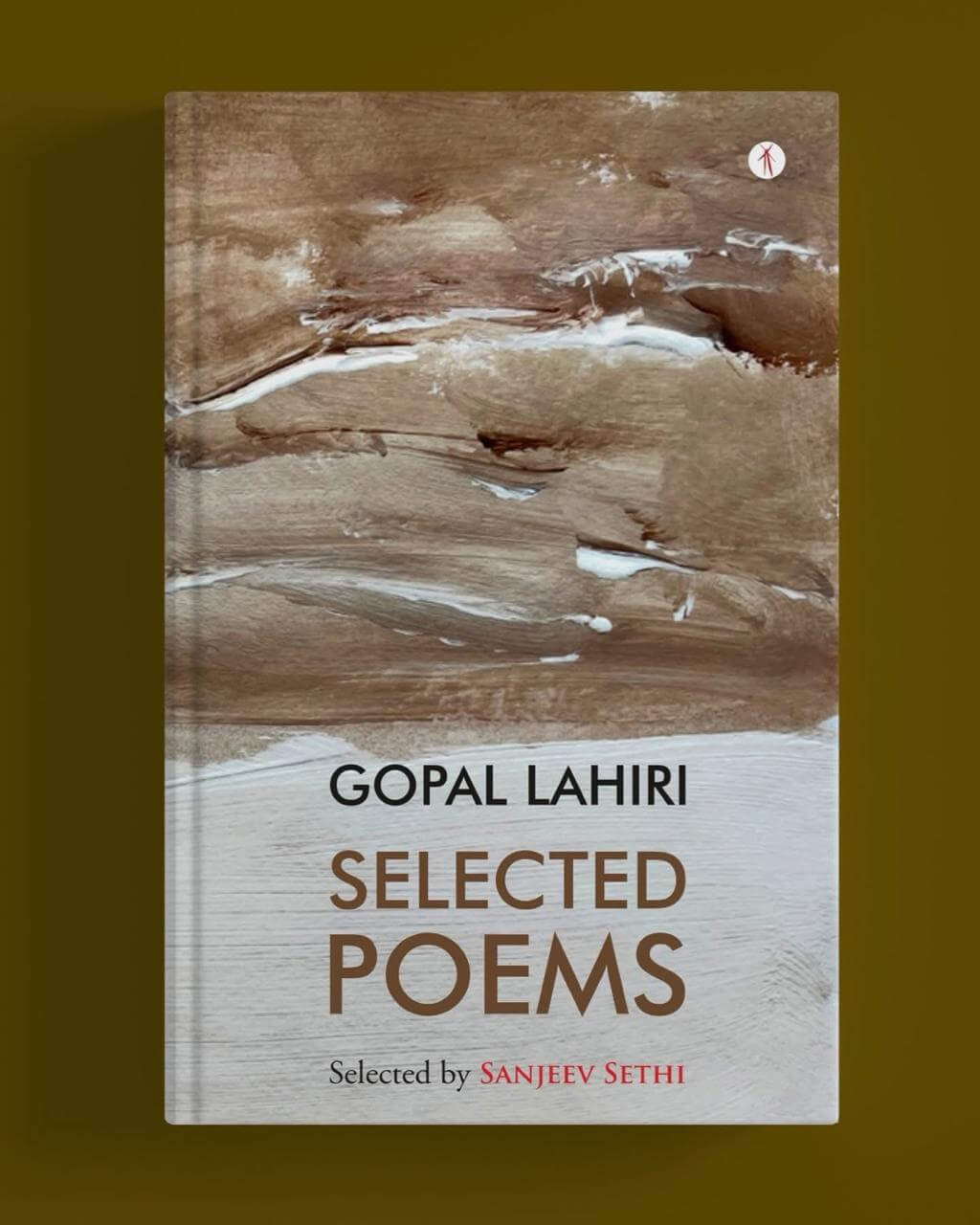
Dr Anasuya explores Gopal Lahiri’s Selected Poems (2025) on DifferentTruths.com, celebrating a bilingual master’s profound poetic journey.

Key Takeaways
· Prolific Bilingual Oeuvre: Lahiri bridges English and Bengali poetic traditions, accumulating 32 published books and international acclaim across 18 languages.
· Introspective Craft: Poetry functions as the poet’s diary, capturing grief, resilience, and soul-searching through rich synaesthetic imagery.
· Cross-Cultural Forms: The collection seamlessly integrates traditional Indian motifs with Japanese poetic forms like haiku, senryu, and haibun.
To be able to comment or even write about Gopal Lahiri, the well-known poet, editor and translator, perhaps, is a daunting task and requires courage because one is never short of wonder at his prolific writing. He is a bilingual poet, English and Bengali being the languages with which he works. With a total of about 32 published books, Lahiri continues to write and publish regularly. He has been published in more than 150 journals throughout the world, and his poems have been translated into 18 languages, spanning 17 continents. He is a well-known presence in the poetry circles of Kolkata, which he graces with his erudite commentary on the genre of Indian poetry. Lahiri is the recipient of several awards, among which is the First Jayanta Mahapatra National Award in Literature that was conferred upon him in 2024. Apart from winning others, he was also nominated for the Pushcart Prize for poetry in 2021. When one receives a copy of his Selected Poems (2025) in hand, one wonders at the vastness of his poetic trajectory, as well as hopes to catch the poet in his essence.
Gopal Lahiri’s recently published Selected Poems (2025) is an ensemble of some 102 poems chosen from 8 collections that he has published over the last fifteen years, from 2010 to 2024 – a feat at once very challenging for a reader and yet a volume which makes a sizeable portion of his poetic oeuvre available and accessible to a lover of his poetry. The book has been published by Classix, an imprint of Hawakal Publishers, India. The book is a splendid aesthetic production with its cover designed by Bitan Chakraborty. The curator of the volume is Sanjeev Sethi, himself a poet, who aptly acknowledges the limitations imposed on such a choice and candidly confesses how selectors have to be, but affirms that the selection is ‘a salute to Gopal Lahiri’s oeuvre’. While Sethi lays stress on ‘images’, Lahiri himself certifies that the ‘collection of poems showcases a range of forms, styles, themes, and emotions, offering glimpses into the depths of human emotion.’ And justifiably, the collection not only spans poetry written over the years but also features a few very interesting examples of Japanese formal poetry.
Lahiri has often described himself as an earth scientist, and truly, his earlier poetry has a fondness for the myriad forms of nature, but one always finds them woven with subjective and introspective expression. In trying to give us a method for his craft, Lahiri gives a very interesting metaphor for his poetry, which becomes his ‘diary’, or a mute confidante to his thoughts, in the Preface to this collection. As he elaborates –
Poetry is the diary I always carry with me. In the tapestry of life, my poems are like threads woven together, each carrying the colours of grief and pain, hope and resilience. A reflection of my thoughts and experiences comes alive in verse, exploring the wonders and complexities of life that provoke, evoke, connect, and unlock creativity. (10)
The poems here are reflective; some are meditative, with distinct observations on the poet’s craft and his language, as well as a concentration, a preoccupation with the self. Early in the collection, one is struck by the lines of ‘My Poem’ –
Every day, the words shuffle their feet; they waltz.
around the books and shelves,

Near the open door, the alphabets wait like a patient.
for the touch of my hands, (21)
The rhythm continues in close camaraderie with the self, where the reader must wait as an onlooker in anticipation of a conclusion. The reader must also suspend his familiar expectations of syntactical norms in the true spirit of poetry. As Lahiri says, ‘Poetry allows me to articulate and make sense of whatever is churning within me.’
Poetry, then, is not only a living companion to Lahiri but also becomes a receptacle for his thoughts. This is borne out by the vast and varied range of his subjects and themes that make up his oeuvre. Strikingly, however, there is, in most of his poems, an unforgiving honesty and the revelation of a reality that filters through all the images used. There is, perhaps, a hint of his craft in ‘Solitude’, where he says,
My journey is never solo.
It's filled with solitude.
searching for a new mindscape.

Each moment is a pinhole.
showing me the
largest canvas possible. (40)
It is this metaphor of soul-searching through a ‘pinhole’, an exploration of the self, that perhaps forms the matrix of his creation. In many of his poems there is an intermingling of the senses – the tactile with the visual, the auditory with the olfactory. Critics would, perhaps, call it synaesthesia after the method used by the nineteenth-century British Romantic poet John Keats (1795 – 1821). Still, I would rather not draw a parallel here with Western parameters of poetic merit. Let them be as they are. My purpose has always been to identify the local and Indian, even in English poetry by Indians, and also to valorise what becomes the universal within the local Indian.
In our culture, life gets defined by the river, by the seasons, by the moon and the sun; we identify specific flowers with worship, and our moods change with the six seasons. These are synaesthetic expressions where many senses co-exist – such tempers find abundant expression in Gopal Lahiri’s poetry. One may cite the examples of ‘Memory of Sky’, ‘River’ and ‘My River’. In fact, the last two poems almost speak to each other – where the ‘River’ ends with ‘There is a river in all of us’ (43), ‘My River’ begins with ‘My river meanders in silence / the temple bell echoes / in search of peace and purity.’ (79)
The metaphor of the pilgrim city perhaps finds a voice after Jayanta Mahapatra’s ‘Dawn’, then continues through other pilgrim sites like Benaras and then to one’s own temple. The moon is a recurrent presence in many of the poems; it is, most often, adjectivised as a ‘silver’ moon, except in ‘Ghost Moon’, where he identifies a village moon whose ‘face is black, not silver’. The moon here has a cameo presence, more objectified by one’s imagination than by reality.
Urban landscapes and scenes naturally find themselves in poems like ‘The Wall of Silence’, ‘City of Joy’, ‘Lodhi Garden’ and others, where it is not the romance of one city but several others through the lens of the poet.
Poet Gopal Lahiri also believes in expressing himself through Japanese form poetry like haiku, senryu, haibun and gogyoshi (‘Empty Nest’). His Selected Poems has a few examples of haiku and, also, very interestingly, a haibun, titled ‘Savannah Ghost’. This one is interesting for its craft, as well as a dreamlike fluidity – it traverses several locations mostly in America and then, suddenly, coalesces into his own self. I take this opportunity to quote a very interesting haiku from Poet Lahiri’s collection, which offers a wry comment on the writer’s craft –
on your writing desk
the diary pages flapping
lies, lies and more lies (125)
There is everything here – irony, truth and epiphany. These forms continually intrigue me because here, at once, one finds the intermingling of cultures – Japanese, with that of a global itinerary and trajectory – in the perspective of an Indian poet. This is internationalism at its best.
Poet Lahiri’s collection of poems was launched in May 2026, in front of a select and erudite audience at the celebrated Oxford Bookshops of Park Street, Kolkata. Along with this collection was also poet Sharmila Ray’s latest work, Space: My Notebook (2026), which is also published by Hawakal Publishers. Both collections have, to my mind, immense potential and should vie for places among the best of contemporary Indian poets writing in the English language. One wishes that both poets find their works in academic curricula, as their work begs to be studied and researched within academia.
Ever since the publication of poet Lahiri’s Selected Poems, his oeuvre has increased and stretched in superlative terms. One waits eagerly for yet another collection of this celebrated poet to supplement the one being reviewed here.
Book cover photo sourced by the reviewer

Dr Anasuya Bhar is an Associate Professor in English and teaches at St Paul’s Cathedral Mission College, affiliated with the University of Calcutta, India. She has several national and international academic publications to her credit, as well as a book of published poems in English. Dr Bhar’s specialisation is in nineteenth-century studies of India and Britain.
 By
 By

 By

 By