
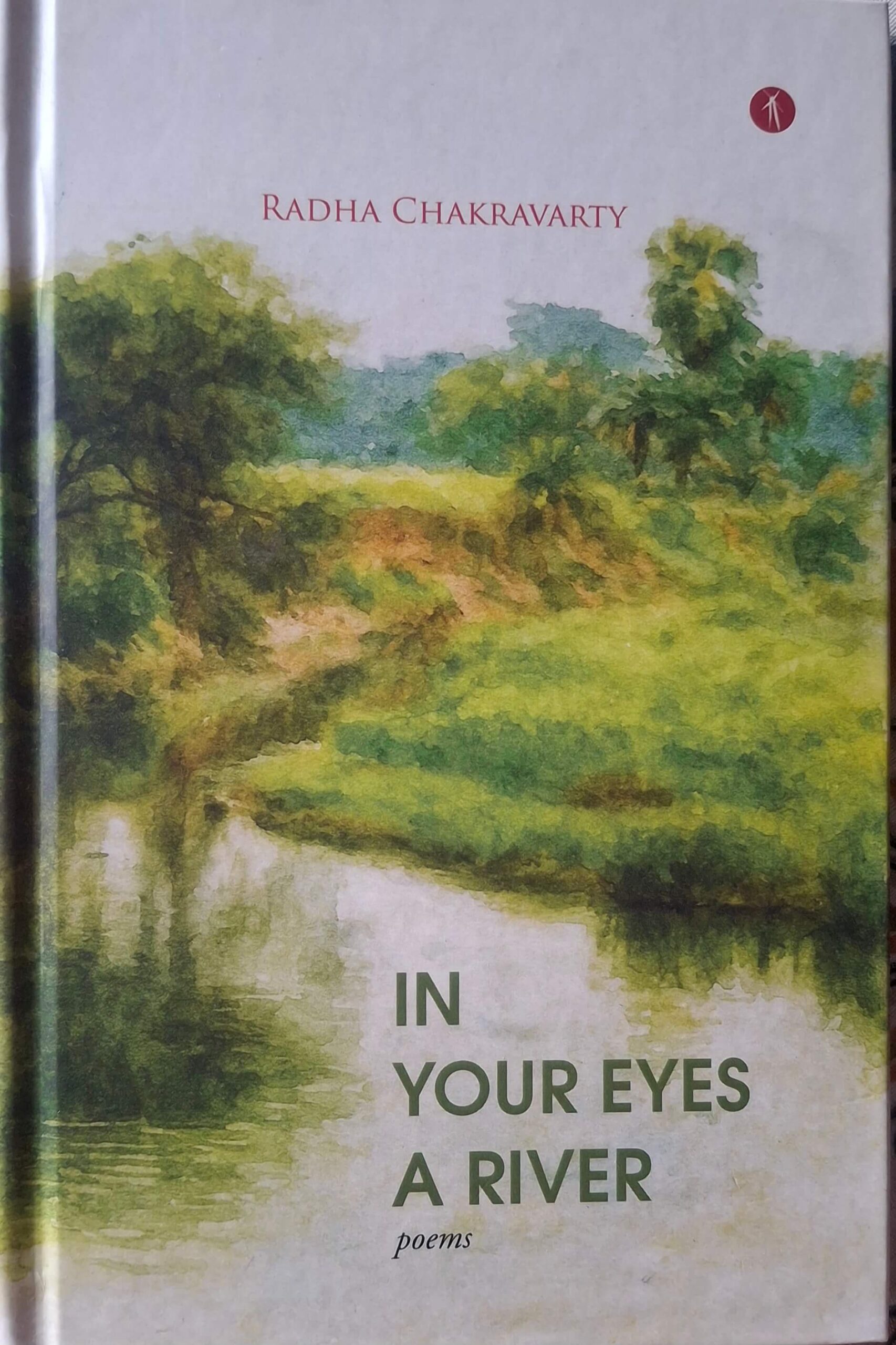
Rituparna reviews Radha Chakravarty’s poignant poetry collection on DifferentTruths.com, exploring memory, domestic archives, and time.

Key Takeaways
- Domestic Archive: The poems anchor universal human experiences within tangible domestic spaces, turning personal recollections into shared memory.
- Temporal Fluidity: Chakravarty deliberately blurs temporal boundaries to converse with ancestors, actively resisting the erasure of the past.
- Ecological & Emotional Depth: The collection balances tender affection with profound grief, weaving environmental extinction into personal narratives of loss.
Radha Chakravarty’s poetry collection of 61 poems, In Your Eyes A River, unfolds like a quiet yet persistent echo chamber of memory, what might be called a “silent explosion of nostalgia”.
It does not explode onto the reader suddenly; rather, it insinuates itself into their mind bit by bit, layering imagery on top of imagery until it becomes almost palpable for the reader to touch. Her poetry is very much grounded in the domestic space – the gramophone belonging to one’s grandmother, the mother succumbing to Alzheimer’s, the eerie silence of an old house.
One of the best things about the anthology is that it gives the impression of being anchored to a particular home. The poet creates in us a sense of inhabiting this house, which is not just an inanimate structure but a living archive that “remembers”. In this manner, she turns the personal memories of one individual into the common memory of all of humanity. What makes her poem all the more powerful and moving is the way she brings the images to life through such detailed imagery – the sounds of chutney being ground up, or the sound coming from a gramophone – that the reader is transported into the past.
Time in these poems flows freely. For Chakravarty, it does not matter what period we are talking about since she is always able to travel through time, blurring the border of their division. This ability brings to life some scenes that look rather hallucinatory. The poet converses with her parents and grandparents, who seem to be alive now, retelling their daily chores and anecdotes. However, this is not delusion but a conscious decision made by the poet, who wants to resist the erasure of the past with memory.
The main focus of emotions in the book belongs to the connection of the poet with her mother and grandmother. It is especially tragic when describing the disease of the poet’s mother, which causes the loss of memory. At the same time, memory, which is a core aspect for the poet, starts fading away in the character of the mother. Thus, the opposition between the desire to save and lose one’s memory makes a very complex layer of feelings possible.
The nostalgia in Chakravarty’s poetry is not sentimental; rather, it is painted by a sense of loss. The recurrent phrase, “Where have all the bulbs gone?”, can be seen as a poetic expression of the destruction of nature. The environment is no mere setting; it is an active participant in these poems. The extinction of species symbolises the estrangement of man from his surroundings.
This is exemplified in the concept of the “living fossil”. The poetess herself, or possibly her surroundings, represents the last vestiges of the dying world. Thus, there is an ironic element to the entire book. While the past is valued, it is also realised that it is lost forever. The poems are torn between preserving it and accepting its demise.
As far as the style of Chakravarty is concerned, her choice of language is such that it is simple and yet multilayered. The term oxymoron, such as “Intuitions at Dusk”, represents the very core of Chakravarty’s poetic philosophy. Dusk, as such, is always in between the day and the night. The author’s language is similarly multilayered, capable of carrying several meanings simultaneously.
Indeed, the book can be accurately described by using the phrase “mixed bag of emotions”. It is full of tenderness and warm affection, but at the same time experiences some sudden eruptions of pain and disquietude. In this way, the reader does not get bored but rather gets a glimpse of how memories can bring about the whole range of emotions all of a sudden.
One of the other strengths of the poet is her storytelling skills. In each poem, the reader feels that there are bits and pieces of a bigger story, but each piece is self-contained. Instead of using major events, she uses minor events in daily life. Chakravarty makes use of the small details in people’s lives to bring a deeper meaning to her poetic works.
Last but not least, the book does not deal with the past as it happened but deals with the past as people remember it. Though she creates an intimate environment for readers, her poems have universal appeal. The memories of loss, family ties, and changes occurring in the natural environment are common feelings. Her poems remain in the mind of the reader as the lingering melody of a gramophone in silence.
While going through this anthology, one does not only read poetry, but rather, one is transported to a state of temporal displacement. It is a journey into a world where time loops, where voices of the departed resonate, and where the mundane takes on a surreal twist. This artistry of converting memory into a vibrant reality lies at the heart of Radha Chakravarty’s poetry.
The publication of this collection by Hawakal Publishers is also something to be noted. With its reputation for choosing insightful and visually appealing texts, Hawakal has enhanced the poetic prowess of Chakravarty by presenting her poetry in an unobtrusive design and layout that is both elegant and minimalist. The resulting collection gives one the impression of a personal repository, further elevating the experience of reading the poetry and travelling back in time and memory.
Cover photo sourced by the reviewer

Rituparna Khan is an Assistant Professor in Geography at Bidhannagar College, Salt Lake, Kolkata. Her inclination to Literature, especially poetry is no less. A few of her works are published and well appreciated and awarded in print as well as social media. Her first book, a collection of short stories, was launched at Kolkata International Book Fair, this year.

 By
 By
 By

 By