
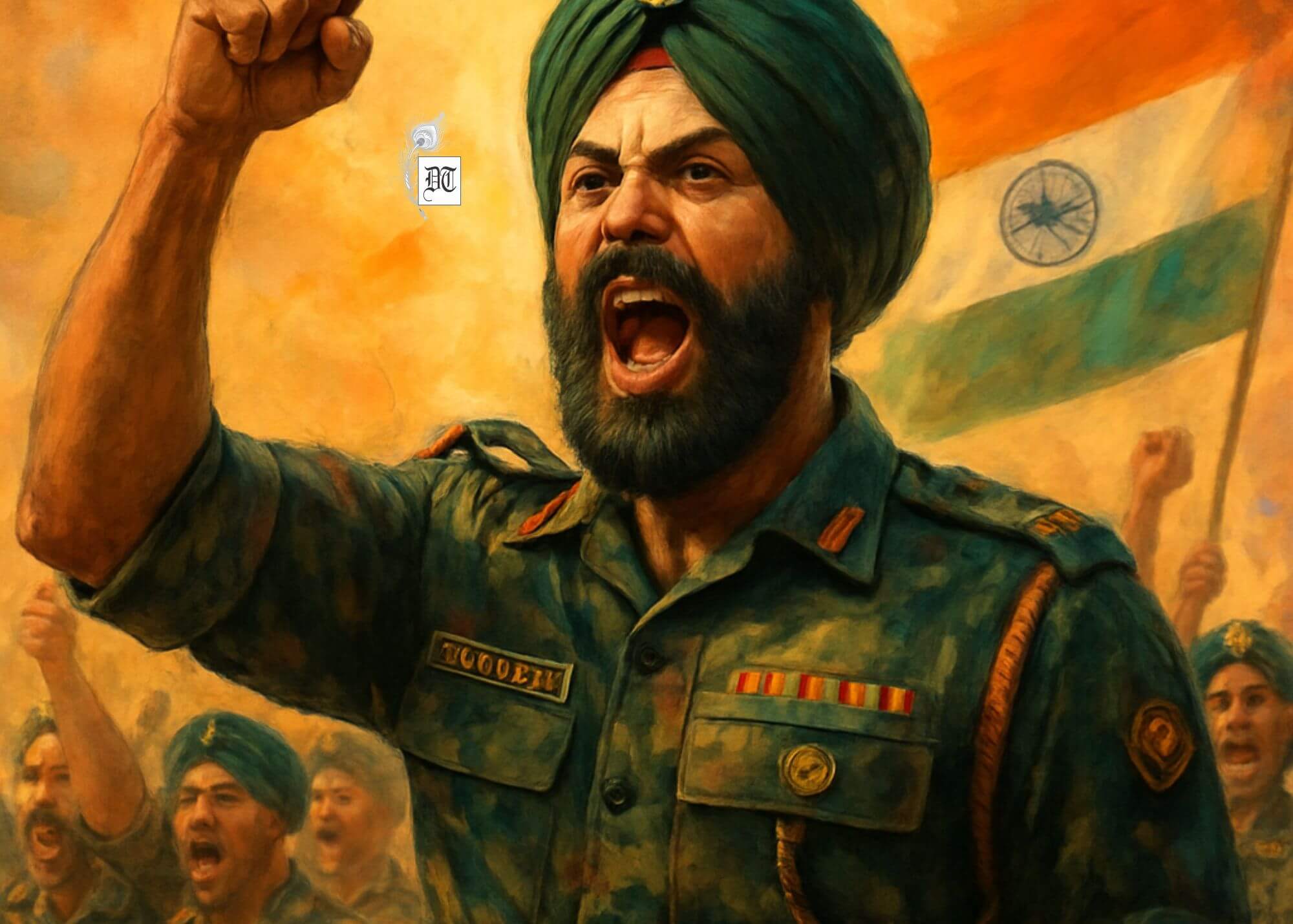

Dr Gill explores Jaikaras and Indian infantry morale on DifferentTruths.com, tracing how battle cries embody Bharat’s unity in diversity.
AI Summary:
- Jaikaras—compound cries of “Jai” + “Kara”—serve as greetings, battle and victory cries rooted in Indic culture and regimental tradition.
- Indian infantry regiments (27, including Scouts and Bhairav Commandos) use jaikaras reflecting culture, clan, history, nation, or religion; 16 per cent are explicitly faith-based.
- Regimental class composition (single, fixed, mixed, all-India) shapes jaikaras, sustaining cohesion, morale, and a shared identity across India’s diversity.
“The unity of India has been and shall always be a unity in diversity.” Gurudev and Nobel Laureate Rabindranath Tagore.
Five prerequisites mark the path to appreciating the cohesion of Bharat’s diversity as applied to universal humanism through the jaikara battle cries of the Indian army’s infantry regiments.
1. Definitions of war cry, battle cry, and jaikara.
2. A look at regiment and battalion.
3. Infantry regiments.
4. Class composition of the Indian army regiments and battalions.
5. An explanation of jaikaras in general before viewing them by —
a. History
b. Clan
c. Culture
d. Nation
e. Religion
War Cry, Battle Cry and Jaikara
War is a composite of multiple short-term military engagements called battles.
A word or phrase collectively shouted by soldiers charging an objective invokes the strength of culture, clan/tribe, religion, nation, history and the regiment itself. The aggressively emitted words intimidate the adversary. Between battles, such a cry serves little purpose, except during training or after success in sports competitions. As such, though ‘battle cry’ might be more appropriate than ‘war cry’, ‘jaikara’ seems most fitting.
Jaikaras are phrases anchored in Indic culture, custom and religious beliefs. A jaikara is multi-purpose, serving as a greeting, a battle cry, a victory cry, a chivalrous warning or expressing devotion. The two-part Sikh greeting and battle cry are the same, though emitted in a different sequence for either context.
Jaikara is a compound of Jai and Kara.
‘Jai’ means victory, glory or hail. Kara is doing/done or achieving/achievement, its verbal base being Karna.
This piece of writing will refer to jaikaras rather than battle or war cries.
Of the three fighting arms, a jaikara has more relevance to the infantry since it is the only arm that charges the enemy without cover from / protection against enemy fire.
An overview of regiments and battalions, the number and composition of Indian Army infantry regiments, abets the understanding of their Jaikaras.
Regiment and Battalion
A regiment is a military formation which enlists, inducts, and trains recruits. The Regimental Centre is the repository of its tradition — a foundational element of morale and esprit de corps. The constituent battalions have a strength of 500 to 800 personnel, commanded by a lieutenant colonel. Thus, the Sikh Regiment is composed of over 20 battalions, whereas the Gorkhas designate different regiments by a number, each regiment further composed of several battalions.
Number of Indian Army Infantry Regiments
Bharat Rakshak, Wikipedia, and websites preparing candidates for commissioned-rank selection converge on a figure of 27 regiments. Scout units and the new Bhairav Light Commando battalions are included in these 27.
Scout Units and Bhairav
The Bhairav are Light Commando Battalions intended to enhance the Indian army’s pre-emptive strike and counter-strike capabilities. Twenty-three such 250-strong battalions will be structured within the twenty-seven infantry regiments.
Scouts are recruited from and identified by their native regions. They are attached to one of the twenty-seven infantry regiments. Arunachal Scouts are part of the Assam Regiment; the Dogra Scouts go with the Dogra Regiment; the Garhwal Scouts depend on the Garhwal Rifles; the Sikkim Scouts are affiliated with the 11th Gorkha Rifles; and the Ladakh Scouts’ parent regiment remains the Jammu & Kashmir Rifles.
The diverse recruitment of Indian infantry regiments is expressed as Class Composition.
Class Composition of Indian Infantry Regiments
Under the umbrella term of class composition, the British identified their catchment sectors for recruitment by overlapping geo-ethnic markers, belief systems, or clans. For example, Sikhs, a faith community, were mainly from Punjab, and the ones who joined the army were largely from the Jatt yeomanry. On the other hand, Garhwal, the name of a regiment, refers to a region populated by warrior clans.
Since independence, the Indian army has been gradually changing its regimental composition without compromising the proven combat value of group integrity.
The Indian Army regimental class composition consists of a single class, a fixed class, a mixed fixed class, and an all-India class.
The battalionsof all-India all-class regiments are heterogeneous, irrespective of religion, geographical provenance or ethnicity. In general, these are post-independence units, such as the Brigade of Guards.
Jaikaras of the Indian Army’s Infantry Regiments
A jaikara encapsulates two parts, one of which may be a single word.
The voice of a commander raises the cry. Either it is repeated by the troops or completed by the second segment.
Thus, the first line of the Indian Gorkha jaikara is ‘Jai Maha Kali’, to which the collective response is ‘Ayyo Gorkhali’ — Victory to the Powerful Goddess Kali — the Gorkhas are upon you (to ensure it).
The Sikh jaikara is dual-purpose — a greeting and a battle cry.
Whereas the greeter declares Sat Sri Akal, and the greeted responds with Jo Bolé so Nihaal, the jangee (battle) jaikara inverts the sequence. A single voice rallies ‘Bolé-so-Nihaaal’ for the collective refrain of ‘Sat Sri Akaal’.
Although rooted in belief, the Sikh jaikara is contextually cultural and historical, instituted by Guru Gobind Singh ji when he reorganised a peace-loving faith community beleaguered by Mughal persecution. He retrieved the values and accoutrements of the martial Jaat/Jatt sangh, amalgamated non-Jats into this value system and forged a communal martial culture of preemptive self-defence.
The Naga Regiment’s “Jai Durga Naga” invokes invincibility and, like all shakti, the visual representation of an imperceptible value. Naga is the subject, and Durga is the intangible attribute. Thus, the Naga Regiment jaikara declares “Victory to the Invincible Naga”, upheld by their battlefield performance.
Barring five straight-off religious jaikaras, the battle cries of the Indian army’s infantry regiments fall into single, combined or overlapping groups by culture, clan, nation, history and regiment. From the dawn of the gotra clans and Indic beliefs, Indian warrior clans have been flaunting their mettle under these very jaikaras. For their effectiveness, these jaikaras were retained and encouraged by the British Indian Army and then refined by the additional values of the independent Indian Army.
Many of the jaikaras integrate the word ‘Jai’, chivalrously tempering personal ego by crediting victory to the Shakti source. The Jat Regiment battle cry is “Jat Balwan, jai Bhagwan” — the Jat is powerful, his victory certain, but attributed to God, and not to Jat endeavour.
Dr Roopali Sircar Gaur, senior academic, poet, novelist, editor, activist and actor, explains: “Our soldiers come from far-flung rural areas, and their culture, food habits and faiths are preserved and maintained to give them a sense of belonging and dying for their land and for their fathers and their Gods.”
This would explain the inclusion of religious semantics in 16 per cent of the jaikaras. For instance, the Dogra Regiment’s “Jawala Ma ki jai” lays the certainty of victory at the feet of their mountain deity, who drapes their clans, mountains and valleys with her protective, incendiary shakti.
Jawala Mata, Raja Ramachandra, Bajrang Bali, Badri Vishal, and Kalika Mata inspire devotees serving in the Dogra Regiment, Rajputana Rifles, Rajput Regiment, Bihar Regiment, Garhwal Rifles and Kumaon Regiment.
The Rajputana Rifles’ “Raja Ram Chandra ki Jai” hails and promises success to Lord Rama. Since many Rajput clans also claim descent from Lord Rama, the evocation coalesces ethnicity and ancestry.
The Rajput Regiment’s assault is propelled by “Bol Bajrang Bali Ki Jai”, reappearing in the 6th paragraph below.
Badri Nath, Lord Vishnu’s avatar, patronises the Teri Garhwal mountains of Uttarakhand. Garhwal Regiment warriors seek to ensure their patron deity’s battlefield dominance, infusing themselves with “Badri Vishal ki jai”.
Goddess Kalika’s fierce regard empowers the Garhwali-Kumauni neighbours, serving alongside Ahirs, in the Kumaon Regiment. They summon her power and resonate her glory in “Kalika Mata ki jai” — Victory to Mother Kalika.”
However, the faith-based jaikaras represent only sixteen per cent of the Indian army’s twenty-seven regiments. The remaining eighty-four per cent of the jaikaras draw upon culture, clan, nation, history and regiment.
Jaikaras by Culture
The Assam Regiments’ English language jaikara of “Rhino Charge” was enshrined during the fierce Burma-Kohima campaign of World War II. It incorporates their self-image of strength, resilience, uniqueness and immersion in their craft.
The Madras Regiment transforms into a mutually exhortative killing machine, crying “Veer Madrasi, Adi Kollu, adi kollu” — Valiant Madrasi, Strike to Kill. The Parachute Regiment and the Grenadier Jaikaras are value-based, anchored in duty and sacrifice in “Balidan, Param Dharma” and the ‘forever strong’ of “Sarvadha Shaktixhali” respectively.
The Rajputana Rifles’ jaikara transmogrifies religion into the heroic, since Lord Rama embodies multi-faith heroism across Bharat, and, accordingly, the Rajput Regiment and Bihar Regiment evoke Lord Hanuman as Bajrang Bali, also the patron saint of all kushti wrestlers, irrespective of their religious adherence.
Sikkim and Ladakh Scouts’ jaikaras are as local as their recruitment, evoking their guardian deities to warn their adversaries of what awaits them.
Jaikaras by Clan
The Gorkha, Jat and Naga Regiments imbibe power from their self-image and ancestry, in addition to exalting the Divine for victory, which they will gain but not claim: “Jai Maha Kali, Ayyo Gorkhali”; “Jat Balwan, Jai Bhagwan”; and “Jai Durga Naga” discussed earlier under Jaikaras of the Indian Army’s Infantry Regiments.
Jaikaras by Nation
There are only two jaikaras unambiguously acclaiming the nation. “Bharat Mata ki Jai” — victory to the motherland — is shared by the Mechanised Infantry Regiment and the Jammu and Kashmir Light Infantry. The Mahar Regiment’s jaikara, “Bolo Hindustan ki Jai”, declares the victory of Hindustan. Both jaikaras share cognate meaning, with the addition of ‘Mata’ to Bharat, complementing their valour with emotional and historical dimensions.
Jaikaras by History and Religion
Although the Rajputana Rifles’ jaikara glorifying Raja Ramchandra has been viewed earlier under Jaikaras by Culture, the historical characteristic of Lord Rama enlarges its dimension.
The Maratha Light Infantry raises three jaikaras: two of them religious and one historical.
“Shri Chhatrapati Shivaji Maharaj ki jai” — victory to Paramount Sovereign Shivaji, hails one of history’s greatest military leaders, who refined the art of mobile warfare and laid the foundations of reviving Hindu sovereignty.
“Temlai Mata ki Jai” — victory to Goddess Temlai.
“Har Har Mahadev” — Hail to Lord Shiva.
Jaikaras by Regiment
The Brigade of Guards heralds Garud, which is also their regimental crest — the Vedic eagle who is Lord Vishnu’s mount and also a royal and martial symbol transcending religion, culture and geography, recorded as the symbol of the mighty Gupta dynasty, which ruled India from the mid-3rd to the mid-6th centuries CE.
The Garud symbol is also relevant to the cultures of Indonesia, Japan, Malaysia, Mongolia, Myanmar, Nepal, the Philippines, Surinam, Thailand and the US Navy’s Garudas Electronic Attack Squadron 134. It is thus safe to say that this eagle has outflown and outgrown its origins. In this context, the Brigade of the Guards’ jaikara “Garud ka hoon, bol pyaré” — ‘Proclaim, comrade, that you are of the Eagle / a son of the Eagle’ — surpasses divinity, retrieves the royal and martial qualities of the eagle, and reverberates pride and self-belief.
Conclusion
Bharat’s two official languages — Hindi and English — and 22 scheduled languages affirm its geographical and ethnic diversity. While politicians, sociologists, political scientists and philosophers might struggle and bicker over diversity management policies and means in a vibrant democracy, the Indian army has discreetly moved ahead.
The British Indian Army was able to put India’s diversity to its service.
Its inheritor, the Sovereign Indian Army, has refined and polished the legacy, measurable by the changes in, and management of, the regimental class compositions, neatly passing Mahatma Gandhi’s test: “Our ability to reach unity in diversity will be the beauty and the test of our civilisation.”
Sources consulted
1. Date of creation of regiments: https://testbook.com/defence/infantry-regiments-of-indian-army
2. https://www.bharat-rakshak.com/army/category/units/infantry/
3. https://en.wikipedia.org/wiki/Infantry_of_the_Indian_Army
4. https://www.aviation-defence-universe.com/infantry-regiments-of-indian-army/
6. https://www.usthadian.com/bhairav-battalions-of-the-indian-army/
Acknowledgement by the author: Thanks for the help and advice, Dr Roopali Sircar Gaur.
Picture design by AI

Dr Azam Gill is a France-based novelist, analyst and retired tenured Lecturer of Toulouse University, France. He has authored nine books, including four thrillers — Blood Money, Flight to Pakistan, Blasphemy and JADINY, and contributed to six anthologies. He also writes for Different Truths, The Express Tribune, and The International Association of Thriller Writers and blogs at https://writegill.com/. He served in the French Foreign Legion, the French Navy, and the Punjab Regiment. JADINY: Just Another Day in New York, his latest novel, is the first counterfactual/alternative history thriller about the 9/11 Twin Tower attacks. He is our Editor-at-Large, Europe.

 By
By
 By
By
 By
By