
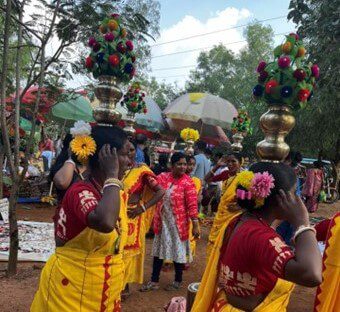

Lopamudra’s poem explores the captivating dance of tribal village women in Birbhum, challenging their self-perception and fostering an unexpected connection, exclusively for different truths.
Shantiniketan, December 2023

(I)

In the mirthful intersection of metered urban chatter
and the staccato bursts of rustic, baul songs
in the rusted soil of Shonajhuri,
we meet.
I, one among the many travellers in whose skin
urban privilege has left its pockmarks
They, the daughters of the primordial soil
of Birbhum, the land of the valiant.
They sway to and fro, in rhythmic, harmonious motion, and I join in
A glorious overture, or an orgy of sensuous poetry, I wonder.
‘Ini bini tapa tini’, their voices in unison open
the lock gates of a tempting archetypal realm,
the beasts of marital desire well-garbed
in folklorish charm—I ponder.
In the high notes and the low notes
of their mismatched, unpolished voices
and the valley in between, an unending stream
flows on, the vanity of my language
stumbling over, trying to merge
with the uncouth glory of their requiem.

(II)

The dust and the grime of the red soil
are the unsettling poems born in this nomad-heart
that rebuilds, and reconstructs homes, shelters, universes.
In between the silence
And the slow movement of poush winds
caressing the shaal, sagoon trees,
my eager footsteps traverse through the wild, jungle voices
of the bauls, through the spirit dance of the mystic scribe.
As slow-moving dust, my feet sway with the wandering feet
of the tribal dancers, the Santhal and the Baha village belles.
In my travel-torn body, my shoulders, arms,
The cracked years of my migrant trails
smell of an impatient, sensuous rhapsody.
“Didi, nachbi aay…” (Didi, come and dance, hold hands!)
A woman, lanky and dark appears from the group,
She catches my arm, and we keep pirouetting in circles,
in the mellow light of the sun.
‘Saheb babur bou hoyechhe dekhte bhari khasa’
(The new bride of our dear sahib is pretty, isn’t she?)—
They clap at the end of the familiar refrain, smiling wryly
as the setting sun marries the luscious, drunken dark.
The dance, the sudden spurts of mirth grow root, then branches, leaves
In the mortal dusk when my vain syllables are blotted out.
Glossary:
1. Shonajhuri: the famous Shonajhuri forest in Shantiniketan, West Bengal, and the weekly Saturday afternoon bazaar set up by local artisans, also known by locals as the Khoai Mela.
2. Baul: nomadic folk singersof Bengal
3. ‘Ini bini tapa tini’: popular tribal folk song of the region
4. Poush: the winter month of poush in the Bengali calendar
5. Santhal: the largest tribal group in the states of West Bengal and Jharkhand and an ethnic group in the Asian subcontinent
6. Baha: tribal village in Birbhum district, West Bengal near Shantiniketan where the santhal people reside…Baha means flower in the Santhali language.
Photo by the poet

Lopamudra Banerjee is an author, poet, translator, and editor with nine solo books and six anthologies spanning fiction, nonfiction, and poetry. Her work has earned recognition in India and the USA. Recent notable books include a collaborative poetry collection with Priscilla Rice, We Are What We Are (1st Prize, New York Book Festival 2024); her translation of Mallika Sengupta’s Kabir Bouthan as The Bard and His Sister-in-Law (Honorary Mention, Paris and Hollywood Book Festivals 2024); and Draupadi theke Nijashwi (2025).

 By
By
 By
By
 By
By
 By
By