

Nabanita reviews Rajorshi Patranabis’ Soliloquy: Ghazals, a literary work that explores themes of love, separation, pain, and loneliness, experimenting with verse form and vocabulary, exclusively for Different Truths.

My first interaction with Ghazal was through music. As I listened to the stalwarts of ghazal singers, I came to realise that it was a form in which both the musical aspect as well as the lyrics demanded attention. It was much later that I came across ghazals in English, primarily reading them as poems. But the association with musical elements remained. It is inherent, like the ghazal, to have a melodious aspect. The raadif, and the quafiya preceding the raadif add to the musical quality. The subjects treated in the English ghazals range widely from romantic to social to protest poetry, but that does not interfere with the melody associated with ghazals. Deriving from the Arabic tradition of poems on divine love, the form of ghazal has now transcended its original form to include a wide variety of issues.
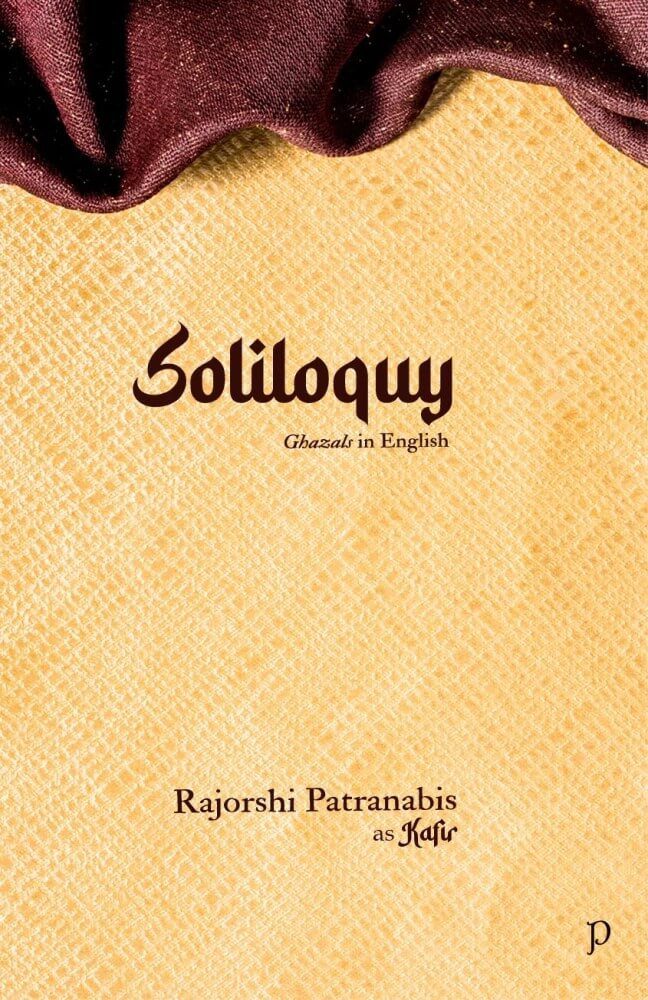
Soliloquy: Ghazals in English published by Penprints is a collection of 72 ghazals by Rajorshi Patranabis alias Kafir. As the title suggests, these compositions are ruminations of the poet, who appears to be on a solitary journey of life. The pictures included in the volume not only accentuate the aesthetics of the book but also highlight the idea of solitariness. A path along the trees, a lonely tree or a single boat – all these images leave an impression of solitude. But this solitude is not loneliness – it is a journey through love, pain, death, separation and much more. If life is a journey, love, friendship, grief, anxiety – all these are emotions through which the poet sails as an individual, singing his personal song. Though the volume is a slim one, the range of emotions that is covered here is wide. The journey of the poet in this anthology finds an apt closure in the last poem:
If again you speak to yourself
My journey begins from me to myself. (79)
For the poet, life is a journey of understanding the self. It is a process of self-discovery which is a lonely journey. Time is the only and constant companion in this journey that the poet undertakes. Hence, the opening piece talks about the wretchedness of time juxtaposed against Kafir’s ecstasy –
Kafir blooms in ecstasy
Love swirls to destiny (5).
As we move along the pages, love, hatred, death – all find a place in these verses. Love is often mingled with pain –
Memories of our forbidden rain
Antique love writhes in pain. (6)
Or in another poem the poet says,
Parting trysts trust your story
Kafir dances his pain to glory (29)
Kafir explores love in all its aspects, also aware of its fleeting nature like that of card game or dice game with all its unpredictability. It has the capability to leave the heart wounded or the beloved in pain. Kafir becomes the spokesperson of the age-old association of love with pain and suffering. Thus the imagery of card and its conventional association with fate is explored in one of the poems –
Cards shuffle for the last kill
Kafir loses his winning deal
….
Wounded heart tries to heal
Cards shuffle for the last kill (19)
Death keeps reappearing in various compositions throughout this anthology. It is often metaphoric, giving way to something new:
Kafir dies in faith
Faith of love in crystallized ether (18)
Kafir, a term traditionally associated with a non-believer, to be in ‘faith’ would mean a death of a way of life. Here, love is the ‘faith’ in which Kafir falls.
Death can also mean silent suffering that becomes a part of being in love
Kafir bleeds through his eyes
Some deaths remain unknown (35)
Memories shape us in multiple ways. The past keeps coming back to the lover who learns of ways to deal with the movement of time –
Fleeting sweeps of those lost gush
Glimpses of revived memories
Barters of swindled thoughts
Walks through treaded happiness (59)
This anthology of ghazals moves away significantly from the traditional structure of this poetic form. The ones included in this volume use refrain, which is a little different from the traditional forms of quafiya and raadif as found in Arabic tradition, or that the English ghazal composers later followed as well. Raadif is the last syllable that is repeated throughout the ghazal, while quafiya is the rhyming syllable/s before it. Traditionally, both quafiya and raadif are present in the second line of the couplet, adding uniformity to the structure. Creative freedom allows the poet the liberty to experiment with the form and Patranabis has made full use of it here.
All ghazals are not in the couplet form. He liberally makes use of a quartet as a stanza and even at times inserts a single line. But when it comes to theme, the poet is faithful to the existing genres of ghazal. Love, separation, and pain are the themes that dominate the anthology. The vocabulary has an inherent melody and keeps the lyrical quality of the ghazal intact. Soliloquy: Ghazals in English is an interesting work in terms of its experimentation with the verse form and vocabulary. There is rich imagery that runs throughout the poem making it an enriching read.
Cover photo sourced by the reviewer

Dr. Nabanita Sengupta is an Assistant Professor in English, Sarsuna College, Kolkata. She is associated with She as a creative writer, a translator and concerned with issues pertaining to women and children. Travel writing and disability studies are her other areas of interest. She has been variously published by Sahitya Akademi, Muse India, Amethyst Review, Coldnoon – A Travel Journal, News Minute, Café Dissensus, etc.



 By
By
 By
By
 By
By
 By
By