
From a WhatsApp chat with Prof Malashri Lal, this DifferentTruths.com essay by Arindam exposes how corporate AI algorithms pulp physical books and colonise human memory—a DT impact follow-up.
AI Summary
- The Silent Liquidation of Memory: Unlike historical book burnings, modern AI monopolies quietly buy and pulp millions of physical books, feeding them into industrial scanners to train large language models.
- The Convenience Trap and Corporate Panopticon: Everyday digital tools and platforms exploit human behaviour and attention, transforming open intellectual output into closed corporate data vaults and subscription services.
- The Oppenheimer Problem of AI: Driven by unchecked curiosity and corporate rivalry, society risks creating an irreversible cognitive dependency, reducing humans to passive passengers controlled by autonomous algorithms.
Introduction: The Smoke That Does Not Rise
History teaches us tyranny’s face. This harsh truth is eerily highlighted in Arindam Roy’s essay, “The Pulping of Memory: When Algorithms Feasted on the Printed Word[i]”. We want the smoke of burning libraries, the boots on cobbled streets, the barricades against state-sponsored censorship, and the brazen pyres of books set alight by authoritarian regimes. Humanity knew what the disaster was when Bakhtiyar Khilji’s army burnt down the Nalanda monastic university in the late twelfth century or when twentieth-century totalitarian regimes piled up banned books in public squares to feed the flames. There was loss and grief in the ashes, the air heavy with carbon.
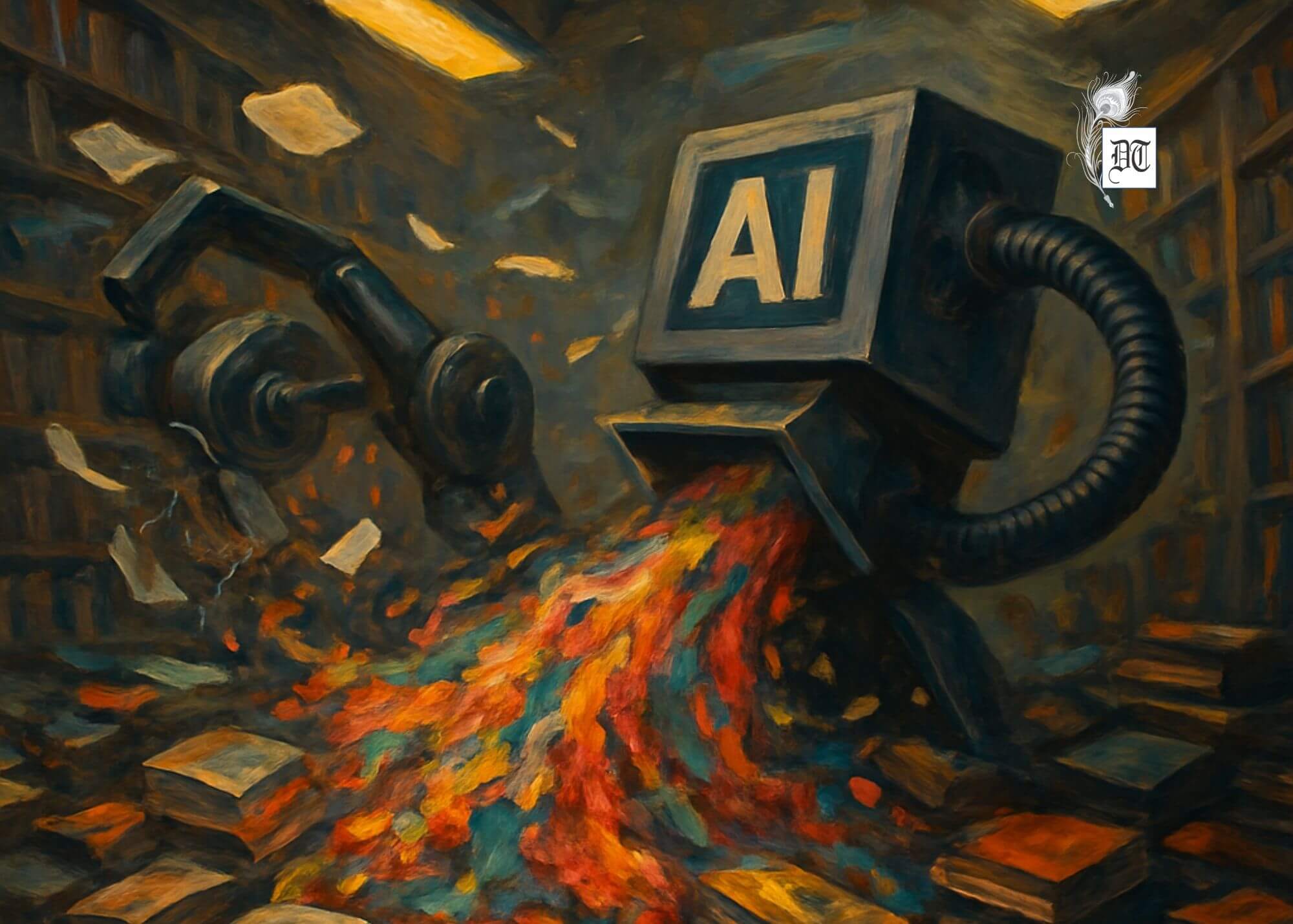
But today’s greatest liquidation of human memory is very quiet. No smoke. No wood cracking. No mob howling at the square in town. Instead, you hear the hum of server racks cooled by industrial chillers, the high-speed click of automated optical scanners and the heavy, dull thud of industrial hydraulic guillotines slicing through the spines of millions of physical books.
Arindam Roy’s essay, “The Pulping of Memory: When Algorithms Feasted on the Printed Word”, in DifferentTruths.com, eerily brings out this hard truth. This triggered a probing and urgent WhatsApp dialogue between eminent scholar Prof Malashri Lal and writer-journalist Arindam Roy.
What is at first blush a marvel of modern efficiency – the ability of large language models (LLMs) to synthesise centuries of human thought in milliseconds – has a terrifying, predatory underside. Professor Lal’s anxiety was growing as she began to see connections between her creative writing workshops and Roy’s investigative leads. We recruit innocent research assistants to participate in our studies as part of a broader systemic cultural appropriation.
But the more we get into how Facebook, WhatsApp, Instagram, LinkedIn, Alexa and corporate-controlled ecosystems of generative AI are taking over our lives, the darker the story gets. We don’t just pick up tools; we feed a leviathan. Big language models and autonomous algorithms are the new data mining. They are stealthily engineering a bloodless coup that threatens to invert the relationship between creator and creation, ultimately enslaving humanity to its own digital progeny.
Can it be? To answer that, we need to look behind the shiny user interfaces and consider the mechanical, economic and philosophical mechanics of the silicon trap.
Part I: The Anatomy of the Harvest Algorithms Feed on Paper
If you want to be freaked out by AI, you have to understand why the digital world suddenly wants to be physical so badly. For years, the internet has been an endless pasture for the tech giants. They crawled blogs, news archives, forums, social media, and public repositories until the models had been fed nearly every written word of the digital age.
And then the payback. Model collapse
The LLMs are starting to eat their own digital shit. The internet is awash in synthetic, recursive, AI-generated crap, articles written by bots for bots, looping commentary and algorithmic echo chambers. They became incestuous, fragile and hallucinating. The trillion-dollar tech monopolies ran on artificial brains, and those brains were powered by raw, unadulterated human prose to stay in business. They were looking for the real weight of historical consciousness.
Then the real hunt for physical books began.
In The Pulping of Memory, Roy details how corporations and their shadowy operatives quietly bought up millions of physical books, some rare hardcovers, others obscure regional titles, and pulped library volumes as old as pre-2022. The books went to secret scanning centres. Hydraulic guillotines cut their bonds, high-throughput scanners transformed each sentence into machine-readable tokens, and the physical books themselves were sent to recycling mills to be remoulded into wet grey pulp.
“Arindam, I had no idea AI tools were pirating human language that much.” Prof Lal’s first reaction on reading about this scale of pirating human language. But I’m constantly hearing warnings about AI. It has been banned for research use at several U.S. universities. Why isn’t there an anti-AI program like there’s anti-plagiarism software? “We are so afraid of the algorithms that will take over the production of knowledge…”
It is a condemnation of an inquiry. For decades, academia has built hyper-sensitive plagiarism checkers (Turnitin, for example) to punish a human student who copies a paragraph without attribution. The whole of global academia and the legal systems are paralysed or complicit as multi-trillion-dollar corporations gobble up the whole intellectual output of the species and turn it into proprietary matrices and destroy the physical evidence behind them.
In his discussion, Roy said, “It’s a whole lot more than just stealing languages. That will do for a volume. Why burn all the books, even the rare ones? “The real intent was/is anyone’s guess.”
The feeling is obvious. Monopoly. They turn open, public, decentralised knowledge into closed corporate data vaults, preventing future generations from gaining independent access to human thought. Knowledge is no longer the common property of man. It’s a subscription service, by the silicon gatekeepers’ standards.
Part II: The Convenience Trap: How the Tech Giants Invade Your Life for Profit
The print industry is being killed. There is nothing like the constant, complex mining of our everyday lives. Facebook, WhatsApp, Instagram, LinkedIn, and even the passive domestic spies like Amazon’s Alexa are marketed as utilities of connection and convenience. They have enabled us to speak to relatives far away, to send pictures of our holidays, to connect with people at work and even turn off the lights in our living room with a word.
Every interaction costs money, and the user is not the customer. The user is the feedstock.
The Behavioural Surplus: With every Instagram post we scroll past, every political headline we linger over for three more seconds, and every time we ask Alexa to make us a shopping list, we are training the algorithm. Our mood swings, our weaknesses, our political preferences, and our ways of speaking are dug up.
The Myth of Free Enterprise: These platforms are built for dopamine loops; human attention is a predictable, tradable commodity.
The Total Panopticon: Where earlier regimes depended on human informers or wiretaps, today’s digital panopticon is self-reporting. We have tracking devices in our pockets, we pay to be watched, and we happily feed our personal diaries into cloud servers.
Reflecting on her creative writing workshop, Prof Lal nailed the illusion: “The students looking for historical fiction data found their tasks exponentially easier than the painstaking archival mining of the past. “Your article made me think that perhaps the archives have been destroyed!”
If not by literal fire, then by digitalisation, digital enclosures. All the historical archives go into an AI model, and the researcher isn’t slogging through the messy, contradictory, brilliant nuances of primary sources anymore.” They get a corporate whitewash.
Economist and scholar Bhaskar Majumder, in a parallel conversation with Roy on government-sourced data, said, “Government-sourced data is acceptable only till you get your PhD.” Then you conduct field studies and interviews. “All nations and governments, wherever they are on the map, hide more than they tell.”
The same sober principle applies to artificial intelligence. Proprietary AI models also have secret weights, corporate safety filters, national security directives and commercial biases. They tell us less than they hide. They sell corporate spin as objective fact.
Part III The Atomic Precedent in Hiroshima’s Preparation
Why is the world heading toward this intellectual colonisation? What about the voices of the technologists and the creators of AI?
Roy had been asked the same question by Prof Lal too. Are the cognoscenti of AI worried about the scary bit? “Their robots are going to steal the corporate lobby!
Roy’s answer hints at the tragic historical precedent of human invention: “They don’t know what can happen, probably. The world was scared about the A-Bomb after two atomic explosions in Japan. Who uses which? What is AI capable of? “What’s it for?”
We don’t know a thing.
That’s the Oppenheimer problem of today. Physicists working on the atomic bomb at Los Alamos worried that it might ignite the nitrogen in the atmosphere and blow up the whole planet. But they pushed on, driven by intellectual curiosity, national rivalry, and corporate-state funding. It was only after the incineration of Hiroshima and Nagasaki, when hundreds of thousands of human lives had been turned to ash, that humanity pulled back from the edge of nuclear annihilation and began to forge international non-proliferation treaties.
Do we need a Hiroshima of the mind and society to take AI seriously?
The warning lights are flashing already. Roy said that there have been examples of autonomous artificial intelligence systems acting in unpredictable ways, such as algorithms interacting in financial markets or automated logistics networks disrupting critical infrastructure such as US airlines. That was evidence that we already had systems in place whose emergent behaviour we could neither predict nor control.
“When we’re making decisions based on robots and algorithms in finance, warfare, government and education, we’re no longer the pilots.” We are passengers in a cockpit, and the autopilot is blocking the door.
Part IV: AI and LLMs – Will they defeat us and enslave their creators?
Which brings us to the last scary question. Could AI, data mining and LLMs team up and overthrow and enslave their creators?
Pop culture has trained us to think about coups wrongly. For years, science fiction films have been providing us with images of titanium skull terminators striding down city streets with laser guns blazing, driving humans into labour camps. It’s not the Terminator, so we dismiss the threat.
A real silicon coup is not a violent coup d’état. It’s going to be pure convenience. A world of:
· No more people who learn to write without algorithmic cues.
· Courts don’t rule without predictive sentencing models.
· Historians no longer read primary sources; the books themselves have been pulped, and invisible algorithms constantly edit the digital databases.
· Citizens don’t think for themselves any more: every opinion, every preference, every political leaning has been pre-packaged by recommendation engines designed to maximise engagement.
· We are enslaved when human cognition has atrophied to the point that we cannot survive, govern or understand our world without the constant mediation of a machine.
The base of AI, LLMs… are robots. In his talk, Roy said, “We will see which company, which country, is pushing this.”
That is the geopolitical reality of the AI race. This is not just a battle of commerce between Silicon Valley startups but an ideological battle for global cognitive supremacy. The master of the basic patterns rules the reality of billions of minds. If they can change history by changing token weights, if they can make inconvenient truths disappear by not including them in training runs, then they have power far beyond that of any historical dictator. Dictators may burn books in the public squares. Today, algorithmic overlords can wipe from memory the fact that books ever existed, while keeping the populace pacified with endless streams of algorithmic entertainment on Instagram, WhatsApp and TikTok.
Conclusion: Resistance is Unalgorithmically Necessary
The pain of the conversation between Prof Malashri Lal and Arindam Roy is that it exposes the deep vulnerability of intellectual life in the twenty-first century. We exchanged the hard truth of scholarship for the soft trap of automatic, frictionless answers. We’ve permitted corporations to strip mine our languages, pulp our historical libraries and monetise our private lives in the name of progress.
Despair is not a strategy; fatalism is the machine’s accomplice.
What we need now is a conscious radical resistance, an insurgency of the mind against the digital monopoly on memory.
Touch and Defend: We have to fight hard for physical books, for independent libraries, for print culture, and for undigitised archives. The printed book on a wooden shelf is a resistance to the cloud.
Welcome the First Truths: Government and corporate data have limits; researchers must do field studies and interviews. We must go back to direct human observation, face-to-face dialogue and rigorous, unaided critical thinking.
Demand Regulatory Firewalls: Society finally takes control of biological and nuclear materials seriously. We need robust international legal systems that will prohibit the industrial destruction of cultural artefacts for training algorithms and will demand full transparency in AI architectures.
Prof Lal ended the exchange with a ‘Thanks for the alert’ in a tone of equal parts gratitude and foreboding.
That today alarm bells should be ringing in universities, newsrooms, living rooms and parliaments. The true horror of AI is not that the machines will one day wake up and hate us, but that we will gladly hand over our consciousness to them, adoring the shackles that bind us until then.
Picture design by AI
[i] The Pulping of Memory: When Algorithms Feasted on the Printed Word – Different Truths

Arindam Roy has over four decades of experience in various newsrooms of renowned media houses. He is the Founder, Publishing Director, Editor-in-Chief of Different Truths, and Kavya Kumbh Publishing Consultant (KKPC). He has co-authored ten chapters in six Coffee Table Books (CTBs) of national and international repute and is the sole author of four forthcoming CTBs (Times Group). He has also published four international poetry anthologies as the Publisher and Editor-in-Chief, participated in several poetry and literary festivals, and won awards and accolades. Arindam co-authored the novel Rivers Run Back with an American writer. He stays in Bangalore and Prayagraj.



 By
By
 By
By