
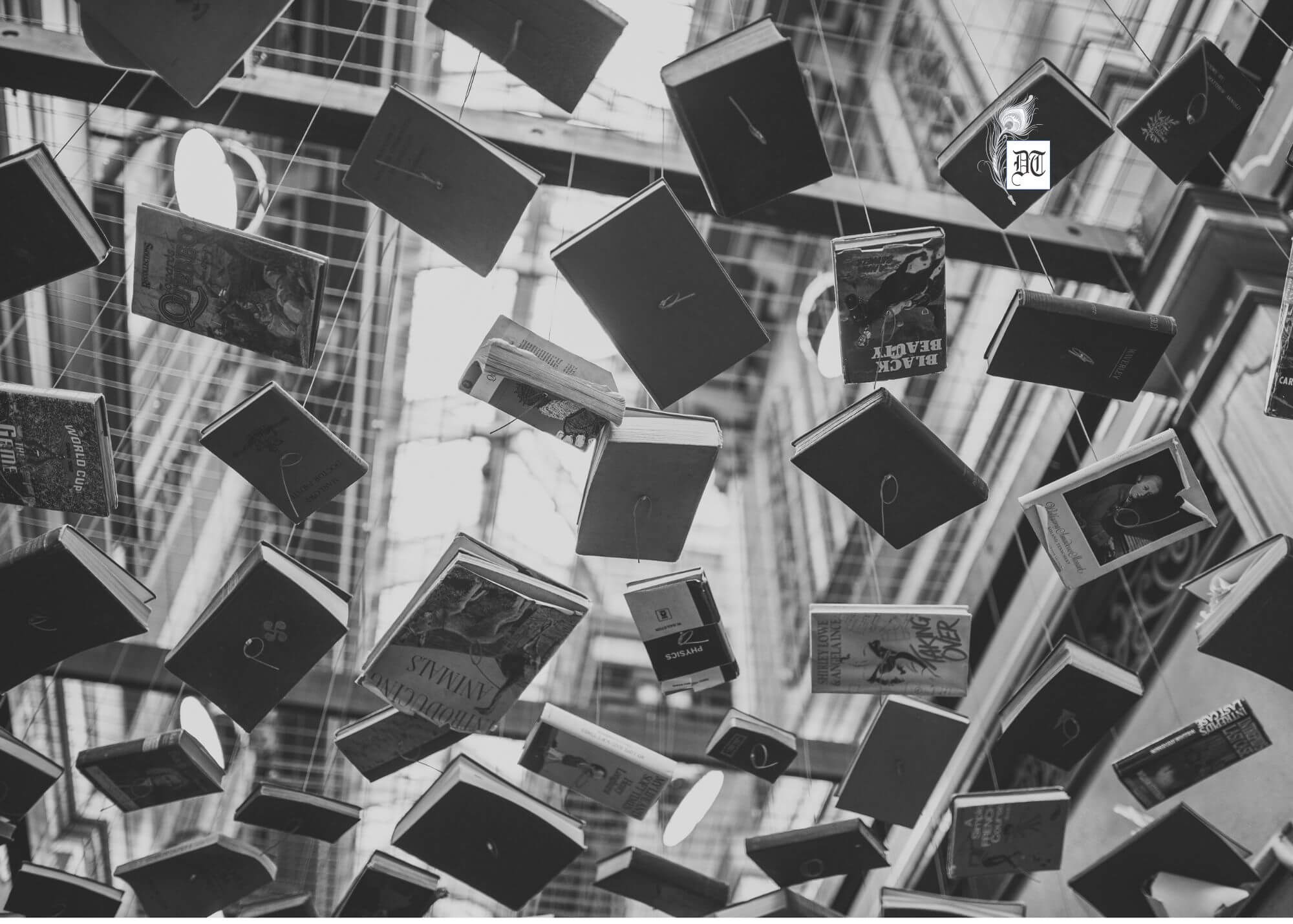

Arindam reflects on the dark reality of AI scraping and industrial book shredding, the destruction of millions of printed books, sharing insights exclusively on DifferentTruths.com.
AI Summary
- Industrial Book Harvesting: Tech companies and AI data scrapers are secretly buying millions of pre-2022 physical books, ripping their spines out with industrial guillotines, and shredding them into pulp after high-speed digital scanning to feed their algorithms real human prose.
- The Threat of Model Collapse: Driven by the desperate need to escape synthetic, AI-generated recursive garbage polluting the web, corporations are treating our tactile literary heritage as raw, disposable fuel.
- The Privatisation of Memory: Systematically destroying physical books transforms open human knowledge into proprietary subscription services controlled by a handful of tech monopolies, threatening cultural archives.
Introduction: The Smell of Paper and the Cold Mechanics of Erasure
There is something sacred, something intimate, about a physical book. Before the tyranny of glass screens and blue-light insomnia dictated the rhythm of our waking moments, civilisation measured its soul in the quiet weight of bound paper. And the smell of printer’s ink, the faint yellowed edges touched by unseen hands in ages past, and the feel of a page turned. These are the sensory anchors of human memory.
I’ve spent four decades in newsrooms, witnessed the frantic evolution of media from the clackety cadence of manual typewriters to the instantaneous, fleeting blur of the digital age, and thought I’d seen the full spectrum of how humans treat information. I’ve seen newsprint turn yellow dust in humid archives. I’ve seen libraries evolve from analogue card catalogues to cold database grids. But nothing in my 40 years of work in journalism, publishing and cultural commentary prepared me for the chilling industrial reality recently revealed.
A silent catastrophe is unfolding, all around the world, behind corporate non-disclosure agreements, supply-chain mediators and clever legal loopholes. Millions of physical books, mostly pre-2022 when generative AI exploded in popularity, are hunted down and bought wholesale, their spines ripped out with industrial hydraulic cutters, then high-speed scanned and forever shredded into worthless pulp.
Why? The AI brains of our modern tech giants are ravenous. They have scraped the entire internet clean of human writing and hit an existential wall: the web is now drowning in synthetic, AI-generated recursive garbage. To make sure their Large Language Models (LLMs) stay smart, nuanced and culturally aware, the algorithms that run them need the real thing. They crave the organic rhythm of human-written prose, pre-2022. And they are turning our literary heritage into trash to obtain it.
Before the 2022 Panic: The Anatomy of the Crime and Destructive Scanning
This news has been in sharp focus recently through investigative reports by media outlets like The Washington Post and 404 Media, and passionate discussions across international media spaces, including insightful digital breakdowns by independent creators like Subhra Sundar in features titled “বইপ্রেমীদের জন্য দুঃসংবাদ: AI এর জন্য লাখ লাখ বই ধ্বংস হয়ে যাচ্ছে“ (Bad news for book lovers: AI is destroying lakhs of books, sending shockwaves through the literary community.)
To get a better sense of why this is the case, you need to understand the panicked economics of the AI race in Silicon Valley. AI companies need massive datasets — trillions of tokens — to train models like GPT-4, Claude, and Meta’s Llama family of models. In the early days, tech companies treated the internet like a digital commons, scraping blogs, news sites and public domains without permission or payment.
But as the copyright lawsuits mounted, as authors began waking up to the theft of their intellectual property, a secondary crisis arose: model collapse. When you train an AI model on text generated by other AI models, the quality quickly degrades, like a photocopy of a photocopy, until it’s a blurry smudge that’s unreadable. LLM developers needed clean, real, human-written text, made before the internet got spoilt with AI-generated text, to keep thinking cognitively.
Enter the used book market, the liquidators, the anonymous bulk purchasers.
Slowly, quietly, tech companies and their vendors bought hundreds of thousands, perhaps millions, of used hardcovers, out-of-print titles and library discards. These books are sent to covert scanning stations. Giant industrial guillotines cut the bindings, leaving loose sheets of paper from bound volumes. High-throughput optical scanners convert the text into digital tokens consumable by machines. Once the pages have been digitised, the physical books are sent to recycling mills.
This is not conservation; it is industrial harvesting. It’s the mechanical digestion of human culture by silicon leviathans.
Destruction and the Law Gymnastics
How do they get away with this? Many of these AI startups are based in the US, where companies have used a cynical reading of legal doctrines. The so-called “first-sale doctrine” means that once you legally purchase a book, you own that physical book and can technically do what you want with it, even destroy it. Tech lawyers have also weaponised the idea of “transformative fair use” by claiming that scanning books for the purpose of extracting abstract statistical patterns and language weightings does not constitute copyright infringement, provided the original physical copies are destroyed forever so they cannot be redistributed as eBooks.
Let that sink in: The law has been twisted to defend the destruction of physical books so long as the destruction is thorough enough to keep human readers from ever seeing them again.
Authors, poets and publishers are pushing back. Powerful writers’ guilds are suing in US courts to challenge the idea that corporations can absorb decades of human creativity without consent, attribution or financial compensation. But the law grinds on at a painful pace, while the shredders of industry work at blinding speed.
Modern Day Looting: How Does It Compare to Ancient History? Barbarism of Today
“The emotional response from book lovers is immediate, visceral and historically laden when they hear of this mass shredding. Many have asked. Is this like invaders destroying libraries in the old days? Is it comparable to the tragic destruction of the ancient libraries of Nalanda and Takshila by the invading armies? Or the deliberate destruction of cultural archives during imperial conquests such as Japan’s invasion of China?
As students of history and literature, we need to look at the comparison with both empathetic clarity and sober intellectual precision.
1. The Question of Purpose
In the late 12th century, Bakhtiyar Khilji’s forces set fire to the ancient monastic University of Nalanda in an effort at cultural annihilation. Nalanda was a legendary seat of learning with millions of manuscripts on medicine, philosophy, astronomy and grammar. The aim was to cut off the intellectual and spiritual leadership of a civilisation by turning its memory to ashes. Similar to the 20th-century vicious wars, where occupying armies systematically targeted national libraries and archives as a means of subjugating populations.
The AI companies in Silicon Valley don’t have an ideological hatred for literature. They don’t hate books; quite the opposite, they love them. They love them as raw material for mathematical optimisation. Their motive is cold and impersonal economic utilitarianism. They look at literature the way a petrochemical conglomerate looks at ancient fossil fuels: as dense, organic stores of energy to be cracked open, refined and monetised.
2. The Nature of the Missing Material
In the ancient libraries there were unique, irreplaceable, singular manuscripts, handwritten copies, the destruction of which meant the permanent loss of entire branches of human inquiry.
But the vast majority of books being shredded by AI contractors today are mass-market paperbacks, duplicate genre fiction and common secondary-market titles. A corporate data harvester is not going to shred a last surviving manuscript of a mediaeval poem they’re buying in bulk; they’re shredding thousands of common titles published from 1990 to 2021.
3. The Monopoly of Memory: Where Parallel Terrifies
The motive is commercial, not malicious, but the long-term civilisational consequence echoes painfully with history.
The structural outcome is the same as a library fire: decentralised, public knowledge is removed from the physical world. The physical paper trail is shredded after millions of books are bought and digitised into proprietary corporate data vaults.
If physical books are systematically removed from circulation and destroyed, and if future generations become wholly dependent on AI models owned by a handful of trillion-dollar monopolies to access, interpret and summarise human thought, we enter a dark age of a different kind. Knowledge is no longer an open, common inheritance. It’s a privatised subscription service. The gatekeepers of silicon can alter, censor, recontextualise or quietly excise historical realities just by changing the weightings of an algorithm. But who does anyone argue with but the machine when the physical proof is pulp in a recycling vat?
The Crisis of the Written Word in the Age of Silicon
This is a very sad moment for one who has spent his life nurturing young writers, editing anthologies of poetry and advocating for the printed page on platforms like Different Truths.
Literature has been and is a refuge for the human soul. It is the record of our weaknesses, of our triumphs, of our griefs, of our revelations. A book is an act of faith. A writer reaches from one hand to the heart of another across time and space.
To reduce this sacred dialogue to a series of numerical tokens ingested by an unfeeling server farm is an insult to the species. It treats human ingenuity as a free externality – a commons to be pillaged, mined and thrown away when the juice has been squeezed out.
Conclusion: Restoring the Sanctuary of Print
We are at a critical juncture in the history of humankind. To turn our physical libraries and our secondary book markets into troughs for algorithmic expansion is to give up not only our copyright but also the material ground of our civilisation.
We must insist on robust legal safeguards against destructive scanning of books. We must champion independent publishing, save public and private libraries and celebrate the unalgorithmed, tactile reality of the physical book.
An algorithm can imitate the style of a poet, but it will never know the broken heart that inspired the verse. It can read a million pages in a minute, but it will never smell the ink, feel the weight of the paper and cry over the stories it consumes.”
We need to protect our books, not just because they are intellectual property, but because they are the vessels, in physical form, of our collective humanity. Once we’ve been mashed up, no amount of artificial intelligence is ever going to be able to write us back.
Additional Reading & References
• Washington Post – Investigative reporting on AI data-scraping, unsealed court documents and publisher litigation (2024–2026)
• 404 Media: Digital investigations into the supply chains of the second-hand book market and the industrial scanning and shredding warehouses used by tech startups
• Subhra Sundar: Digital video documentation and commentary on cultural impacts in Bengali media (“Bad news for book lovers: Millions of books are being destroyed for AI”)
• Roy, Arindam: Archives and essays on media evolution, journalism ethics and preservation of literary heritage, Different Truths.
Picture design by Anumita Roy

Arindam Roy has over four decades of experience in various newsrooms of renowned media houses. He is the Founder, Publishing Director, Editor-in-Chief of Different Truths, and Kavya Kumbh Publishing Consultant (KKPC). He has co-authored ten chapters in six Coffee Table Books (CTBs) of national and international repute and is the sole author of four forthcoming CTBs (Times Group). He has also published four international poetry anthologies as the Publisher and Editor-in-Chief, participated in several poetry and literary festivals, and won awards and accolades. Arindam co-authored the novel Rivers Run Back with an American writer. He stays in Bangalore and Prayagraj.


 By
By
 By
By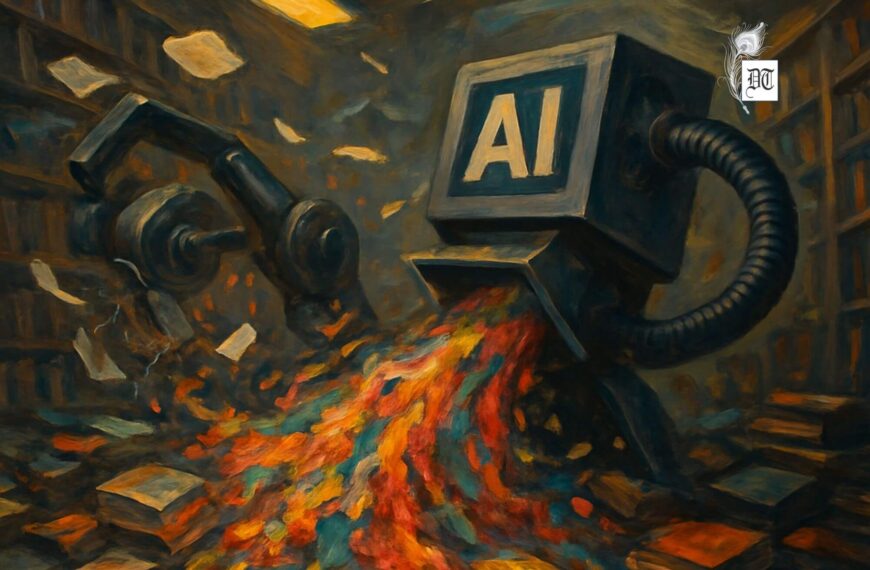
 By
By
This sends a chill down my spine. It is a deep tragedy and one that may not find redemption. What is the way forward? How do we curtail this Frankenstein we have let loose. Time alone will tell
It’s indeed scary and leads us to a ‘Future Imperfect’ world, Saranya.