

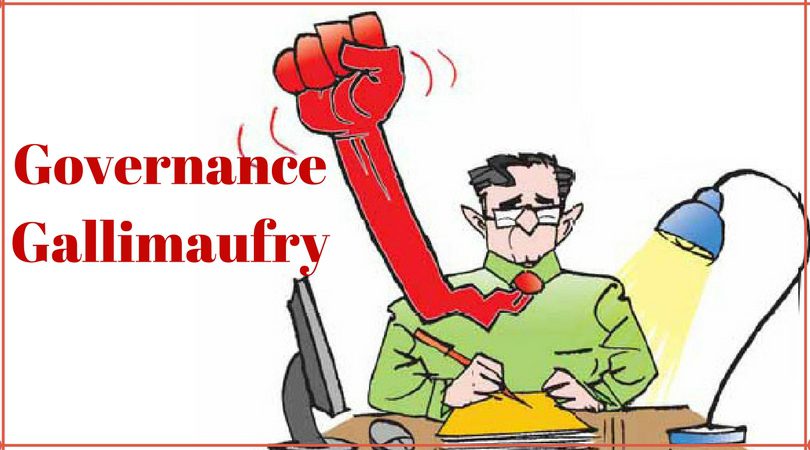
Indian bureaucracy thrives on sycophancy, and the most favoured officer is the one who is most flexible in pleasing certain people. However, whenever there was a major crisis, this gentleman officer, my mentor, would step in to manage the situation. In her weekly column for Different Truths, Hemashri explains how difficult it is for honest, credible people to work without being harmed.
I have been on an eternal quest for mentors. We cannot find everything we need to know about life in books. To refine my search, the first thing may be to know who a mentor is.
A mentor is a person or a friend who guides a less experienced person by building trust and modelling positive behaviours. An effective mentor understands that their role is to be dependable, engaged, authentic, and attuned to the mentee’s needs.
I have met various mentors in my life.
After qualifying for the state civil service, I had to submit two recommendations from two renowned individuals. One of them was an economist of great repute and the then Director of the Indian Institute of Entrepreneurship (IIE), Dr DD Mali. I knew him personally as he was the father of one of my close friends, Archana. I went to his office with my father and explained the purpose of our visit. Uncle wrote the letter very promptly, gave it to us, and narrated an interesting experience.
He said that the beautiful IIE building stands on a plot of land that was actually occupied by illegal encroachers, which prevented him from officially taking possession of it. The construction was getting delayed. So he submitted an application to the deputy commissioner’s office requesting that the land be cleared. He even met the then-chief minister of this land, as the encroachers were politically influential. After a series of initiatives, an instruction was finally issued to evict encroachers. The order was entrusted to an executive magistrate. So, to carry out the eviction, an executive magistrate arrived fully prepared.
Uncle said he saw a lean, thin executive magistrate and was worried, wondering how this man could handle the goons with strong political patronage. He thought something untoward might happen, and he would be a helpless witness. That day, the executive magistrate displayed remarkable nerve and was completely in command of the situation, even as a dozen unruly youths tried to resist him and their advocate threatened him with dire consequences. Starting at 8 am, the executive magistrate demolished all illegal structures by the evening.
The day saw a high-voltage political drama unfold, thanks to the intervention of an honourable minister. The executive magistrate skilfully managed the situation, as he was highly knowledgeable about the citing rules and the provisions of law under which he carried out eviction orders.
Narrating the story, Uncle told me, “You are going to be an officer. Please be like that officer who cleared this land on which this structure stands today. We need officers like him. His name is Rajat Baran Mahanta.”
It was a strange coincidence that in my very first posting, I met this gentleman officer as my senior  colleague. He was very supportive and cordial, and he was my first mentor in my service life. I learnt from him how to write orders in CRPC cases. He suggested to me books that an officer should have and must read thoroughly. I noticed he was always in his chamber, reading something when there was no file. In my view, he is the most knowledgeable and capable officer, but he was not the big boss’s favourite.
In fact, I heard how the big boss would ill-treat this man on the slightest pretext. Indian bureaucracy thrives on sycophancy, and the most favoured officer is whoever is most flexible in pleasing some people.
However, whenever a major crisis arose, the big boss would call in this gentleman officer to manage the situation. I saw it many times, personally, especially during the elections. When a central observer discovered a procedural lapse, the big boss promptly called in the most competent officer to ensure effective damage control. That was some 20 years back.
I again met him after 10 years of my first posting. At that time, we were both officers in the same department. He was the same man, cool and composed in his chamber. I never saw him leave this chamber for that one, whether for tea or for small talk. After a few years, I learned that he had joined a newly established university as a registrar on deputation.
Throughout, he was my trusted mentor, and whenever I needed counselling, he was always there. Occasionally, when he appeared too busy, I would come back seeking another date to meet him. I saw him working very diligently to set up the university, which began in a remote corner of a government office building. He took voluntary retirement to continue his tenure as the registrar.
I was out of touch for a few years. After maybe two to three years, when I went to his office again, I was told that the university now had its own building and that he had moved to the new office. I went searching for  the new building, and I was surprised to see that within just two to three years, the new university had established itself in a beautiful building in a scenic location. I felt happy to see my mentor sitting in his new office.
After a few months, the earlier vice-chancellor left, and a new VC took over. I came to know that, due to a rivalry between the outgoing and the new VC, my mentor was suspended on frivolous charges, though the actual reason was the unfailing integrity of this strong man in a frail frame. He protested against an illegal decision, which antagonised some influential people. I am still in touch with him.
He is fighting for his honour, and I am completely sure that my mentor will emerge unscathed. The only thing that pains me is the prolonged struggle and the stress and strains that the family has to endure with him. I pray that God grants them the strength.
It is difficult to be a man of uncompromising integrity. Rajat Baran Mahanta is still my most trusted mentor. Twenty-one years down the line, I have no idea to what extent I could live up to the expectations of Dr Mali Uncle. There are very few who can imbibe the indomitable courage this man possesses. I am happy that he has been my most trusted mentor for more than two decades. Only time or those whom I serve can say if I am his worthy mentee.
Salute to an unsung hero, my trusted mentor.
©Hemashri Hazarika
Photos from the Internet
#HonestOfficer #Mentor #Life #GovernmentGallimaufry #DifferentTruths

Hemashri Hazarika is an Officer of the Assam Civil Service since 1997. Her research on Assam Civil Service brought reforms in 2015. A first-class Postgraduate in Economics from Gauhati University, she was awarded JRF/NET by UGC in 1997. Her experience as a bureaucrat has sensitised her to human sufferings. A solutionist by passion, she takes an active interest in issues related to Governance, Development, Women, Children, etc. Reading, Writing, Speaking and Painting are her hobbies.
 By
By
 By
By
 By
By
 By
By
What’s an irony!! Rajat Baran Mahanta perhaps not only your mentor, but a finest mentor of the world for many others including me. After a long dedicated service he was awarded with the Life Time Achievement Award by authority of K K Handiqui State Open University with suspension from his job for nearly two years for no established reasons. We must congratulate the Board of Management of the University for such a historic decision to punish an innocent administrator. And it is obvious that the judgement of the inquiry will come after his retirement date so that he cant serve for a single day. It is really unfortunate that we are unable to help our mentor.