
Writing exclusively for DifferentTruths.com, Prof Bhaskar critically examines the political exploitation of food habits and cultural identity in West Bengal.
Key Takeaways
- State Patronage of Intolerance: The article highlights how state machinery and political figures offer uncritical hospitality to controversial figures who target regional dietary habits.
- Cultural Homogenisation: It critiques the imposition of a singular, binary-driven cultural narrative that attempts to undermine West Bengal’s historical diversity and scientific outlook.
- The Fear Factor and Silence: A survey reveals that public apprehension and a climate of insecurity prevent citizens from openly challenging pseudo-religious policing.
The latest is that West Bengal is in agony again – one Bageswar Baba, probably in his late twenties, apparently half-educated or miseducated from the heartland of Madhya Pradesh, has accused non-vegetarian Bengalis of being ‘pakhandi’ (hypocrite, a culturally unacceptable term for all Bengalis). He advised an ‘unknown power’ to oust Bengalis from the domain of Hindutva-based human existence. The Baba received all state entertainment and hospitality from the West Bengal government at public cost.
The Baba (or, Ore Baba in Bengali) was seen as sharing the same cushion with the CM of the ‘double engine’ government, naturally attended by other high-level state beneficiaries, shown through electronic media on September 07, 2026. I have no hesitation in opining that Baba violated the boundaries of human rights; first, by questioning the food habits of Bengalis. The members of the ‘double engine’ government were seen as taking cooked non-vegetarian dishes in large quantities and variety to prove that Bengalis were not in crisis because of the imminent conquest of West Bengal by the BJP.
Baba Bageswar represents miseducation of Madhya Pradesh and pan-India, for he is also favourably quoted by the PM of India. The ‘childish’ Baba represents a form of miseducation more venomous than illiteracy or the absence of education. Middle-level state representatives are waiting to go into damage-control mode. The CM of West Bengal has assured a franchise in West Bengal for Bageswar Baba, who termed Bengalis as ‘Bhondo’ (hypocrite). BJP representatives are in no mood to accept or reject the baba because they don’t understand the difference between private and public. Baba had safe passage to West Bengal to announce Bengalis as ‘dharmachyut’ (left out of dharma).
Why is such a Baba given weightage in West Bengal? It is a different episode that he went unquestioningly glorifying the death of many devotees as Moksha in the Kumbh at Allahabad/Prayagraj a few years ago. While UP might have practised silence in the public domain, people in West Bengal have not maintained silence since the era of the renaissance.
This ‘childish’ Baba is not new in India. Previously there were ‘machan baba’ whose feet former Prime Minister Indira Gandhi used to touch. And there were Dhiren Brahmachari, Ram Rahim and so on, who might have been vote-catchers for political power.
Swami Vivekananda has been juxtaposed in this discourse of concerned citizens of India – unfortunately, though. This is not the space to assess Vivekananda’s Himalayan heights. At the least, one may opine that a criminal-converted baba must not be compared with Ramakrishna-Vivekananda.
How best or worst to express anti-Bengali feelings? One is to brand the Bengalis as ‘Naxal’; the other is ‘urban Naxal’, with some examples that involved the premier educational institution like Jadavpur University. But the cultural history of undivided Bengal was/is so robust that, so far, these attempts have failed, at least partially. India is a civilisation with diversity in food, clothes, language… that is not so brittle, except for what happened in 1947 through geographic partition. Heartland was not partitioned.
Baba comes from the central part of India, previously called Central Province, which had/had no history of partition-agony or much advancement in education. It seems not surprising that such regions, at the risk of my revealed parochialism, cannot offer enlightenment through persons with a scientific outlook. Developing a scientific outlook is a Herculean task.
My disguised observations during more than a decade, starting from 2008, in Uttar Pradesh, which encompasses most of the Hindi heartland, revealed an ‘underground’ cultural space where adult educated people used to claim to be ‘pure’ vegetarians while, in practice, they were absolute non-vegetarians. I confirmed this through my participatory observations. I failed to understand why ‘vegetarianism’ was pure and ‘non-vegetarianism’ was impure. On a Rajdhani Express journey from Howrah to New Delhi a few years ago, when asked what kind of food we wanted, my co-passenger responded, ‘pure vegetarian’, and I replied, ‘pure non-vegetarian.’ But the baba question is not a personal position – it is an institutional question, and through active support of the state machinery, it becomes a state question.
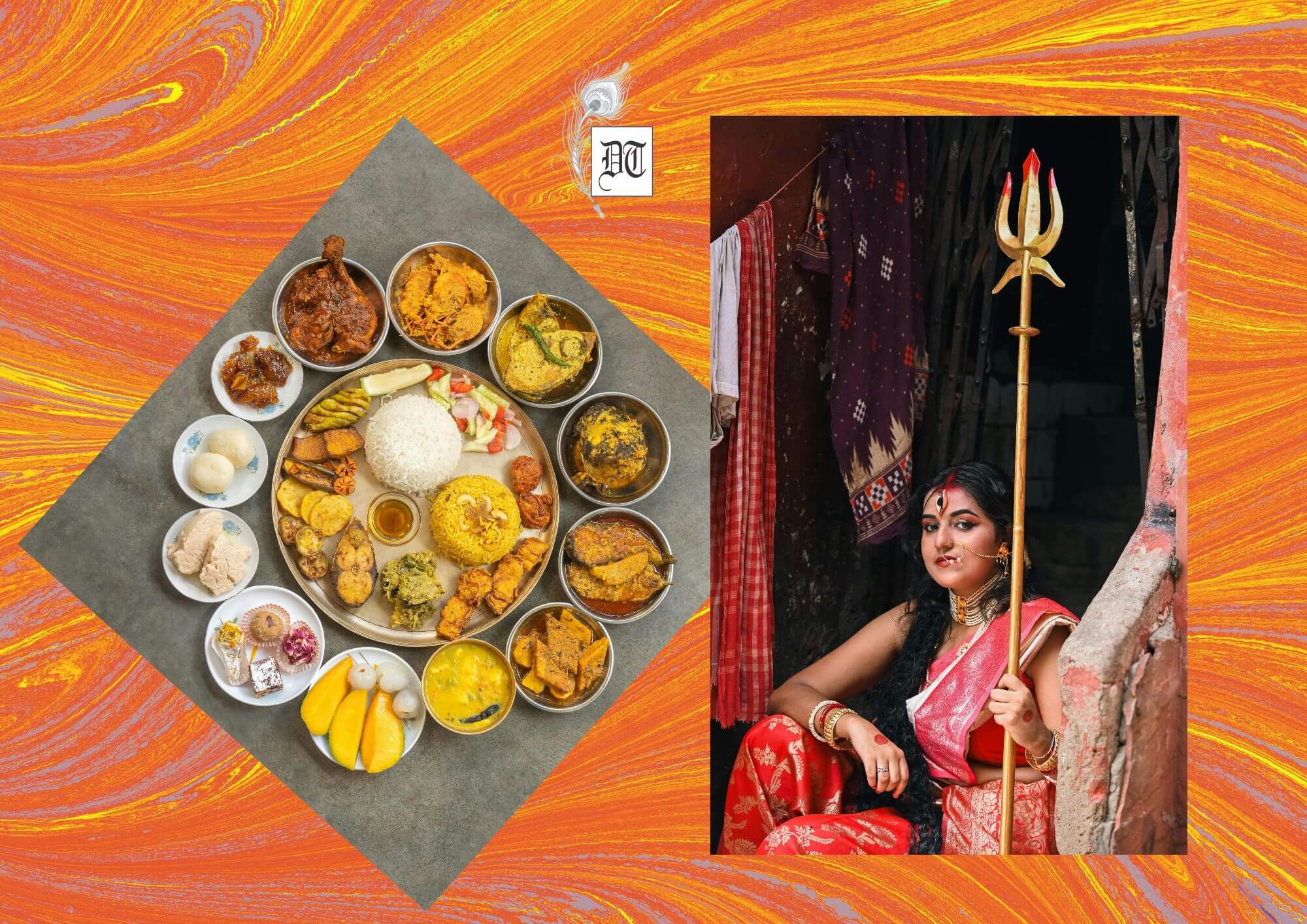
I surveyed on September 07, 2026, asking educated adults residing in West Bengal what food habits they would follow. It was a single question: whether they would stop eating non-vegetarian dishes during Durga Puja in October 2026. Most of them kept silent – fear factor. The fear is not West Bengal-specific – it has a bigger canvas. Some opined that vegetarianism is advised only by a ‘baba’, but food is distributed by ‘maa’ at home.
If anybody touching religion is people-sensitive, then I fail to understand why and how no FIR is made against the baba who hurt the sentiments of all Hindu Bengalis? The reason is power fear. The other reason could be uncertainty and insecurity in life. Some are engaged in fulfilling basic needs, and some are micro-smart.
The anti-Bengali approach is based on Delhi-consensus – Hindi-homogenisation. The pseudo-religious mastery is actually a ‘deshdrohi’ approach because it attempts to divide the people who do not live in the binary of Hindu-Muslim or Brahmin-Dalit or BJP-Congress. It also may be that Baba was only an instrument to malign Bengalis for their enlightenment, which seems to be a barrier to a homogenised Hindi-Hindutva-based Rashtra. While most of the rest of India is ‘rashtravadi’, West Bengal and Bengalis go in the ‘wrong’ direction of ‘deshvadi-antarjatikatavadi’. So, West Bengal has to be tamed – what better medium than religion? Baba is not irrelevant – is he a messenger of some higher authority?
Picture design by Anumita Roy
Prof Bhaskar Majumder superannuated as an Economics professor from GB Pant Social Science Institute, Allahabad. He served as a visiting professor at Central University of Bihar (Patna), Sri Sri University (Cuttack), Banaras Hindu University (BHU), Science College (Calcutta University), and others. He published extensively in 26 reputed journals, authored 11 books, co-edited two, and contributed 38 chapters. He completed 26 research projects funded by the Planning Commission, GoI ministries, ICSSR, the World Bank, NTPC, and Tata Chemicals. An international academic, journal reviewer, and PhD supervisor, he holds degrees from the University of Calcutta. He is our National Editor: Economics and Social Science.

 By
By