
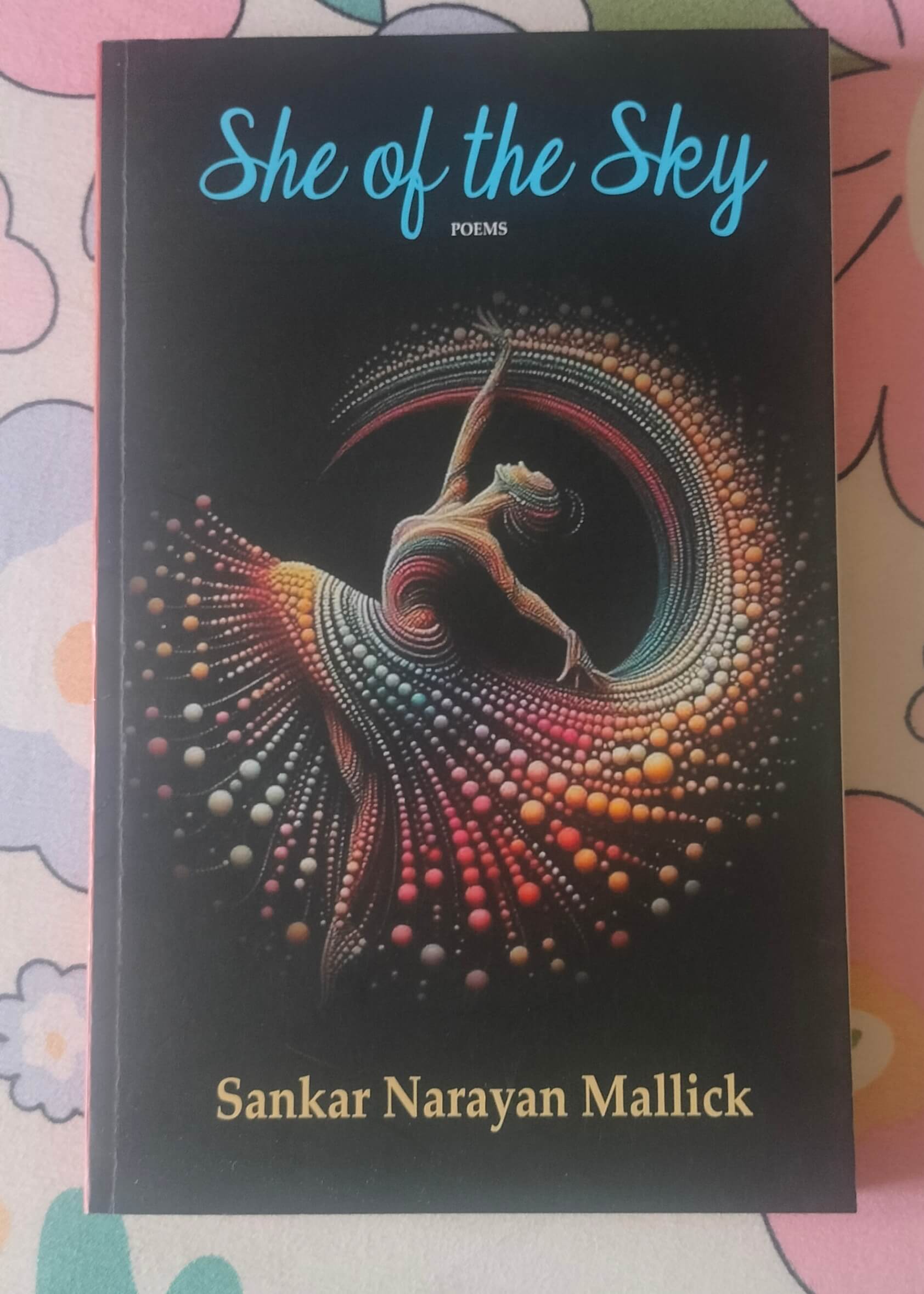
Prof. Nandini reviews Sankar Narayan Mallick’s She of the Sky on DifferentTruths.com, capturing a raw, emerging, and soulful poetic voice.

AI Summary
- Raw Poetic Exploration: Sankar Narayan Mallick’s She of the Sky presents fifty-one poems exploring identity, memory, and personal loss.
- Honesty Over Craft: While the collection occasionally wavers in technical execution, its unguarded, sincere emotional clarity remains highly redeeming.
- Promising Trajectory: The volume captures a budding, sensitive poet testing his voice and transitioning toward deeper metaphysical awareness.
She of the Sky is the juvenile poetry collection of Sankar Narayan Mallick, a book of fifty-one sophisticated and seamless poems, written with unmistakable edginess and a sensitivity that wants to feel deeply, travel widely, and turn every stirring of the heart into verse. This book is not a finished poetic voice, nor does it claim to be one. What the collection offers is a sincere, sometimes uneven, yet delicately complex attempt to locate the self in memory, movement, loss, and dream. The poems frequently waver in craft, yet they rarely feel or read dishonest. That honesty, unguarded and searching, is perhaps the book’s most redeeming quality.
The Introduction sets the tone for the entire volume: the landscape as identity. Mallick lists cities and landscapes, Guwahati, Bhubaneswar, Chennai, Frankfurt, Rishikesh, Aizawl, and Lucknow, as if mapping his inner life through geography. While this catalogue occasionally reads like a travelogue of consciousness rather than a poetic manifesto, it reveals a poet eager to belong everywhere and nowhere at once. Experience, for him, is fuel; imagination, its extension. What is missing at times is reflection, experience filtered through a more disciplined poetic lens. Yet the desire to see poetry as emerging from both lived reality and dream is genuine, and that sincerity gives the poems their emotional charge. In “Touch of Muse,” the poet attempts an intimate lyric moment:
I try to look at you.
in the mirror.
My face and yours
meld with each other,
as if we somnambulate together
on a dream corridor!
The image is tender and earnest, revealing Mallick’s instinct for emotional closeness and blurred identities. The mirror is a space of merging selves, a familiar but effective metaphor. At the same time, the poem hesitates where it could have dared to bare. Phrases like ‘dream corridor’ gesture toward depth, but then, they stop short of surprise. One senses that the poet feels more than he yet knows how to articulate. The best is yet to come in the case of Mallick. This is not a fiasco so much as an incompletion, a voice still learning to trust silence, tension, and restraint. A restive yet perseverant poet taking baby steps toward his Muse! A similar quality marks “Waiting in the Rains”:
A vaporised reality
and an awakening dream
sing and hang around
after a promising May
and a seething June,
in the downpours
of this July rain.
In such soothing, full-of-surprises stanzas, Mallick shows a fine sensitivity to mood and seasonal rhythm. The poem moves softly, almost hesitantly, between reality and dream, heat and rain. Yet again, abstraction dominates where sensory detail could have deepened the experience. The rain is emotionally present but physically absent. The reader is told how the moment feels, like T. S. Eliot’s “time present and time past, always present in time future.” Still, the lyric impulse is unmistakable, and the poem’s emotional cadence lingers longer than its imagery.
The most compelling moment in the collection, to me, is with “Half a Drop of Tear,” a poem that confronts absence and grief with greater seriousness:
A void was around him in the mute house,
a void in the room where his father sat,
a void on the roads he had walked and his bed,
a void around the writing desk, and beside the radio set.
A void into which once or twice,
his father’s image came sailing in,
in solitary nights, simple dreams, life-like and so real
telling him whatever was empirical,
And for the world to see in the light of day was not all!
Here, repetition works as an emotional hammer; it is not a stylistic weakness. The word ‘void’ accumulates weight, and the father’s fleeting return in dreams is rendered with quiet poignancy. The poem resists overt sentimentality and settles into a reflective sadness that feels earned. The closing lines gesture toward metaphysical awareness, perhaps slightly overtly, but they reveal a poet capable of thinking beyond the visible and the immediate. This poem suggests that Mallick’s strongest work emerges when personal loss forces him into deeper stillness and clarity.
Black Eagle Books has done a very aesthetic job in terms of production and printing, as ever. She of the Sky is sometimes asymmetrical, sometimes naïve, and somewhat technically tentative. The language occasionally slips into nebulousness, and the poems would benefit from sharper and greater compression. Yet focusing only on these limitations would miss the book’s underlying strength. This poetic sensibility is alert to emotion, memory, life, love, and the fragile spaces between waking and dreaming. Mallick does not fully control his medium, but he listens intently to his inner weather, and that is not a small achievement. This is not a collection to be celebrated uncritically, nor should it be concluded as his best. It can be read as the work of a juvenile poet testing his voice, experimenting and enjoying his verse, feeling his way forward, and learning what to keep and what to let go. Mallick is promising, precisely because his poems are still searching. One hopes he will continue to write, revise, and risk more in the near future. If he allows chastisement to meet his sensitivity, his poetry may yet rise beyond the sky it so earnestly invokes.
Cover photo sourced by the reviewer

Prof Nandini Sahu is the Vice Chancellor of Hindi University, West Bengal, and a celebrated Indian English poet and Amazon’s Best-selling Author. Formerly a Professor and Director at IGNOU, New Delhi, she is the author/editor of 23 books. A double Gold-Medalist, her accolades include a Gold Medal from the Vice President of India for English Studies, the Michael Madhusudan Academy Award-2024, and the Tagore Samman-2025. Her expertise spans Folklore, Hindu Studies, Comparative Literature, and Critical Theory.


 By
By
 By
By
 By
By
 By
By