
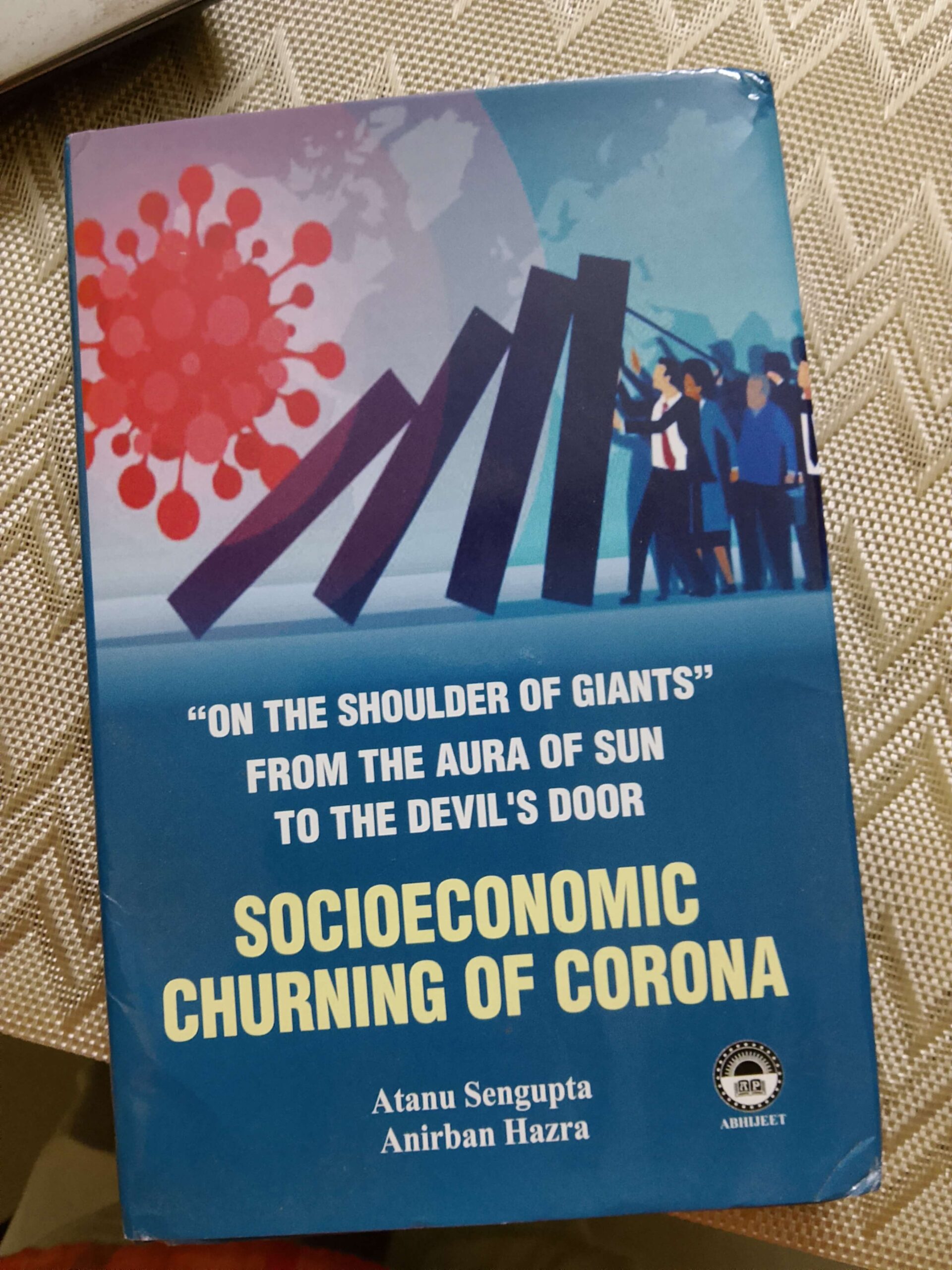
Reviewed by Prof. Bhaskar for DifferentTruths.com, this text evaluates Atanu Sengupta and Anirban Hazra’s book on Covid-19’s macroeconomic impact.

AI Summary
- Malthusian Framework: The book analyses COVID-19 through historical economic thought, framing the pandemic as a validation of Malthus’s population theory.
- Geopolitical and Social Impact: It critiques China’s initial lack of transparency and examines India’s aggressive lockdown effects on domestic migrant workers.
- Classical Connections: While praising the robust classical economic citations, the reviewer notes that links between the virus, democracy, and urbanisation remain weak.
The book, Socioeconomic Churning of Corona (On the Shoulder of Giants: From the Aura of Sun to the Devil’s Door), authored by Atanu Sengupta & Anirban Hazra, contains five chapters and a robust References section (p.169-195). The authors posit Covid-19 in the context of the history of economic thought. They dealt critically with classical political economy with a major focus on Malthus. The authors took it for granted that the virus identified as Corona had its origin in China (p. 20). To quote the authors, “The deep instability of the land-man ratio in China has triggered a virus that the social nature of man and its globalisation have led to havoc” (p. 21). Chapter one concludes with the statement, “Whatever it may be, COVID-19 is teaching a lesson – a lesson to live in harmony with nature” (p. 21).
The justification of such a statement is found in the beginning of Chapter Two, where the authors opined, “The world of COVID-19 seems to give legitimacy to the ridiculed population doctrine of Malthus” (p. 23). The rest of this chapter is heavily loaded with ideas cited from Samuelson and Lucas in support of ‘Malthusian Equilibrium’ (p. 26). As reminded by the authors, with respect to technological advancement, “Economy is no longer resource-constrained. Malthus was stigmatised as the prophet of stagnancy. The industrial revolution and technological change removed the barrier of Malthus” (p. 28). The rest of the chapter is loaded with ideas drawn from Malthus, Ricardo, Marx and others to explain the trap model and growth insufficiency model (p. 48); however, here the link of these with COVID-19 is not very clear. The context of India came in terms of urbanisation (p. 64), but it is not clear if the authors intended to link the coronavirus with urbanisation.
Chapter Three dealt with exchange in a broad sense that goes beyond the conventional frontier of economics. The authors quoted here are Adam Smith (pp. 90-91) and Malinowski (p. 90), in addition to market exchange as elaborated by Samuelson and Nordhaus (p. 91). Some ideas and terms have been introduced in this chapter, like power and religion (pp. 94-97), that need more explanation on why and how these are linked with COVID-19. The authors have restarted ideas on exchange with some propositions offered (pp. 98-101). Abruptly, the authors had a strong opinion when they stated, “In the issue of COVID, we also saw China suppressing facts even when she should have been transparent” (p. 104).
Chapter Four dealt with the phrases used by the competent authority in the context of the origin and spread of COVID-19. The authors opined, “The first country from where Covid-19 was reported” was China. “In China, the first cases of mysterious pneumonia were reported from Wuhan on November 17, 2019” (p. 108). The steps taken by China and the hesitant observations of the WHO were cited by authors here (p. 110). The authors did not forget to mention how, at one stage, the impact of COVID-19 had been linked with the minority community (as the carrier) (p. 111). The Government of India also started cautioning about the impact of COVID-19 and enforced measures like “social distancing”, quarantine, lockdown, and the use of sanitation and masks.
This chapter also dealt with the impact of lockdown on migrant workers and casual manual workers (pp. 115-116). The authors cited “job loss” due to the spread of the coronavirus. In this chapter, the authors dealt with major political issues like democracy, quoting from Rousseau and others, which this reviewer finds difficult to link with COVID in India and abroad.
The concluding chapter, that is, Chapter Five, took stock of COVID-19 as understood by the authors as a Malthusian prediction (p. 148). Some of the opinions are difficult to swallow, like the following: “In China, where land is scarce, pressure for food crossed the barrier that nature has provided for millions of years. The result is the COVID-19 virus emanating from the wild and spreading among humans like fire” (p. 149).
This is not the occasion to critically examine Malthusian relevance in the Chinese context, though that would have been historically necessary. In parallel, the authors here juxtaposed the question of democracy, leftist government in West Bengal and examples from Rabindranath Tagore (pp. 150-152) that seem difficult for assimilation in the context of COVID-19.
Overall, the book needs careful perusal at least for a robust citation of classical political economy and the history of economic thought. Since the book has left many questions unanswered or some of those questions were not posed at all, it is expected that a new look by the authors will help us understand the link between COVID-19 and the historical understanding of political economy.
I appreciate the authors for taking the theme to explore.
Cover photo sourced by the reviewer

Prof Bhaskar Majumder superannuated as an Economics professor from GB Pant Social Science Institute, Allahabad. He served as a visiting professor at Central University of Bihar (Patna), Sri Sri University (Cuttack), Banaras Hindu University (BHU), Science College (Calcutta University), and others. He published extensively in 26 reputed journals, authored 11 books, co-edited two, and contributed 38 chapters. He completed 26 research projects funded by the Planning Commission, GoI ministries, ICSSR, the World Bank, NTPC, and Tata Chemicals. An international academic, journal reviewer, and PhD supervisor, he holds degrees from the University of Calcutta. He is our National Editor: Economics and Social Science.


 By
By
 By
By
 By
By
 By
By