

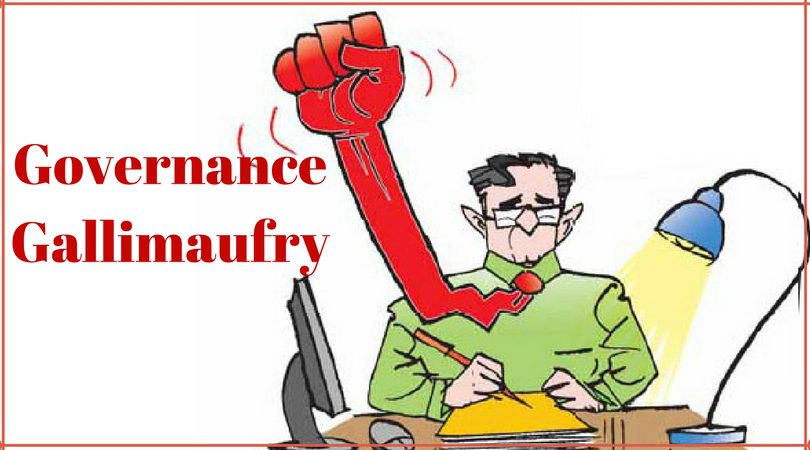
In offices, we are often a wall away from our wall-mates. But each of us seems to be walled within our small selves, seldom helping each other, agonises Hemashri in her weekly column. A Different Truths exclusive.
‘Roommates’ and ‘wallmates’ were common terms among friends in hostels. Roommates were like family members, and so were wall-mates. ‘Wall-mate’ meant someone who lived in the next room, separated by a wall. I was always a local “murga” in college, as I used to commute from home.
At the university, I moved into the hostel to escape the commute from home, which involved changing two buses, and to experience the flavour of hostel life. The words “roommate” and “wall-mate” kept coming to mind.
In my department, my immediate senior was a lady who was my wallmate. She was the only lady officer of the department for eight long years. She seemed to be one of those bored ladies who needed a job to keep herself occupied. She was an active socialite and was a member of several clubs. Kitting and partying were her favourite pastimes. On the first day, after I reported to her, she told me she wanted to leave because she was bored in the same department.
As I started working, I needed to understand the department’s background. To learn issues related to the department, I started reading the old file notes. It was a small yet crucial department, but it was operating somewhat like a post office. Every letter that we received was promptly forwarded either to the group of experts attached to the department or to the partner organisation working in the field. In a very short time, I gained the confidence to handle departmental matters.
In all her notes, my senior forwarded them to the assistant without her input. She had a computer and a costly printer, but I never saw her drafting a letter. Superficially, we were very friendly, and I was determined to forge a bond with her. On two occasions, I went outside the state for official conferences or meetings. I would collect small gifts for her. She used to reciprocate very generously. On my birthday, she gifted me a lovely handloom saree. It was one of the prettiest sarees I had received as a gift.
Then came this big event, where our department was one of the organising departments. To handle the various aspects of this event as instructed, I created new files and coordinated with the relevant stakeholders. Ours was basically a team of four officers, with me at the bottom, rank-wise. During this period, I had to assert myself against one of the bosses, number two in the hierarchy, who was very frequently rude to me for no apparent reason. When the event was just a week away, I suddenly found that boss number two had removed me from the event organiser’s team. A new order was issued. Consequently, I heard from someone reliable that boss number two had told me I was to stay in the office during the two-day event scheduled for Saturday and Sunday. I could make out he was trying to settle a score. My senior lady colleague keeps visiting the venue of the mega event, but not once has she asked me to accompany her. Just a day before the event, the entry passes were issued. I found my pass was missing. No pass was issued to me. I asked the boss number two via SMS but received no reply. In the evening, my husband, who was on duty, asked me to accompany him to see the venue to cheer me up. As I entered the venue, I saw my boss, number two. I rushed to him. Seeing me, he started dialling his mobile. I interrupted. “Sir, I heard you deleted my name from the list of passes.” He told me, “You go and talk to boss number one.” Seeing my predicament, a well-wisher gave me a VIP pass to see the country’s Prime Minister live. I told boss number two, “Actually, I have been given a VIP pass.” He just said, “Then it is fine.” The next day, when all my colleagues saw the Prime Minister’s address on the monitor, I was the only one with the top bosses to see it live.
The same day, there was a dinner for which a card was left in my name. I did not go, though my senior colleague reminded me. The big event came and went, but it made me aware of how much of a goodwill deficit I had to work on.
We were still sitting in adjoining rooms as wall mates. The only difference was that there were fewer jolly talks. The wall separating my wallmate and me was a perceptible barrier.
My wall-mate, the senior lady, used to sit in a spacious air-conditioned room. She had two promotions in the same department. She used to handle the department’s budget and send proposals to it. At the peak of summer, my small chamber became atrociously unhygienic because the only window could not be opened due to heaps of dirt and the resulting mosquito menace. Someone from the department’s Partner Organisation told me that I only needed to send a proposal to the senior lady. He stated that she had been provided with an AC while serving at a rank junior to mine. One day, I approached and explained that my chamber was very hot. She told me in a cold voice that I should approach the concerned department, which we all knew would involve many formalities. Not even once did she show any concern.
After a few days, when I found the heat unbearable, I approached the top boss and requested that he go on a long field visit to all 33 districts of the state. When he asked the reason for it, I told him, “Sir, my chamber is minimal, and it is unbearably hot. It is not fit to be working in.” He asked me, “Why?” I told him, “Sir, I do not have any AC in the room. It is a cramped, congested room. In this scorching heat, it is  atrocious.” He said, “You should have told me earlier. I am sending someone to your room,” said the elderly boss, a father figure. An engineer came, and after three days, an AC was installed. My wallmate peeped into my room and asked for a treat to celebrate the great achievement. We had tea together.
All over the world, women complain about discrimination, prejudice, mental and physical abuse and harassment. I, too, have endured some of these, in a milder form. One thing concerns me deeply – why do we, the women, not feel the pain and suffering of each other?
This phenomenon appears to be a global concern, and various studies and surveys have been conducted on it. Findings are very intriguing. Some say it is ingrained in women’s DNA to be overcompetitive. Some others say it is a behavioural syndrome or deeply psychological and stems from insecurity. What Indira Noory said is worth referring to: “Women do not help women enough in the workplace. We need to recruit a behavioural psychologist to design a programme that addresses why women do not support each other.
The typical saas-bahu stories continue to dominate our TV serials even today. The mother-in-law thinks, “My mother-in-law did all this and that, but I am only doing this much.” This syndrome may thrive due to a chain pattern of pain transmission. A relationship that should have been the most fulfilling, mentoring, supportive, and nourishing influence degenerated into a bondage of distrust that destroyed peace in the homes.
Trying hard may be the only way to prevent transmitting my pain to others. When meanness stones me, I just part ways silently with unuttered goodbyes. Every time the world shrinks, it creates agony deep within.
Yet, the show must go on!
©Hemashri Hazarika
Photos from the Internet
#Workplace #WorkplaceSeparation #WalledMentality #AbuseInWorkplace #GovernanceGallimaufry #DifferentTruths

Hemashri Hazarika is an Officer of the Assam Civil Service since 1997. Her research on Assam Civil Service brought reforms in 2015. A first-class Postgraduate in Economics from Gauhati University, she was awarded JRF/NET by UGC in 1997. Her experience as a bureaucrat has sensitised her to human sufferings. A solutionist by passion, she takes an active interest in issues related to Governance, Development, Women, Children, etc. Reading, Writing, Speaking and Painting are her hobbies.
 By
By
 By
By
 By
By
 By
By