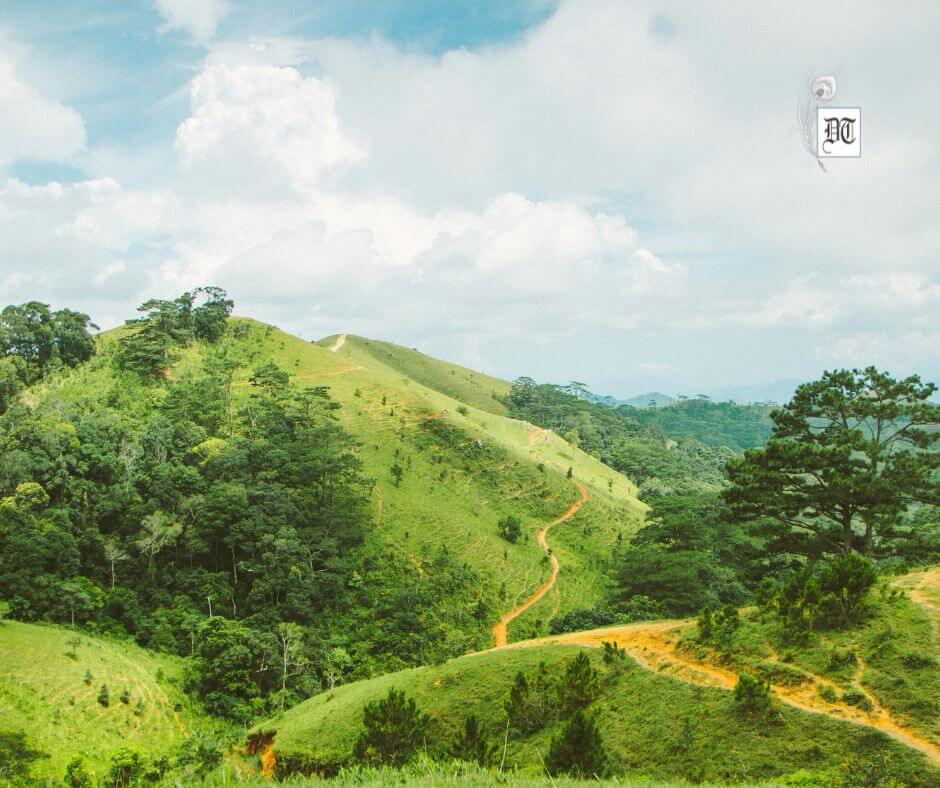
Prof Bhaskar’s critique, for Different Truths, explores the tension between state-driven “development” and the preservation of the Aravalli hillocks, questioning the cost of ecological annihilation.
One of the few phrases that policymakers, as well as economists, have become obsessed with over the past few decades is ‘development’. This phrase mostly bypassed the need of the common people for reasons well understood in the circle concerned with the market, which does not reflect ‘need’. One of the consequences of such an obsession is the government’s decision to demolish hillocks with a height of less than 100 metres in the Aravalli range, which have existed since unrecorded historical times.
The Ministry of Environment, Forest and Climate Change of the Government of India proposed on October 13, 2025, that ‘landforms’ at an elevation of 100 metres or above from the local relief should be considered part of the Aravalli hills. On November 20, 2025, the Supreme Court accepted the 100-metre definition. The Forest Survey of India was tagged in the process. There was, thus, no expertise deficit in decision-making other than that the livelihood viewpoint, including the cultural living of the people around, was ignored. This decision-making is not unnatural because it was the ‘history of development’ – cutting trees and making roads, bulldozing hilltops for roads-cum-landslides, mining and ‘munapha’ (profit), digging the womb of earth and so on. ‘Development’ seems unstoppable once the journey starts.
What happens if all post-puberty women are made flat or if all women are made flat? Will they be machoistic and pro-development, or will it lead to imbalance? Nature has its own plan – man’s arrogance often unplans it and often destroys nature. One major reason is ‘nuisance value’ in man that overpowers sanity – the only mantra becomes ‘development’. The context is the law-abiding annihilation of the hills, or better termed hillocks, on the Aravalli range that worked as cover for climate, land and people in states like Rajasthan and Haryana. Let me be clear on this point.
Nature has a value that is basically non-cardinal, and economics has a value that is because of neoclassical ‘non-satiety’; this non-satiety is basically of the power lobby, specifically of the corporate, fed by the state. The state thinks it is the owner of nature circumscribed by political sovereignty. So, the end of 2025 came to decide the annihilation of all hills or hillocks below the height of 100 metres. The decision of the core state has been sanctioned by the judiciary. This is where the pertinent question comes. Where do the victims stand?
Existence Value and Nuisance Value
I was reminded by one stalwart in economics that nature becomes natural resources, and these resources are meant for transformation. What he had in mind was commodity production that fulfils want. My simple point here is that non-satiety is to be understood at a particular point in time of a privileged few in an economy like India; otherwise, the country would go for annexation and conquest of others’ land to expand the boundary of political sovereignty. It is, of course, a different issue that man is going to search for space on the Moon and Mars. For the time being, let me confine the analytical-geographic boundary to the post-1947 space India has post-1947.
Often, the existence value of the provision of public utility is not understood, for no single individual is paying the price for it. In that sense, no hills or rivers will have existence value, and the domination of ‘nuisance value’ may convert hills into plain land or rivers into deserts. There may be no guarantee that one hillock that stands more than 100 metres in height between two such hillocks of height less than 100 metres will not be demolished once a nature-hater machine starts the operations.
Development Value and Non-development Value
It is readily understood what the market price of cement is, but it is not understood what the price of a hillock is unless converted into boulders and stone chips and then crushed for cement. Economic literature elaborates on the transformation of a hillock into cement while it remains silent on the hillock itself. Not only the scenic value, but also the groundwater recharging, climatic balance, anti-pollution environment and so on are latent in the existence of the range of hillocks. This is where the environmental value of hillocks comes in. It may be that the ‘environmental value’ of nature is not estimated in Gross Domestic Product (GDP).
Whatever is not privately owned belongs to the state, and there lies the stately disorder because, under the wrong idea of ownership, the core state may go for sale or lease out or demolish the hills and hillocks. The hills that surround and protect the area of Rajasthan are many in number over a long range and constitute also common-pool resources (CPR) in western terminology. Actually, these are more than convertible resources – convertible to fulfil the non-satiety of a few corporates or monopolists. Demolition of hillocks may open up the path for mining, which will create health hazards, and all the affected common people cannot be readily relocated to other unknown, unfriendly regions of India or exported abroad as labourers. If media reports are followed, it is reported that the Environment Ministry of the Government of India dismissed any imminent threat to the Aravalli’s ecology and that mining would be permissible in ‘only’ 0.19 per cent of the Aravalli’s total expanse. At least one point is conceded: that mining is permitted post-demolition of the range of hillocks below a height of 100 metres.
Homogeneity of Heights?
Surely, the Centre went for the decision to demolish whatever height is there on earth below 100 meters, following the expert committee that it formed, or the other way round, the Centre got intellectual endorsement of what it decided in advance. So, the decision came to demolish any hillock that is below the height of 100 meters, as if all hills need to be homogeneous in terms of height. It needed to have been understood that Rajasthan’s Aravalli range is not like the transnational Himalayan belt. My idea is that if an intellectual position is far distant from the survival of the common people of the locality and around in a chain reaction, then the intellectual position is to be questioned.
Sharing Common Earth or Sharing GDP?
Earth does not belong to the power elite only – some people are part and parcel of nature, whether or not it is spelt out. GDP refers to economic growth, but it is not development, whether the latter includes what benefits people derive from that development. If these assumptions are accepted, then the question remains how the core state makes draconian rules to convert nature at will, and more surprisingly, the judiciary gives its judicious seal on it.
Sustainability
From the people’s perspective, sustainability stands not only on the non-decreasing inter-temporal material consumption per capita but also on assured fresh air to breathe, clean water bodies, space for animal grazing, a place of prayer and all that. The stakeholders in the system are not only the government and the corporation but also, maybe more so, the local inhabitants, whether or not these inhabitants directly opposed ‘destructive development’. The local inhabitants remain unaware until the final impact of state-corporate actions is felt directly by the probable loss of livelihood and threatened human existence. The outcome is public protests like the one in front of the Udaipur Collector’s office in December 2025 – local people cannot move far beyond the frontier of their district to register protests. Public protests are not the consequences; these are in the processes.
Picture design by Anumita Roy

Prof Bhaskar Majumder superannuated as an Economics professor from GB Pant Social Science Institute, Allahabad. He served as a visiting professor at Central University of Bihar (Patna), Sri Sri University (Cuttack), Banaras Hindu University (BHU), Science College (Calcutta University), and others. He published extensively in 26 reputed journals, authored 11 books, co-edited two, and contributed 38 chapters. He completed 26 research projects funded by the Planning Commission, GoI ministries, ICSSR, the World Bank, NTPC, and Tata Chemicals. An international academic, journal reviewer, and PhD supervisor, he holds degrees from the University of Calcutta. He is our National Editor: Economics and Social Science.



 By
By