

Joydev examines how Gen Z forced the Modi government to its knees in DifferentTruths.com, shattering an invincible political myth.
AI Summary
- Union Education Minister Dharmendra Pradhan resigned following intense Gen Z-led protests over NEET-UG irregularities and police clashes at Jantar Mantar.
- The 36-day movement shattered the BJP’s 12-year invincible image, breaking narrative control and prompting unprecedented internal party rifts.
- Despite the resignation, the Cockroach Janata Party demands official compensation and the withdrawal of all protest-related FIRs.
For the last 12 years, there was a myth with this government that the BJP were ‘invincible’! Now, the myth seems to have been shattered. How did a generation that is known to make reels on Instagram, the Gen Zs, manage to bring a government that did not give in to the demands of farmers, Muslims, CAA-NRC, etc. to its knees?
On July 26, 2026, at 2:18 PM… the Union Education Minister Dharmendra Pradhan resigned from his post by uploading a letter on X. This marks the second resignation during the Modi government’s 12-year tenure. The first was that of MJ Akbar in 2018, who stepped down amidst the #MeToo movement. However, Pradhan’s resignation represents a victory for the generation once derisively labelled as ‘cockroaches’. The Modi government did not yield to the farmers’ protest, did not waver in the face of opposition to the CAA-NRC, and remained unmoved by criticism regarding its COVID management; yet, Gen Z forced this very government to its knees, claiming the BJP administration’s biggest defeat.
The 36-day protest and struggle leading up to the resignation
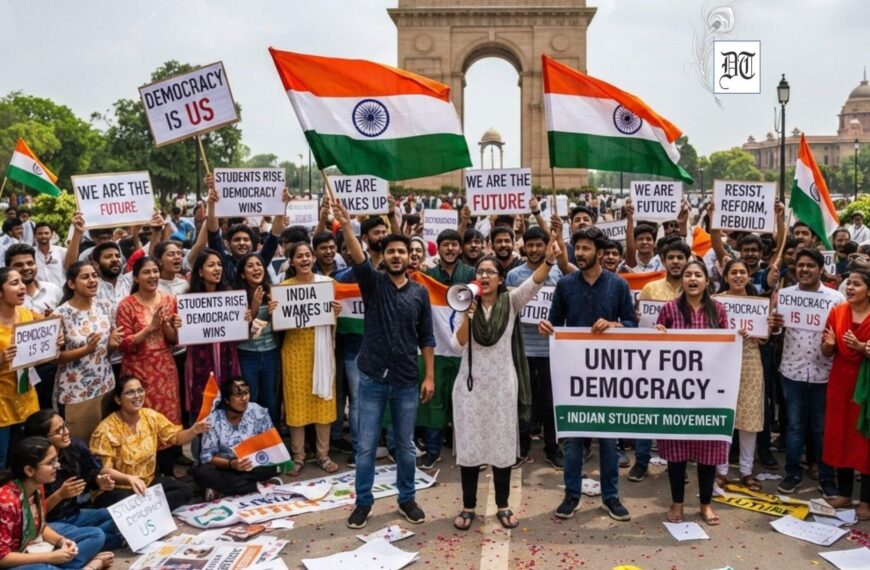
The Cockroach Janata Party (CJP) launched a peaceful protest at Jantar Mantar on June 20, 2026. Their demand was clear: the resignation of Dharmendra Pradhan. Social activist Sonam Wangchuk joined the protest on June 28 and sat in an indefinite hunger strike. On May 13, the CJP announced that the protesters would march to Parliament on July 20. Students from all over the country started reaching the protest site from July 20. To curb the inflow of youth to the protest site, some metro stations were shut down on the 20th. On the day of the protest march to Parliament, Delhi Police came with all its force to stop the march. Police fired tear gas and resorted to a lathi charge, and the RAF allegedly used pellet guns and nail-studded batons to control the crowd. However, by the end of the day, the outcome was the opposite of what was intended; the movement, which had initially been confined to the NEET issue, transformed into an anti-establishment protest with a large number of youths joining the protest.
On July 24, talks took place between the CJP and the government at the Constitution Club. The CJP stated unequivocally that the demand for Dharmendra Pradhan’s resignation was non-negotiable. The Modi government sought time until July 25. The government believed it could hold its ground, but by the afternoon of July 25, everything changed with Pradhan’s resignation.
What is the story behind the Education Minister’s resignation?
Dharmendra Pradhan announced his resignation by posting a letter on X. He submitted his resignation to Prime Minister Narendra Modi. In the letter, Pradhan stated that the incidents surrounding the NEET-UG exam had caused him deep anguish. Addressing the students, he acknowledged his responsibility following the irregularities in the NEET-UG exam held on May 3.
Following this, the CJP hailed the resignation as a major victory. A video of Abhijit Deepke was posted on X.
Prime Minister Modi’s Reaction
Prime Minister Narendra Modi posted his first selfie-style video addressing the widespread student protests and exam paper leaks late at night on Thursday, July 23, 2026. He subsequently released a follow-up video the next day, on Friday, July 24, 2026, to thank the youth for their positive responses. In his late-night videos, PM Modi directly addressed the student community, expressing that the paper leak scandal was painful and promising strict government action, including fast-track courts and tougher punishments.
Why is this resignation regarded as the BJP’s biggest defeat?
Dharmendra Pradhan’s resignation signifies more than just the departure of a minister. For the BJP, it marks its biggest political setback since 2014. It represents a historic turning point for a party that had spent a decade watching the opposition, farmers, and institutions yield to its will, only to find itself forced to concede defeat to Gen Z. According to experts, there are four major reasons for this:
1. Loss of the BJP’s greatest weapon: ‘Narrative Control’
The BJP’s greatest strength lay in its ability to gauge the public mood on the ground and control the narrative accordingly. This time, however, the party lost that crucial edge. Initially, the BJP dismissed the backlash against the NEET paper leak as merely an ‘online joke’. Yet, that ‘joke’ evolved into a cause, dubbed the ‘Gen Z movement’ by the world. Sonam Wangchuk’s hunger strike had failed to make headlines initially; however, the moment the government wrapped him in a white sheet and rushed him to the hospital, the video went viral across platforms from Instagram to X.
They were challenged by a generation that could not be dismissed as ‘Sikh separatists’, ‘Muslim terrorists’, or ‘Pakistani infiltrators’. These were their own children—Hindu, middle-class, and educated.
2. ‘We do not bow to pressure’: The collapse of a 12-year-old image
Over the past 12 years, the BJP had cultivated a tough image, projecting that no amount of street protests could force a minister to resign. Whether it was the 2020 farmers’ protest, the opposition to the CAA, or the handling of the 2021 COVID crisis, the government never bowed. The BJP’s stance was that ‘our ministers do not have to resign’, which was once said by Union Minister of Defence Rajnath Singh at a press conference. That stance crumbled on July 26. In essence, a government that championed itself as ‘strong’ and ‘unwavering’ was forced to bow before Gen Z.
3. Political pressure from 20 MPs: An ‘upheaval’ within the party
This resignation was not merely the result of external pressure; it also reflects a political upheaval within the BJP. Dharmendra Pradhan was not just a minister but the ‘leader’ of the BJP’s 20 MPs from Odisha. When pressure for his resignation mounted, he sent a clear signal on July 22 by posting a photo with these 20 MPs, effectively saying, “Try to remove me and see what happens.” This is significant because the NDA holds only 298 seats in the Lok Sabha (26 above the majority mark of 272). The resignation reveals that rifts have emerged even within the inner corridors of the BJP.
4. RSS signals a ‘surrender’
The RSS forms the foundation of the BJP. In 12 years, the RSS had never signalled that the BJP should give in to pressure from a mass movement, but this time, it did. Speaking at an event on July 25, RSS chief Mohan Bhagwat said that the younger generation today is more inclined to ask questions, making it essential for parents and elders to engage with them. At the same time, he voiced concern over the shrinking space for conversations within families.
“The new generation asks questions. We have to explain the reasoning to them. We need to give them a lot of affection. We need to spend time with them. We need to communicate with them,” Bhagwat said.
According to political analysts, this was a direct signal to the government: do not clash with Gen Z; give in instead. Had the RSS not said this, the movement might well have escalated to demanding a ‘regime change. Bhagwat himself repudiated the BJP’s stance—a major humiliation for the party. This marks the first time the RSS has had to signal to its own government to ‘surrender’. It represents a significant rift in the BJP-RSS relationship.
Two CJP demands remain; what happens next?
Despite Dharmendra Pradhan’s resignation, the CJP has determined its next course of action. The CJP has announced a nationwide candlelight march for 6 PM on July 26. The aim is to show solidarity with the victims of police brutality during the ‘Sansad Chalo’ (March to Parliament) protest on July 20. The CJP states, “We stand in solidarity with the peaceful protesters who were subjected to a lathi-charge by the police and against whom FIRs were registered on July 20.”
While the government has agreed in principle to provide compensation, no formal announcement has been made yet; the CJP wants this implemented as soon as possible. Meanwhile, the Delhi Police have registered 13 FIRs in connection with the July 20 protest. The CJP demands that all these FIRs be withdrawn and that no such action be taken in the future. Although the government has given its consent in principle, the process of withdrawing the FIRs could take time.
CJP spokesperson Ashutosh Ranka has clearly stated, “The agitation will continue until we receive a written assurance regarding compensation and the withdrawal of the FIRs.”
Picture design by Anumita Roy

Joydev Majumdar completed his Masters in Journalism and Mass Communication from Central University of Orissa and is working as Technology News Writer in CIO Review Magazine. He has also worked with a UK based company as Language Consultant on a project. He completed his graduation from the Steel City, Rourkela. Settled in Bangalore, he loves travelling, reading books, interacting, writing poems and stories. Has passion for photography and writes for theatre too.
 By
By
 By
By

 By
By