
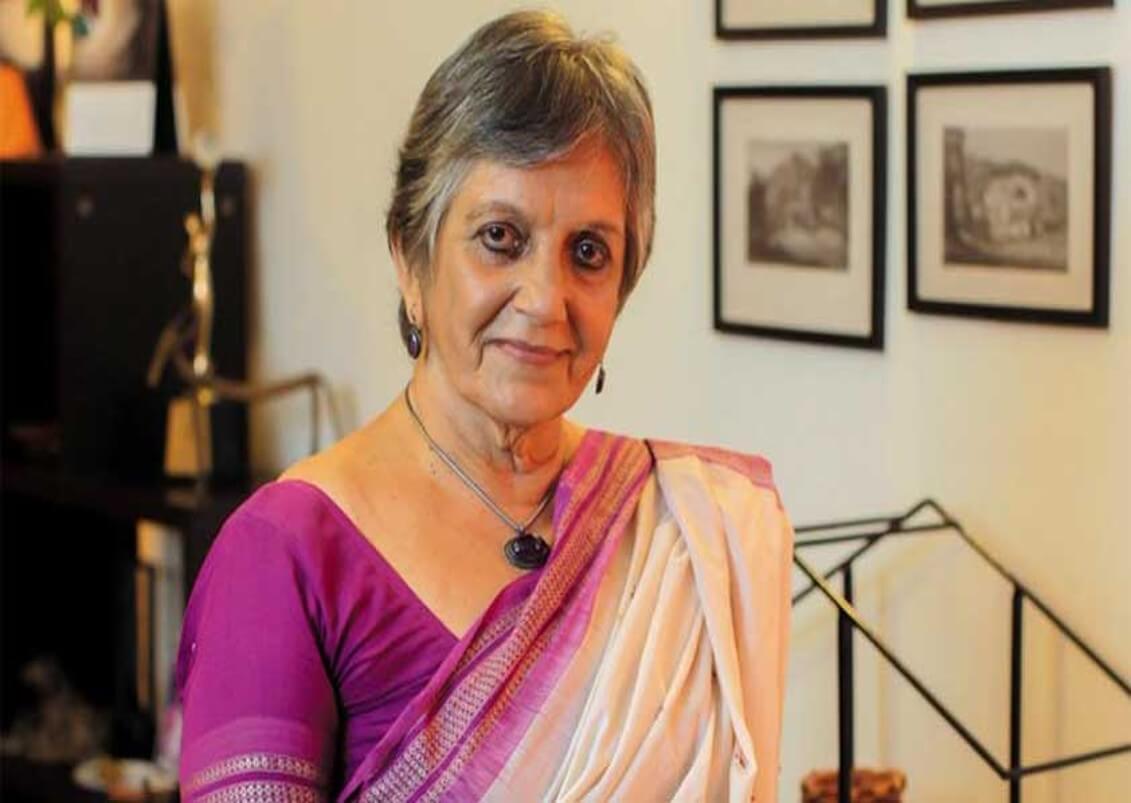
Dr Rositta explores the inspiring journey of legal luminary Flavia Agnes and her transformative work at DifferentTruths.com for women’s rights.
AI Summary
- A Journey of Resilience: Flavia Agnes transitioned from surviving years of domestic abuse to becoming a pioneering feminist lawyer, academic, and author.
- Empowering Through Majlis: She co-founded ‘Majlis’, a resource centre providing legal, social, and emotional support to over 100,000 marginalised women and rape survivors.
- Visionary Advocacy: Agnes’s work bridges theory and praxis, focusing on intersectional feminism, legal literacy, and the challenge of systemic, communal, and patriarchal injustice.
My adoration for Flavia Agnes had commenced much before I actually met her. Firebrand feminist, legal luminary, relentless social activist and brilliant writer – I was equally excited and nervous about interviewing the woman who had always been described in glowing terms.
I still remember that warm, cloudy morning in June 2019, when I first walked into her office at ‘Majlis’ on the Kalina Market Road in Santa Cruz East, Mumbai. I could see the modest yet attractive office abuzz with activity. A host of young women legal professionals scurried around the highly utilitarian office space, busy with client meetings, phone calls and browsing through computer screens, all in the process of offering legal assistance and a fair chance at justice to hundreds of aggrieved women. Amid all of them, like the sun at the centre of the solar system, Flavia Agnes moved from one desk to another. A calm and graceful figure, her grit and beauty shining through her grey hair and soft wrinkles, Flavia Agnes gently guided the team of feisty women at Majlis – lawyers and activists dedicated to harnessing every letter of the law to empower thousands of women. Flavia Agnes welcomed me in her usual warm and down-to-earth manner that could put anyone at ease. I could immediately sense that, beneath the delicate exterior, lay a no-nonsense attitude, a backbone of pure steel, and an unfathomable ocean of raw courage. Truly, having a heart-to-heart talk with one of the torchbearers of the glorious Indian feminist movement was a rare privilege. The story of Flavia Agnes’ life unfolded before my eyes, a story I believe should be shared repeatedly with every generation of women across the length and breadth of India.
The Rise of the Phoenix
Women’s rights lawyer, feminist social activist, scholar, author, professor – Flavia Agnes wears several hats and makes it all look so effortless. But her story is that of a human being rising like a phoenix from the darkest depths of personal suffering to become a torchbearer for human rights.
Born on November 30, 1947 (the year India won independence), in Mumbai, to a humble middle-class Christian family, Flavia Agnes grew up in her native Mangalore, Karnataka, while her parents worked in Aden. After completing her schooling and her guardian aunt’s death in Mangalore, she joined her parents and siblings in Aden and began working as a typist to support her family. Soon thereafter, she lost her father. After three years, due to the political turmoil in Aden, the family had to return to Mangalore. She was 20 years old at the time, and there was pressure on her to get married. She obeyed her mother and entered into an arranged marriage in 1967, subsequently giving birth to a son and two daughters. The marriage was a disaster right from the start, with Agnes suffering physical and mental abuse, domestic violence and cruelty for thirteen years.
In 1980, she came across the newly emerging women’s movement, where she found a supportive group of women, and with their help, she was able to leave her violent marriage. She went through a long and bitter legal battle for custody and maintenance of her daughters. While she succeeded in getting custody, her husband chose to resign from a well-paying job as a company secretary rather than pay maintenance to her and the minor daughters. She struggled to educate her children, secure a roof over her head, and complete her own education so she could build a career for herself. In the process, she found her calling. Through the anti-rape movement and organisations like Forum Against Oppression of Women, Flavia Agnes bloomed into a fiery feminist. Initially, in 1981, she, along with a few feminist friends, started an initiative called the Women’s Centre, where women facing problems could come to seek emotional and social support. But after a few years, due to internal differences, she left the Women’s Centre. Beginning her work in the women’s movement in Mumbai, she soon became a national and global voice.
A Mission Called Majlis
Flavia Agnes is among those who begin after everything seems to have ended. Having studied only up to SSC in a Kannada-medium school, she resumed her education during the bitter legal battle. There was no looking back as she earned one laurel after another – a BA in sociology, an LLB and an LLM from Mumbai University, and an MPhil in law from the National Law School of India, Bengaluru. Her MPhil thesis – ‘Law and Gender Inequality’ – was published by Oxford University Press.
Her own suffering propelled her to offer legal succour to victims of domestic and sexual violence. Since 1988, she has been practising as a women’s rights lawyer in the Mumbai High Court. Apart from serving on state and central government commissions and agencies related to women’s and children’s rights, she has been a faculty member at National Law School, NALSAR and several other reputed legal universities in India.
Flavia’s mission to offer legal assistance to women culminated in the famous ‘Majlis’. In 1990, Flavia Agnes and her friend Madhushree Datta co-founded ‘Majlis’ (meaning ‘association’ in Arabic), a legal and cultural resource centre. While the cultural centre provided a platform for multifaceted cultural productions, the legal centre aimed to ensure legal representation for women through an all-women team of lawyers and social workers. After some years, the cultural centre closed down. Majlis Legal Centre has been at the forefront of mass movements and legal battles for Indian women’s social, matrimonial, economic and political rights.
Its first cell, ‘Rahat’, provides legal aid, mental health support and socio-economic assistance to victims of sexual violence, especially rape survivors. Majlis has, to date, rendered legal services to over 100,000 women. Agnes and her team do not provide mere legal aid. Their focus is on raising awareness of rights, providing physical, emotional, and financial support for survivors, and supporting long-term rehabilitation and rebuilding of women’s lives. They also work to intensively train officers from the police and other law enforcement agencies about dealing sensitively with and protecting the rights of women and children. As Agnes has pointed out in an earlier interview, “In addition to acquainting officers with the nuances of the laws, our training teaches them how to interrogate women and children sensitively; what guidelines to follow when escorting perpetrators and survivors for medical examinations; how to prepare detailed case reports to secure government aid; and so on” (https://idronline.org/features/social-justice/interview-with-flavia-agnes-womens-rights-lawyer-and-feminist-legal-scholar/).
The impact of Majlis extends far beyond what one can imagine. The Majlis tagline declares, ‘Transforming victims into survivors.’ The vision statement is crystal clear: “An ecosystem that provides empathetic justice and rehabilitation to every woman and child victim of sexual and domestic violence” (http://www.majlislaw.com). To quote from the Majlis website, “Majlis is a team of women lawyers, social workers, academicians and activists who work for the protection and promotion of women and children’s rights through legal representation, advocacy and training. As age and health issues surfaced, Flavia Agnes successfully transferred the mantle of leading Majlis to her daughter, Advocate Audrey D’mello, who had volunteered with Majlis for over a decade and finally became its director. She is building upon her mother’s legacy and has succeeded in taking Majlis to even greater heights (http://www.majlislaw.com).
The second cell, ‘Flavia Agnes Centre for Learning’, initiated by the current director, offers multi-disciplinary learning and legal education to women who have suffered domestic violence and familial/societal oppression/exploitation in various ways. It is dedicated to mentoring young women lawyers and to “advancing knowledge, promoting research and fostering discourse on the intersection of gender, law and society” (http://www.majlislaw.com).
The War Against Religious Fundamentalism
Majlis had its baptism of fire during the 1992-1993 Hindu-Muslim riots. For the first time in Bombay, as Agnes recalled during our conversation, religious identities became all-important and were either blatantly flaunted or brutally attacked. She was pressurised to change the Arabic-sounding name of Majlis by mobs who had no idea of its real meaning or relevance, only because it sounded “Muslim”. But she withstood the pressure. For the first time in her life, she understood what it meant to be targeted as a woman from one minority community working for the uplift of women from another minority community. Those who were Muslims or spoke Urdu or were associated with the minority community in any manner were targeted and had to prove their loyalty to India or their patriotism repeatedly. This motivated her to oppose the alienation and ghettoisation of innocent Muslims strongly and to work even more fervently for the empowerment of Muslim women, crushed both by society and state.
Flavia Agnes recalled every detail of those dark days with precision and objectivity. During 1992-1993, women from the slums, cutting across religious barriers, fought for peace. They were shocked when police opened fire on women in Behrampada during a peaceful agitation. A lot of such confrontations between police and women took place, especially in Dharavi and Dahisar, but went unreported. Ironically, large numbers of uneducated Muslim slum women, along with Parsi and Christian women, and a few affluent Muslim women, came out to fight for peace. They were exceptionally bold in their testimonies and vented their fury against the system, castigating the attempt to ruin the country through the Hindu-Muslim divide. Never having been bothered by the mandir or the masjid in Ayodhya, they rued that a non-issue was being used to incite the masses while they were tackling bigger issues of food, clothing, shelter, and a secure future for their children. As Agnes shared, these women were exceptionally resilient; they had lost children and husbands, and they were injured. Still, they fought, gave statements, and took on men’s roles. Launching a fiery battle with the state to protect the rights of Muslim women, Flavia Agnes, along with Madhushree Datta, produced the famous Filmfare Award-winning documentary ‘I Live in Behrampada’ to highlight the plight of slum-dwelling Muslim women during the riots. Muslim women, already crushed under social and domestic pressure, had no avenues to approach and no faith in a system hostile to their community. She gradually learnt to deal with their complex identities and crises.
Seek Justice
Majlis made significant contributions during the dark days of 1992-93. In the social space, they intervened to seek justice for the Muslim women who were victims of the riots in the slums of Behrampada. They made it clear to government agencies that political issues and women’s issues could not be separated. They also collaborated with various youth organisations and NGOs to provide aid, relief, and rehabilitation, as well as some form of compensation, to these women. In the legal sphere, they gathered and documented testimonies from women in relief camps. Agnes herself deposed before Justice Srikrishna Commission. The Commission strongly condemned the atrocities against the minorities and came out with landmark policies in its report.
Unfortunately, as Agnes observed, these policies aimed at upholding the rights of the most vulnerable sections of society were never implemented. 1992-93 marked an indelible shift in Indian society. There was no closure or justice for the victims of 1992-93. There was no psychological counselling for the traumatised women and children. The children suffered due to gaps in education and were haunted by fear throughout their lives. The grim harvest would be reaped in Gujarat in 2002.
Following the traditions of the majority Hindu culture, Manglorean Christian women had adopted the trend of wearing a bindi and a mangalsutra as a fashion statement. One day, when she had to pass through a riot-affected street, her friends insisted that she wear a bindi. It was astonishing that an ornamental adornment such as a bindi could act as a lifeline during the dark days of the riots. That day, she listened to her friends’ ardent pleas; however, she decided it would be the last day she would wear a bindi. When religious identities were at their horrific heights, wearing a bindi seemed to be a cultural appropriation of the majoritarian religious/cultural symbol. In rejecting this, she found it relevant to establish her Christian minority status and also join hands with women of other minority communities.
Through her articles and public demonstrations, she openly opposed polarising forces, thus inspiring a new generation of committed social activists. There was a fundamental shift in her perspective. She realised that secularism and women’s empowerment were closely intertwined. Women across religious communities faced similar issues. She became the mouthpiece of women’s anger and activism directed against the communal state, society and politicians in particular. To quote Flavia Agnes, “I changed, Mumbai changed, the political discourse changed… but the women were amazingly resilient.”
Violence Against Women
Violence against women had been the pivotal point around which campaigns for women’s empowerment had been rallied during the eighties. The movement had not interrogated issues of religious identity or majority-minority politics. So, when it had to confront the riots, which were based on cultural and religious identity, there was confusion and turmoil. This was the case with other progressive movements, such as the trade union movement. Consequently, several progressive movements split along religious lines. An incisive essay that she wrote around this time helped to shed light on this development in the women’s movement and became very popular. (“Redefining the Agenda of the Women’s Movement within a Secular Framework” in Tanika Sarkar and Urvashi Butalia’s Women and the Hindu Right (ed.), 1995, Kali for Women, pp. 136-157.)
Agnes continued her relief, rehabilitation and peace work during the Gujarat riots of 2002, when gruesome violence was unleashed upon women’s bodies. She organised young social workers to serve in the field. She also deposed before the Nanavati Commission. Gujarat was totally different from Bombay. The sexual atrocities and rapes were unprecedented. Women were too ashamed to report what they had undergone, and gathering testimonies was almost impossible. “Truth spoke through the lips of dead women,” as she put it. Young teenage girls would talk about the gruesome rapes and murders of their sisters, but would never admit that they themselves had been raped. This is because rape is a crime that would cause her to be stigmatised within her own community.
The seeds for all this violence had been sown during 1992-93. What worries Flavia Agnes greatly is the constant attempt by fundamentalist forces to hijack women’s movements. Upper-caste Hindu women have always been persuaded to support anti-Muslim riots. Hindu women, crushed domestically, found honour and liberation in new roles as rioters and religious protectors. In Gujarat, the narrative was that since Hindu women’s breasts had been chopped off, Muslim women had to be violated through gruesome sexual violence. On the other hand, Muslim women in purdah came out to fight the police and rioters, to shield their sons, fathers, brothers and husbands.
According to Agnes, the Uniform Civil Code is a mirage that will be misused again for religion-based politics. The false rhetoric is polarising Indian society, claiming that Hindu laws are right-wing and Muslim laws are anti-women. Through her writings, Agnes tried to pierce this myth. (See her article, “Liberating Hindu Women” in the Economic and Political Weekly, March 7, 2015, Vol. L, No. 10, pp. 14-17.) The talk of liberating Muslim women is a clever political ploy and remains only on paper. The Muslim women’s movement itself has been divided from within by their own orthodox religious leaders and unscrupulous politicians.
To top it all off, Flavia Agnes shared that class conflicts have been cleverly engineered and replaced with identity conflicts. This results in one poor man fighting another based on caste and religion. Sadly, the educated liberals are out of touch with the masses and with vernacular mass media. The masses, brainwashed by right-wing politicians, fall prey to the delusions of capitalist globalisation and the quest for a strong religious identity. In this context, Agnes confessed that she felt depressed. She did not wish to write any more. However, Agnes still believed that women had great potential and a significant role to play in communal harmony. But they needed a radical mindset change. Compared with lower-class women, middle-class women needed considerable persuasion to enter the social sphere. Working with them demanded loads of patience, and Flavia Agnes and her team have continued the lonely battle despite all odds.
The Voice of the Voiceless
Flavia Agnes has produced a vast and brilliant corpus of publications on women’s rights, family laws, marriage laws, gender justice, minority rights and feminist jurisprudence. The most powerful of her books is her first and shortest one, narrated in the simplest style – her 100-page autobiography, My Story…Our Story: Of Rebuilding Broken Lives (1984). In straightforward terms, devoid of sentimentality, Agnes speaks of her struggles to liberate herself and rescue her children from an abusive marriage. She highlights the immense suffering caused to women by domestic abuse and violence that has either been hidden or normalised by Indian society. Exposing the massive failures of social and legal systems in rendering justice to suffering women and chronicling her endless determination to fight for herself and millions of her suffering sisters, this book has been a source of solace and inspiration to scores of women. It is on the syllabi of educational institutions worldwide. Some of her major books include ‘Law and Gender Inequality: The Politics of Women’s Rights in India’ (2001); ‘Family Law Volume 1: Family Laws and Constitutional Claims’ (2011); ‘Family Law Volume 2: Marriage, Divorce, and Matrimonial Litigation’ (2012); and ‘Women and Law in India’ (2016) – all published by Oxford University Press. Her myriad articles in prominent journals, magazines and newspapers across India and abroad have shaped feminist legal scholarship, theory and practice in India.
Perhaps the greatest contribution of Flavia Agnes has been to critique the Indian legal system from a feminist perspective. She has also won landmark cases that strengthened women’s rights through her litigation work in the Bombay High Court and the Family Court. Honoured with several national, international and lifetime achievement awards, Flavia Agnes has been vociferous in demanding honour and a normal social life for rape victims and in spearheading campaigns that prioritise deep-rooted pro-women social change over superficial measures such as death sentences. She highlights how the law affects Indian women differently across various socio-cultural, religious, caste, class, political and other contexts. She has always exposed the gap between laws on paper and laws in reality, showing how women lack access to justice and how laws seem to be gender-neutral but are actually applied in favour of the patriarchal system. She is also very conscious of the fact that women in minority communities face a two-edged sword: exploitation from both within their community and at the hands of the majority who pretend to liberate them from religious codes and personal laws. Much before mainstream feminists spoke of intersectional feminism, Flavia Agnes had declared that there is no ‘one size fits all’ formula for liberating Indian women and that Indian feminism must consider women’s religion, race, caste, marital status, economic status and access to education if it wants to empower women truly. She also exposed the deeply political and exploitative family structures wherein women suffer from patriarchal domination, domestic violence and unfair enforcement of divorce, custodial and maintenance laws. Through her own experience and through her autobiography, she was successful in changing the popular slogan of the women’s movement from the culture-specific term “dowry violence” to the more far-reaching and universal term “domestic violence”. She was among the first to investigate domestic violence and abuse not as a personal problem but as a structural and systemic issue that reflected the failure of social, legal, political and economic systems. Above all, Flavia Agnes’ life has been dedicated towards making the Indian legal system accessible to Indian women.
Castigating elite legal systems that exclude women, Agnes has been committed to promoting legal literacy among women, offering them effective and affordable legal aid, and creating networks that focus on counselling and supporting victims and survivors.
In Retrospect
It has been a very long journey, and Flavia Agnes knows exactly how much Indian feminism has achieved and how much more needs to be done. While legislative reforms have been enacted about the protection of women from domestic violence and ensuring their rights within their matrimonial homes, there is a huge lack of legal professionals willing to work for marginalised women. To me, Flavia Agnes seemed deeply worried about the fact that, today, women and other vulnerable sections of society have to fight an additional and extremely formidable enemy: the vicious political climate in the country that has created deep hatred and mistrust amongst communities, further endangering the lives of women and children.
Why Flavia Agnes Will Never Give Up
Flavia Agnes exemplifies a rare combination of grassroots activism, deep scholarship, and incisive, enlightening, and visionary perspectives. She and her team thus constitute a vital bridge between theory and praxis. Though she reflects the sadness that most of the nation’s stalwarts share about the degeneration of values in public life, she continues to inspire and mentor scores of brilliant and committed young legal professionals, especially young lady lawyers, through her scholarly contributions to academia, her grassroots activism, and, above all, her uniquely empathetic approach rooted in deep personal suffering. She is a rare unifying force, bringing decades of experience and hard-won wisdom to fresh perspectives that reflect the challenges and aspirations of the younger generation.
Flavia Agnes’s feminism is deeply humanistic, empathetic, and practical. She has always been in favour of gradual grassroots reforms instead of a top-down approach. While state interventions often favour vested political interests and legal reforms remain only on paper, it is only a conscious community that can make a real difference to women. Humane legal practices that protect pluralism and minority rights and respect cultural differences; emotional support systems that create time and space for women to heal and to rebuild their shattered lives; and above all, socio-cultural and educational awareness among all sections of society, particularly younger generations – these are the only concrete solutions, according to Agnes.
As my interview, or rather, my long conversation, with her drew to a close, something within me had changed forever. Here was a woman who had achieved so much but was filled with the desire to do so much more. More than her laurels, what mattered to her was how she could empower her fellow Indian women in the present and enrich their future in a very practical way. Yes, she did confess that she often felt like giving up. But Flavia Agnes is a hardcore realist. The story of her life and of her struggles is known to the whole world. Flavia Agnes cannot give up. She must, and she will continue the great mission of her life. There is too much at stake, and too many women look up to her for light amid the deepest darkness. She has paid too high a price to ensure that the law serves the most vulnerable. And we will not allow this to go to waste. The hint of light in her diamond-like eyes told me this, much louder than her words.
Photo sourced by the author

Dr Rositta Joseph Valiyamattam is a Fellow of the Royal Society of Arts, U.K., a scholar, poet, author and educator with over two decades of experience in higher education. A former visiting research fellow at the University of Edinburgh, she is currently a consultant editor with Orient BlackSwan India and an English faculty member at prestigious institutions in Hyderabad. With a gold medal and doctorate from Andhra University, she has published widely and champions literature, youth engagement, translation, theatre, oratory, and socially committed education.


 By
By
 By
By
 By
By
 By
By
A truly inspiring story and a superb writeup. A tribute to Ms. Agnes and also a tribute to India, where freedom of speech and democratic action admit caste, gender and creed for redress of grievances.
Thank you very much