
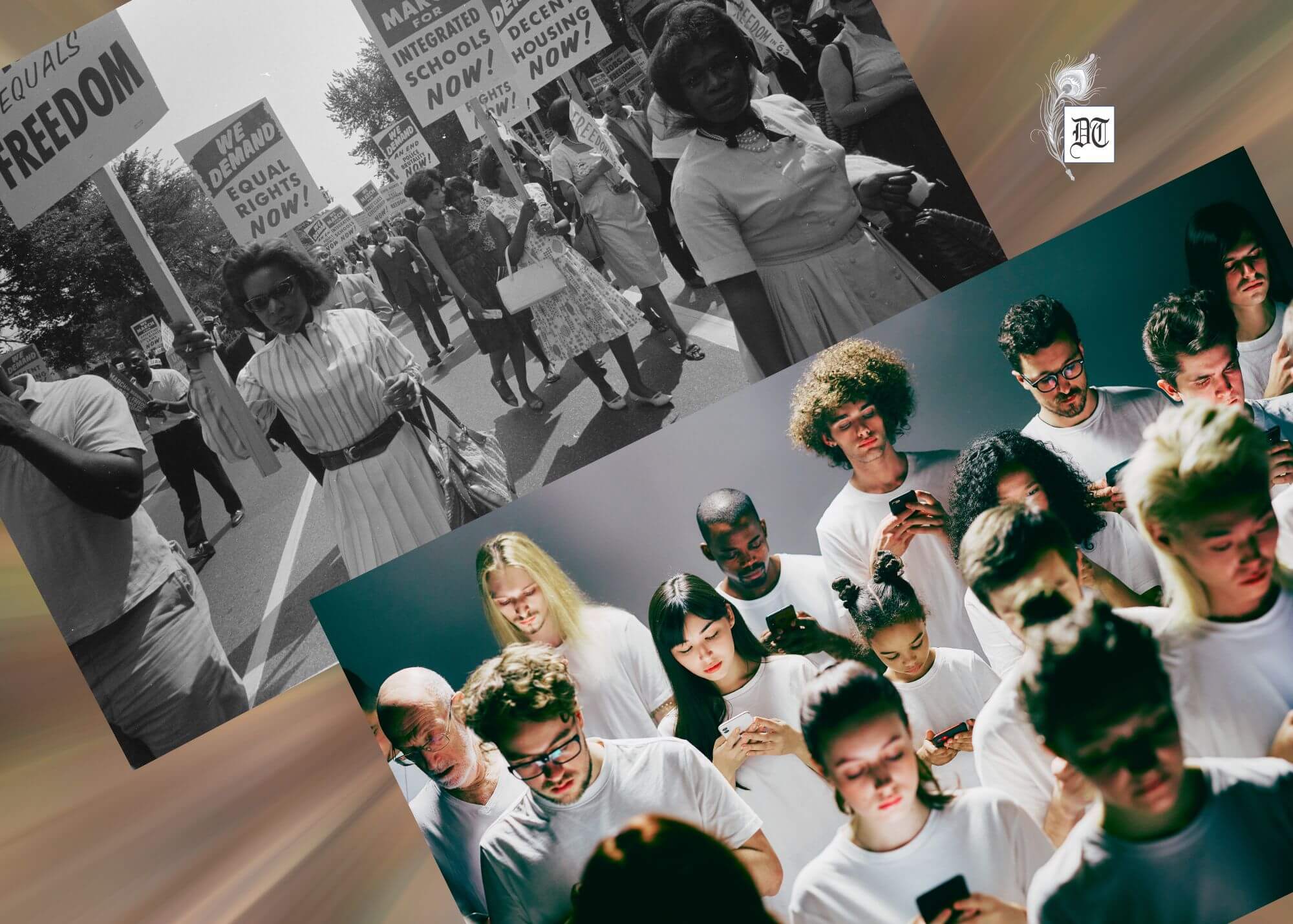
Mowmita champions social activism, examining its evolution from historical grassroots struggles to the boundary-pushing power of digital movements for DifferentTruths.com.

AI Summary
- Historical Foundation: Social activism has deeply rooted origins stretching from early labour and global anti-colonial movements to mid-twentieth-century civil rights struggles.
- Digital Transformation: The modern era has shifted collective action online, utilising digital platforms to rapidly amplify intersectional issues globally.
- Future Horizons: Youth-led initiatives utilise advanced tech-driven strategies to combat burning systemic issues, shaping a newly connected global solidarity.
Social activism has always been the heartbeat of societies in transition. It is the collective refusal to accept injustice, the insistence that the world can be reshaped by ordinary people who dare to speak out. Across centuries, activism has taken many forms—marches, strikes, petitions, and digital campaigns—but its essence remains the same: a belief in the possibility of change. To understand activism is to understand the story of humanity’s struggle for dignity, equality, and justice.
The roots of activism stretch deep into history. In the industrial age, workers faced gruelling conditions in factories, often labouring for twelve or more hours a day with little pay and no protection. Out of this hardship grew the labour movement, a wave of strikes and union-building that demanded fair wages and safer workplaces. These were not abstract debates but life-and-death struggles. Workers risked their jobs, their livelihoods, and sometimes their lives to stand together. Their activism reshaped economies, giving rise to labour rights that today seem fundamental but were once radical demands.
The Civil Rights Movement in the US
In the mid-twentieth century, the civil rights movement in the United States became a defining chapter in activism’s story. It was not simply about ending segregation; it was about reclaiming dignity and asserting equality in a society built on racial injustice. Leaders like Martin Luther King Jr and Rosa Parks became symbols, but the movement was sustained by countless unnamed individuals who marched, sat in, and endured violence to demand change. Their activism forced governments to confront systemic racism and pass landmark legislation. It proved that collective action could dismantle centuries of oppression.
Activism has never been confined to one region. Across Asia, Africa, and Latin America, anti-colonial struggles mobilised millions against imperial powers. These movements were often met with brutal repression, yet they succeeded in reshaping the global order, giving birth to new nations and identities. Activism in these contexts was not just political; it was existential, a fight for self-determination and cultural survival. The courage of those who resisted colonial rule reminds us that activism is often about reclaiming the very right to exist freely.
New Forms of Activism
As the twenty-first century unfolded, activism evolved into new forms. Grassroots organising remained vital, but digital activism transformed how movements spread. A single online post could ignite global conversations. The MeToo movement exposed the pervasive nature of sexual harassment, while Black Lives Matter forced societies to confront systemic racism in policing and justice systems. These movements showed how digital platforms could amplify voices that were once silenced, connecting local struggles to global audiences in ways unimaginable a generation ago.
Environmental activism surged as well, driven largely by young people. Greta Thunberg’s solitary protest outside the Swedish parliament grew into a worldwide movement, Fridays for Future, mobilising millions to demand urgent climate action. This generation sees activism not as an option but as a responsibility, recognising that their future depends on the choices made today. Their activism is not only about policy but also about survival, a reminder that the stakes of activism can be nothing less than the fate of the planet.
Intersectional activism has become increasingly important, acknowledging that struggles are interconnected. A woman of colour may face both racial and gender discrimination, and activism that ignores this overlap risks leaving people behind. Intersectionality ensures that movements are inclusive, recognising the complexity of human identity and oppression. It is a reminder that activism must evolve to reflect the realities of those it seeks to serve.
Activism Challenges Power Structures
Activism matters because it challenges power structures, raises awareness, and builds solidarity. It is the reason why women vote, why workers have rights, and why marginalised communities can demand recognition. Without activism, progress stalls. It is the heartbeat of democracy, the mechanism through which societies evolve. Yet activism is not without challenges. Governments often repress activists, using censorship, imprisonment, or violence to silence dissent. Corporations sometimes co-opt movements, adopting slogans for marketing without committing to real change. Activists themselves face burnout, as the emotional and physical toll of constant struggle can be overwhelming. These challenges remind us that activism is not easy—it is a long, often exhausting journey.
The digital revolution has made activism more visible but also more complicated. Social media allows movements to spread rapidly, but it also creates risks. Misinformation can distort causes, and performative gestures without real commitment—sometimes called slacktivism—can dilute genuine efforts. Surveillance is another concern, as governments monitor online activity to suppress dissent. Despite these risks, digital activism remains a powerful tool, democratising access to information and mobilisation.
Global case studies illustrate activism’s diversity. The Arab Spring showed how digital platforms could fuel uprisings, reshaping Middle Eastern politics. The Hong Kong protests combined street demonstrations with digital tools to resist authoritarianism. In India, farmers staged one of the largest protests in history, demanding economic justice and drawing international attention. Each of these movements reflects the adaptability of activism, its ability to evolve with context and technology.
Future of Activism
Looking ahead, the future of activism lies in youth-led movements, tech-driven strategies, and global solidarity. Young people are increasingly at the forefront, especially in climate activism and identity politics. Technology will continue to shape activism, with blockchain, artificial intelligence, and decentralised networks offering new ways to organise and resist. Global solidarity will become more important, as interconnected struggles across borders demand collective responses. Activism will not be confined to national boundaries but will increasingly reflect the global nature of challenges like climate change, inequality, and human rights.
Social activism is not just protest—it is imagination. It is the belief that the world can be different, that injustice is not inevitable, and that change is possible. It is the courage to stand up, the persistence to keep going, and the solidarity to fight together. From historical struggles to digital revolutions, activism has proven that ordinary people can reshape the world. Its future lies in the hands of younger generations, who are more connected, more diverse, and more determined than ever.
Picture design by Anumita Roy

Mowmita Sur is an educationist, author, poet, and content writer. She has received many accolades for her writings at both the national and international levels. She was awarded as one of the best 50 poets of India. Many of her published book gets effusive praise and good reviews. Her books are captivating, incredibly well-researched and evoke strong emotions. She writes witty fiction, non-fiction, horror and mysteries. Her characters are clever and fearless like her.


 By
By
 By
By
 By
By
 By
By