
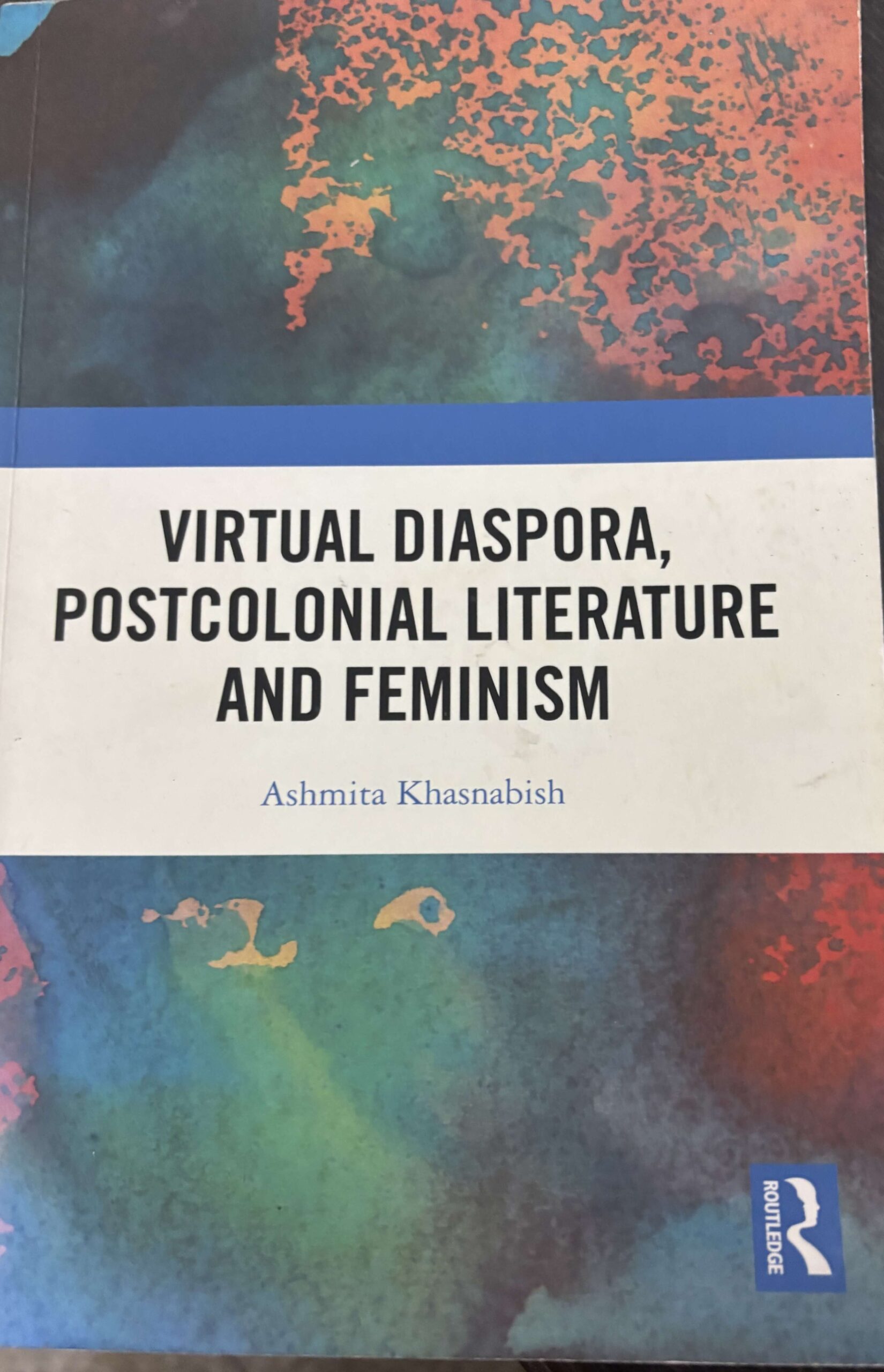
Prof Sanjukta reviews Ashmita Khasnabish’s “Virtual Diaspora” on DifferentTruths.com, exploring the philosophical depths of migration and literature.

Key Takeaways
- Philosophical Reframing: Khasnabish reimagines the “Virtual Diaspora” through ontology and epistemology rather than standard geopolitical definitions, using Deleuze and Guattari’s concept of virtualities.
- Diverse Literary Analysis: The book weaves together diverse texts—from Tagore and Kalidasa to Jhumpa Lahiri and Hélène Cixous—highlighting universal themes of longing, precarity, and belonging.
- Aesthetic Sublimation: The author argues that spiritual consciousness and aesthetic transcendence offer powerful mechanisms for healing immigrant identity crises and trauma.
The generalised global definition of virtual diaspora refers to the online communities and networks formed by people living outside their ancestral or original homeland, utilising digital platforms to maintain connections, share cultural identity, and engage in transnational activities. It’s essentially the digital extension of a real-world diaspora, allowing individuals to connect with others from their homeland and diaspora communities across geographical boundaries. “Virtual diaspora” (and related terms like “virtual diasporas”) is widely credited to scholar and media professor Karim H. Karim in his early 2000s work, particularly his influential 2003 book, The Media of Diaspora.
It is precisely this definition that trained philosopher Ashmita Khasnabish chooses to elide, and in contrast, she ushers in the curves of epistemology and ontology in her reading of Indian colonial and postcolonial texts. Through scholarly interpretations of the writings of Rabindranath Tagore, Pamela Sue Anderson, Jhumpa Lahiri, JM Coetzee, Kunal Basu and Hélène Cixous that address the philosophical concepts of immanence and transcendence, she uses the theoretical premises argued in Deleuze and Guattari’s book A Thousand Plateaus, where they state, “a life consists only of virtuals… It is made up of virtualities, events, and singularities. What we call virtual is not something that lacks reality but something that is engaged in a process of actualisation following the line that gives it its particular reality.”
Khasnabish delves into the relatability of colonial writers such as Rabindranath Tagore and Sri Aurobindo, referring to their discourse about spiritual unification of the Universe fractured by the politics of Othering, xenophobia and single exclusivity. ‘Khasnabish’ refers to Tagore’s Religion of Man and Sri Aurobindo’s The Ideal of Human Unity in order to foreground their non-dogmatic and liberal worldview that is often transcendent rather than topical. It is necessary to read these referred texts without being oblivious to the fact that both Tagore’s and Aurobindo’s visions and missions crystallised in British India when the freedom movement was reaching its peak, and the devastation of the First World War only seemed to enforce the need to start a Second World War. This alternative philosophical discourse does not pay much credence to Marxist existentialism and the concepts of being and nothingness as adumbrated by Jean Paul Sartre, Toni Morrison, Salman Rushdie and Mahasweta Devi, among others. Instead, Khasnabish brings together the sameness and differences in the arguments of Tagore, Sri Aurobindo and Pascale Casanova’s debates in her book The World Republic of Letters, first published in 2004.
The author’s selection of diverse texts for close readings represents diverse contexts and many literary genres, ranging from poetry and novels to essays and short stories. In the concluding line of the Introduction, her purposive paradigm is outlined: “My vision of ‘virtual diaspora’ will emerge in a globalism where politics may play a role, but that role will be a positive one by aestheticising its outcome.”
The richness of each chapter that explores the divergences and convergences within the intersectional networks of the actual world is very well represented, as Khasnabish finds Pamela Sue Anderson’s articles, “Towards a New Philosophical Imaginary” and “A Thoughtful Love of Life: a spiritual Turn in Philosophy of Religion”, of greater significance than Judith Butler’s theorisation of gender.
Furthermore, she underscores the cultural stress of diasporic writers, the process of loss, memory, belonging, cultural identity and nomadism. As the concepts of transnationalism are not germane to the sense of alienation from the place of origin that migration inevitably brings about, the author does not prioritise the conceptual parameters of transnationalism.
Though it is often stated that her readings of literary texts primarily focus on the subjective and aesthetic features of the text, the author herself acknowledges that contextualisation and historicisation are essential for a holistic understanding of any text, literary or non-literary.
The problematics of intersectionality and de-territorialisation are cross-referenced as Khasnabish reads Jhumpa Lahiri’s memoir Other Words and JM Coetzee’s Youth and emphasises the vulnerabilities, precarity and resistance that physical migration unleashes. This inevitably leads to social, psychological and cultural ruptures that cannot be erased, as memory plasticity disrupts the apparent complacency that material comfort often creates, exposing the scars that will not heal.
The fifth chapter of the book Virtual Diaspora opens up exciting windows of literary perception by comparing the pining of the Japanese wife, the romantic exchange of much-awaited letters in Kunal Basu’s short story The Japanese Wife, with Kalidasa’s Meghdutam, The Cloud Messenger. The juxtaposition of a 21st-century English short story written by a member of the Indian diaspora and the classical magnum opus Meghdutam (The Cloud Messenger) by Kalidasa, written in the 5th century CE, identifies waves of communication that create a microcosm far from the madding crowd’s ignoble strife, as Thomas Grey had phrased it so succinctly.
The two other riveting essays that problematise the virtual and the real, the existential reality and the intangible subjective reality, are a fascinating re-reading of Tagore’s timeless short story, Kabuliwallah, where the cognitive faculties and affect seem embattled in order to find a median space of healing. The final essay that uses Hélène Cixous’s memoir So Close foregrounds the often-cited diasporic dilemma of being regarded as a valid passport holder who, in all circumstances, is essentially a resident alien. The tug-of-war between homeland and heartland for first-, second-, and third-generation immigrants often leads to depression and other mental health issues. So, in conclusion to her intriguing essays on virtual diaspora, Khasnabish sums up her findings by stating that all the authors cited by her “are mourning some form of separation from their countries and continuously striving to offer solace or a survival mechanism. Khasnabish is of the view that aesthetic sublimation and transcendence, rather than historicisation and cultural politics, have within themselves the power of resolving identity crisis and identity fragmentation through spiritual consciousness.
Ashmita Khasnabish’s thought-provoking essays included in Virtual Diaspora about the identity problematics of the immigrant individual will be of immense benefit to students, research scholars, and faculty members of cultural studies, feminist studies, and literary studies.
Cover photo sourced by the reviewer

Dr Sanjukta Dasgupta is a poet, short story writer, critic, and translator. She was a General Council of Sahitya Akademi, New Delhi, member and the Convenor English Advisory Board Sahitya Akademi, New Delhi. She is the President of the Intercultural Poetry and Performance Library, Kolkata and has twenty-six published books. Her poems have been translated into German, Serbian, Bengali, Hindi, Punjabi, Kashmiri, and Tamil.


 By
By
 By
By
 By
By