

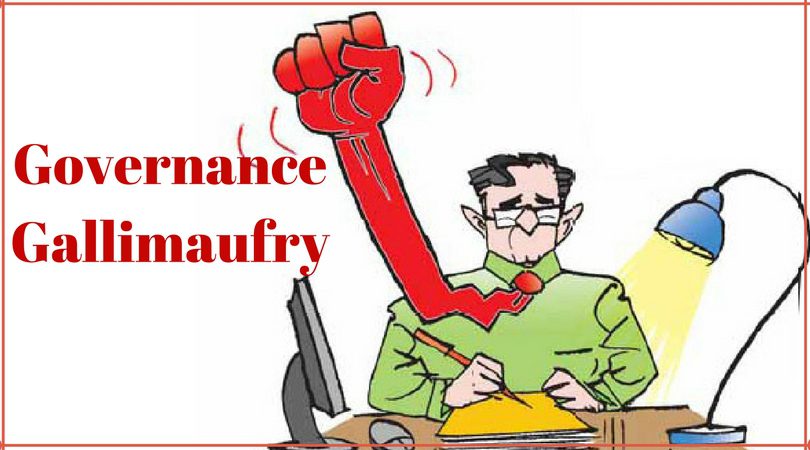
Hemashri shares her experience of training as a bureaucrat, which enriched her. She shares her experience in the weekly column, exclusively for Different Truths.
I was nominated for training on ‘Good Governance’ at the Management Development Institute (MDI), Gurgaon. I started preparation for the two-week stay in Gurgaon in 2011. Just two days before departure, a responsible officer called to inform me that, since I was the junior-most officer, my name had been deleted. I would be accommodated later. I was disheartened. But the next day, I received another call from the same officer, informing me that I was to report for a briefing before the training. My nomination was confirmed. Though upset initially, I was pleased.
The group of 24 officers landed in MDI Gurgaon. A senior lady officer of the Government of India  delivered an inspiring lecture. Our course director was a dynamic retired IAS officer, Dr Arun Kumar Rath. To date, it’s the most engaging training of my life.
Dr Rath had retired as the Secretary, Education, Government of India. He was a remarkably active academician. His classes were interesting and highly interactive. Prof. Pritam Singh delivered highly illuminating speeches that demonstrated his profound knowledge of the scriptures. One day, he said, “Big people grow big by making others big, while small people grow big by making others small.” This adage has deeply instilled itself in my psyche. I have really seen this happening in my life over and over again. I have seen some pompous souls projecting their pathetic self-inadequacy onto others, making them feel small. A few people respect everyone, but many more do not.
In one of his lectures, Prof. Singh asked us, “How many of you have experienced this in life: that people whom you help do not even look back at you? This made you crib, ‘I helped him or her so much, but see what he or she did to me.'” Many people, including me, raised their hands. The professor added, “Now think of your life and of the people who helped you. Tell me honestly, how many of you have been able to help those people who actually contributed a lot to you or helped you generously? Have you been able to return their help or support?” This time, there was total silence. The wise professor smiled and said, “Do not worry! This time, there was total silence. The wise professor smiled and said, “Do not worry! The truth is a harsh fact. Actually, we most often cannot help those who help us. Instead, we help a different set of people, who may not be able to help us in return. Yet we only talk about those we helped, and we rarely think about those who helped us. Gratitude decides the altitude in life.” Prof. Singh delivered several lectures, each full of wisdom.
One of his lectures began, “Have you nourished your constituency? Suppose you feel seriously sick and need help at midnight. How many faces will come to your mind who you may disturb at such odd, unearthly hours? How many people – friends or relatives – do you have in your kitty that you may disturb at any odd times? That is your constituency. The bigger the constituency, the more empowered you are to handle the challenges that life throws at you. Until this day, his words keep ringing in my mind! What a wonderful way to raise awareness about some basic life management techniques.
There was this interesting session on the Lotus Principle of leadership by a learned management guru. To introduce the topic, he asked all trainees to list the various uses of the lotus, and we began listing them. The lotus is used to worship Hindu gods and goddesses. Some parts of the lotus are eaten, and the list goes on. The  professor said that lotuses remain pure despite the muddy surface on which they grow. Leaders are like a lotus. Only those who endure extreme adversity and can overcome all hurdles make the finest of leaders.
Towards the end of the training session, we had a very unconventional one. One day, the instructor divided 24 officers into groups of two and asked us to roam around the campus for half an hour to get to know each other. He asked all of us to share our life stories and instructed us to gather in the same place after half an hour. When we all reported back, the instructor asked us to come to the podium and asked each member of the two teams what they had to say. What we appreciated about the person on the podium was that, eventually, each one had to be sincere and genuine.
I teamed up with a senior lady, a fearless officer. We both spoke about what we liked about each other. The trainer said it was an “appreciative learning approach.” In real life, we are often very vocal when we dislike something about someone, and we tend to discuss it a lot. When we like or appreciate something about a person, we keep it secret, and often it is much later, or maybe only after the person is no longer with us, that we confess what we liked about them. Is it not a strange culture? He asked.
We were taught interesting, hands-on team-building exercises. Often, in real life, we focus on self-promotion and miss the bigger picture, failing to bring out the best in each other as a team. That may be one of the reasons for poor team performance.
Towards the end of the training, we were supposed to make presentations on assigned topics. The group was divided into four teams. A team with relatively younger members took me as a teammate, but they did not discuss the topic. On several occasions, I asked that we start the project. One day, a male member of the team told me that I need not worry about it; he would do it for the team. The topic, ‘Public-Private Partnership’, was very intriguing, and as an economics student, I was keen to participate. However, the senior, who thought he knew everything, dismissed it as an irrelevant topic and chose another instead. He said in clear terms that I have nothing to do, and he will only decide and make the presentation. I told him directly that I will not be a silent member of the presentation team. Further, I told him that since they did not want me, I was leaving the group to work where I was needed. I joined the group of senior officers who needed someone comfortable with working on the computer. On the day of the presentation, we were the second group, and our topic was civil services reforms and prospects. The team that had declared me an unproductive member prepared a detailed presentation that exceeded the time limit. Due to the guest speaker’s early arrival, they had to wrap up within three minutes, and, obviously, they could not remould the presentation at such short notice. Although I was amused to see their condition, I pretended otherwise.
We had to assess our professors, and I gave generous feedback to most of them, including Dr Rath. After nearly six years, I one day received a call from this dynamic professor, who was visiting our city. I called on him and had lunch with his team, who were mentoring the state’s first private university.
This training provided me with great insight into some golden rules of life, management, and teamwork, as well as into the teachings of a guru, Dr Rath.
©Hemashri Hazarika
Photos from the Internet
#Learning #Management #Teamwork #Guru #Professor #GovernanceTraining #DynamicProfessor #GovernanceGallimaufry #DifferentTruths

Hemashri Hazarika is an Officer of the Assam Civil Service since 1997. Her research on Assam Civil Service brought reforms in 2015. A first-class Postgraduate in Economics from Gauhati University, she was awarded JRF/NET by UGC in 1997. Her experience as a bureaucrat has sensitised her to human sufferings. A solutionist by passion, she takes an active interest in issues related to Governance, Development, Women, Children, etc. Reading, Writing, Speaking and Painting are her hobbies.
 By
By
 By
By
 By
By
 By
By