
Our Editor-in-Chief, Arindam, at DifferentTruths.com explores how internal dissent within the Election Commission exposes cracks in India’s democratic machinery.
Key Takeaways
- Institutional Rift: Two Election Commissioners formally recorded fourteen objections against unilateral decisions made without their knowledge between late 2025 and mid-2026.
- Digital Control: Controversial software changes, unauthorised Form 6 modifications, and centralised IT management threatened transparent voter registration and appellate oversight.
- Collegial Breakdown: Legal statutes and historical Supreme Court rulings mandate a majority-based consensus, challenging the unreviewable executive supremacy of the Chief Election Commissioner.
On Rajpath, democracy rarely collapses with tanks. It frays in file notes, in software fields that appear on a portal without a rule amendment, and in the quiet arithmetic of a three-member constitutional body where two members keep writing ‘unauthorised’ and the machine keeps running.
When the opposition parties raised the cry of “Vote Chor”, the establishment took it as the defeated’s alibi. But the paper trail inside did not support that defensive posture. By September 23, 2026, an investigation by The Indian Express, reported by Ritika Chopra, found that Election Commissioners Sukhbir Singh Sandhu and Vivek Joshi had formally recorded their objections at least fourteen times to decisions and orders that they said were taken in the name of the Election Commission without their knowledge over a period of about ten months (between November 2025 and August 2026).
Four of those objections were filed in one day. The public reaction was that all decisions, including the SIR (Special Intensive Revision), were unanimous and backed by all three members, the Commission said, via sources. Sandhu and Joshi did not publicly respond. All that is left is the paper trail, as reported.
1. Fourteen Notes and a Self-Glorifying Committee
The report says the objections went beyond seating plans or trips abroad. The objections targeted the electoral process itself, addressing voter registration, name management, and control of the digital systems ECINet and ERONet that maintain constituency lists.
The most obvious flashpoint was Form 6, the clearest to date. It is the prescribed application form under the Registration of Electors Rules, 1960, for a citizen to get himself enrolled. In May 2026, a proposal was made to add a declaration in the SIR asking whether the applicant, or a parent or grandparent, was on the electoral roll of the “last SIR”. “A SIR direction under Section 21(3) of the Representation of the People Act, 1950, cannot modify Form 6 unless the Union Government modifies the Rules,” noted Vivek Joshi on May 16. “It was an extraordinary one-off measure,” said the SIR, “and a sentence in a guideline could not change a statutory form. Sukhbir Singh Sandhu accepted the amended version on May 19. But the Commission posted the amended version on its website. Even if not formally designated “mandatory”, applicants would need to answer the new field for a complete submission. The Indian Express reported the change in July. On 13 August, Sandhu sent a letter to the Deputy Election Commissioner and Director General (IT), with a copy to the Chief Election Commissioner and Joshi. The “unauthorised/illegal changes in Form-6 in the portal” were not removed. “They should be removed immediately so that young and would-be first-time voters can register as voters as per law, without any harassment. That question was still open at the time of the investigation’s publication.
The second thread was the control of the digital spine. Field officers reported throttling or restructuring of access to ERONet and ECINet. Sandhu said on 14 August that the Commission’s IT division had no statutory powers to disempower the quasi-judicial Electoral Registration Officers. Joshi pointed to what he termed a slow centralisation of the electoral roll database in Delhi. The two Commissioners each wrote to the Cabinet Secretary individually to complain that changes to the allocation of work had removed a layer of oversight over the IT systems that held the rolls and had departed from institutional practice. They also used their combined authority to resist any unilateral reallocation of responsibilities under the 2023 Act.
West Bengal asked a sharper question. A large number of the voluminous appeals pending before tribunals were for deletion of voters, which judicial officers reported as about 16.10 lakh. Sandhu sought to know on record who had been given authority to file those appeals “on behalf of ECI” and by whom, as neither he nor Joshi had been informed. It is not a clerical question when two members of a three-member constitutional body ask who authorised litigation in its name.
The Commission is no longer a seamless referee when two of the three Commissioners keep a running ledger of formal dissent to protect the record—and themselves, by implication. It is a contentious institution.
2. First Among Equals Is Not a Licence to Rule Alone
As the internal rupture became public, political defenders of Chief Election Commissioner Gyanesh Kumar fell back on the phrase primus inter pares. Protocol precedence is real. But not substantive superiority.
In TN Seshan, Chief Election Commissioner of India v. Union of India (1995), a five-judge Constitution Bench rejected the argument that the CEC was superior to the other Commissioners in administration and operations. Each Commissioner has an equal vote. The Chief Election Commissioner and Other Election Commissioners (Appointment, Conditions of Service and Term of Office) Act, 2023, Section 10: Business to be transacted unanimously as far as possible; where opinions differ, by majority. Three is more than half of two. The statute requires the three to reach consensus on how to apportion the work. The metamorphosis of “first among equals” into an unreviewable executive supremacy results in an office which is unrecognisable in the Constitution and the 2023 Act.
Former Chief Election Commissioner SY Quraishi made the institutional point without frills in The Indian Express on the same day: the Election Commission is not another name for its chairman. The controversy is no longer just about whether the SIR was wise or if the reported record is correct. It is now a question of whether the Commission remains a collegial constitutional body.
3. Choice of Referees
The political investment in the current architecture is not a mystery. In Anoop Baranwal v. Union of India (2023), the Supreme Court ruled that a panel consisting of the Prime Minister, the Leader of the Opposition, and the Chief Justice of India shall appoint the Election Commissioners. Parliament reacted by enacting the 2023 Act, which retained the Prime Minister and the Leader of the Opposition and replaced the Chief Justice with a Union Cabinet Minister nominated by the Prime Minister.
The executive effectively guaranteed a 2-to-1 majority on the selection committee. Under this framework, Gyanesh Kumar, a 1988-batch Kerala-cadre IAS officer who had served in senior central roles including those related to the Article 370 process and the Ram Janmabhoomi trust, was appointed and took charge as CEC in February 2025. The executive designs the selection panel. The appointee’s defence is not mere institutional loyalty. It is a defence of design.
3. “Logical Discrepancy”: The Algorithm That Avoided Accountability
The SIR was launched in June 2025 in Bihar and subsequently rolled out across states and union territories. Secondary reporting puts the scale of deletions across the national exercise at around thirteen crore names—figures contested in the political argument and still being tested in courts. The exercise was most visible in West Bengal. Draft and final rolls were heavily trimmed. The work of exclusion and adjudication used categories such as Absent, Shifted, Deceased, Duplicate (ASDD), “unmapped” voters (who could not link to the 2002 baseline), and “logical discrepancy”.
The most original work was done by the bureaucratic phrase “logical discrepancy”. The software cross-referenced the current entries against digitised legacy rolls, many of which dated back to the early 2000s.
The flags covered differences in parents’ names, age gaps between an elector and a parent outside a prescribed band, age gaps with grandparents and cases where more than six electors were linked to one ancestor. West Bengal had crores of logical discrepancy counts at the start, which were then whittled down after re-verification. Then came adjudication and tribunal processes. The court has heard that notices in Delhi and elsewhere seemed to be machine-generated in large numbers. The Supreme Court has directed the Commission to specify the category and the mode of notice.
It’s the classic semantic trick. Disparity is a contradiction. It’s ‘logical’ and gives software a patina of science. The human fallout is even older. The burden of proof of entitlement lies with the elector, a migrant, a rural worker, or a first-time registrant, against a baseline compiled decades ago by Booth Level Officers in conditions no algorithm remembers. ” Article 326 does not envisage disqualification on the ground of being ‘flagged by cross-match software’. In the 1960 Rules, Rules 21A and 26 still require inquiry, notice, and a quasi-judicial order to strike a name off. Mass automated sorting is not a substitute for that process; it subverts it.
4. The Constitutional Tool Box Is Not Bare
Petitioners need not make law. A franchise under Article 326 is not merely an act of executive benevolence. The bar on manifest arbitrariness under Article 14, as developed in Shayara Bano and other cases, applies to state action that is either capricious or lacks an adequate determining principle. This is especially true when the citizen’s grievance stems from the state’s own historical data-entry errors. Audi alteram partem still requires a hearing before a civil consequence of this order. The process is liable to be challenged as ultra vires where Form 6 has been amended without amending the 1960 Rules. Where directions on Form 6 or IT allocation have been issued contrary to the written position of two Commissioners, Section 10 of the 2023 Act provides the argument that such unilateral action lacked the statutory mode of decision-making. Writs under Articles 32 and 226 – certiorari against deletions without process, mandamus to compel collegial decision-making – are still available. If the internal notes are admitted in evidence, they show a breakdown in the process, not just politics.
The Judgement
The Republic of India is founded on the simple faith that the ballot box is harder to capture than a ministry. Slogans like ‘Vote Chor’ are just partisanship. Fourteen formal objections filed by two sitting Election Commissioners, copied to the Chief Election Commissioner, regarding Form 6, deletions, restorations, appeals in the name of the Commission and custody of the digital rolls cannot be dismissed. The paper trail must be weighed against the Election Commission’s insistence that the final decisions were unanimous. They cannot both be true.
The Chief Election Commissioner is no autocrat. He is one vote of a three-member body, bound by majority when unanimity fails and by statute in the division of work. If software can surreptitiously thin the rolls, if a statutory form can be rewritten by portal design, and if two Commissioners have to write to the Cabinet Secretary to preserve oversight of the very systems that hold the franchise, then elections are free only as spectacle and fair only as a claim.
The mutiny was off the street. It lay in the files of Nirvachan Sadan. Here is where the republic must look before the next ballot is cast, before the next voter learns that the algorithm had already decided.
Sources and References
1. The Indian Express (Ritika Chopra), 23 September 2026: ’14 times in 10 months, two Election Commissioners raise objections on record to poll panel steps’; related exclusives on Form 6, IT centralisation and Cabinet Secretary letters.
2. SY Quraishi, “Election Commission is not another name for its Chairman,” The Indian Express, 23 September 2026.
3. Scroll.in, The Wire, The Hindu, Hindustan Times, Times of India, The Quint, Business Standard, NDTV, Economic Times. Same-day and follow-up coverage of the objections, ECI sources’ response of ‘unanimous decisions’, and political reactions. 23 September 2026.
4. TN Seshan, Chief Election Commissioner of India v. Union of India, (1995) 4 SCC 611, 632.
5. Anoop Baranwal v. Union of India, (2023) 6 SCC 161.
6. The Chief Election Commissioner and Other Election Commissioners (Appointment, Conditions of Service and Term of Office) Act, 2023 (Act No. 49 of 2023). Section 10.
7. Representation of the People Act, 1950, s. 21(3); Rules for Registration of Electors, 1960 (Forms and Rules 21A, 26).
8. Constitution of India, Articles 14, 32, 226, 324, 326.
9. “The Hindu and related coverage of West Bengal and Bihar SIR, ‘logical discrepancy’, ASDD, unmapped electors and tribunal restoration rates, 2025–2026.”
10. Supreme Court hearing on Delhi SIR notices and ‘logical discrepancy’, September 2026 (as reported).
A Constitutional Body Under Strain
An institution’s strength is measured by the consensus on which it rests. “Once the internal parity dissolves into one-sided executive fiat, the constitutional balance is dangerously tilted.”
1. The Trigger
The immediate trigger is an investigative expose that highlights friction within Nirvachan Sadan. Reports said that Election Commissioners Sukhbir Singh Sandhu and Vivek Joshi had voiced their dissent on several occasions in the past ten months. The sticking points: key administrative actions including changes to Form 6, additions and deletions to the voter roll and increased centralisation of the electoral database, allegedly initiated and communicated under the aegis of the “Full Commission” without its formal concurrence or review.
2. Motion for Contempt
Advocate Brajesh Singh has moved the Attorney General for statutory sanction to approach the Supreme Court under Section 15(1)(b) of the Contempt of Courts Act, 1971. The legal crux hinges on:
• The Principle of Primus Inter Pares: The petition, relying on a landmark precedent (T.N. Seshan v. Union of India), argues that the CEC is “first among equals” – not an independent superior authority with the power to supersede fellow commissioners.
• Binding Precedent and Article 141: Presentation of administrative directives issued in the guise of unanimous decisions as a wilful subversion of the jurisprudence of the apex court governing multi-member bodies so as to bypass institutional consensus.
• Institutional integrity: The Supreme Court, under Anoop Baranwal, reiterated that an autonomous and transparent election machinery is vital to the basic structure of the Constitution. Unilateral actions on voter lists and access to the system threaten to undermine that mandate.
3. The Counter and the Context
It has consistently denied charges of factionalism, saying the disagreements in the records were normal deliberations and consultations during the drafting process. But the timing raises the stakes for judicial scrutiny. The development comes as the Supreme Court delivered a split verdict on referring the 2023 Election Commission Appointment Act, which altered the composition of the selection panel, to a Constitution Bench.
The immediate procedural hurdle is whether the Attorney General gives the nod. But the development is an unprecedented escalation in institutional accountability from the poll body.
Arindam Roy
The Heat on Nirvachan Sadan
48-Hour Ultimatum, ‘Jantar Mantar 2.0’: Street Politics Catches Up with the Poll Panel
The rifts that are ripping Nirvachan Sadan apart are no longer the stuff of legal briefs and the corridors of Parliament. And they have spilt onto the tarmac.
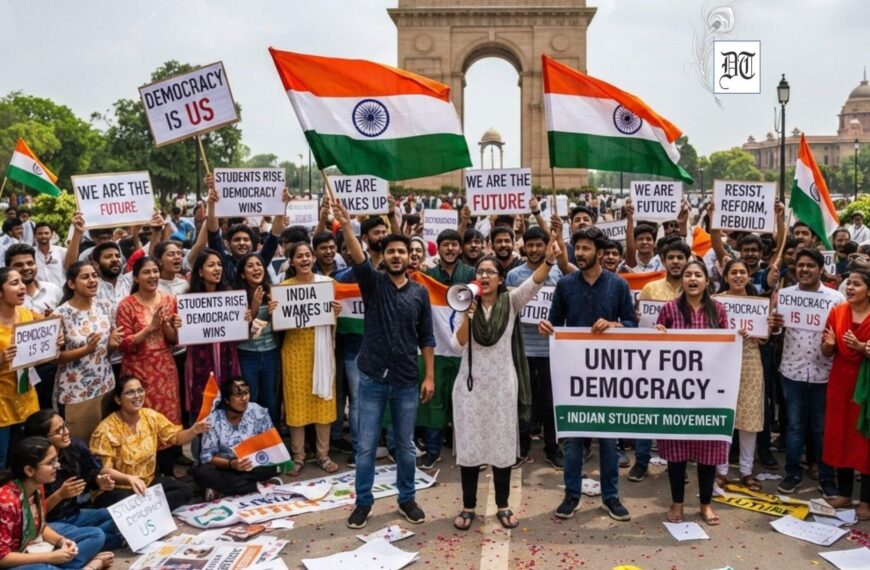
Cockroach Janta Party (CJP) chief Abhijeet Dipke has upped the ante against Chief Election Commissioner Gyanesh Kumar, giving him a 48-hour deadline to resign. What more? Nationwide agitation culminating in what Dipke calls “Jantar Mantar 2.0” right in the heart of the national capital.
Dipke lets fly with both barrels. He called CEC the country’s “biggest anti-national” and demanded criminal proceedings against him. He argued that the basic social contract of Indian democracy, in which voters elect the government and not the other way round, has been completely reversed. Crucially, he also issued a direct challenge across the aisle to mainstream opposition parties: if the rolls are rigged, walk away from the contest or take an uncompromising stand.
What this means, in addition to the story:
This street-level offensive does not exist in a vacuum. It rests on explosive disclosures that fellow Election Commissioners Sukhbir Singh Sandhu and Vivek Joshi formally flagged dissent at least 14 times on record over unilateral decision-making in the Special Intensive Revision (SIR) exercise.
Mainstream stalwarts, from Rahul Gandhi and Mamata Banerjee to Arvind Kejriwal, have largely framed their offence around institutional subversion and legislative outrage. Dipke’s ultimatum suggests that the controversy surrounding SIR has broken containment. The crisis is no longer restricted to internal file notings and court petitions for the CEC; it is fast becoming an unruly public trial on the streets.
Arindam Roy
Picture design by Anumita Roy

Arindam Roy has over four decades of experience in various newsrooms of renowned media houses. He is the Founder, Publishing Director, Editor-in-Chief of Different Truths, and Kavya Kumbh Publishing Consultant (KKPC). He has co-authored ten chapters in six Coffee Table Books (CTBs) of national and international repute and is the sole author of four forthcoming CTBs (Times Group). He has also published four international poetry anthologies as the Publisher and Editor-in-Chief, participated in several poetry and literary festivals, and won awards and accolades. Arindam co-authored the novel Rivers Run Back with an American writer. He stays in Bangalore and Prayagraj.


 By
By