

In her deeply moving write-up on DifferentTruths.com, Dr Rositta explores how Shaheen Kadri survived the 1992-1993 Mumbai riots and went on to champion peace.

AI Summary
- Resilience Amid Tragedy: Despite losing her home, possessions, and trusted neighbours during the 1992-1993 Mumbai riots, Shaheen Kadri chose forgiveness over hatred, valiantly testifying before the Sri Krishna Commission.
- Unyielding Community Service: Shaheen rebuilt her life brick by brick while dedicating herself to uplifting marginalised communities, focusing specifically on education and women’s rights.
- A Beacon of Hope: Retiring as a joint secretary, she continues fighting religious extremism and empowering youth, proving that love can triumph over deep-seated communal hatred.
According to the Constitution, India is a secular, democratic republic. However, ‘secularism’ has become a problematic concept in India today. Recent times have seen a rise in incidents of religious extremism that threaten to annihilate a long tradition of harmonious co-existence. In such a scenario, it is often observed that ordinary citizens, especially women, have stepped in to restore peace and harmony when the state machinery has abdicated its responsibilities to serve vested interests. However, mainstream history often leaves them unmentioned, dominated by those who wield power.
Similar is the case with the 1992-1993 Hindu-Muslim riots that shook India’s secular foundations. As the culmination of a massive campaign by right-wing Hindu organisations, extremists demolished the 16th-century Babri Mosque in Ayodhya, which was allegedly built after the destruction of a temple which stood at the birthplace of the Hindu deity Rama. This triggered widespread riots all over India and serial bomb blasts in Mumbai, resulting in over 2,000 deaths (chiefly Muslim) and losses of over $3.6 billion. Numerous women, doubly subalternates by gender and socio-economic status, bore the brunt of the violence and manoeuvred with various stakeholders to cope, render relief, rehabilitate, reconcile, rebuild and empower. One such little-known story is that of Ms Shaheen Sayed Kadri.
Even before I met her, Shaheen Kadri’s voice made a deep impact on me. I hadn’t expected such perfect articulation, objective analysis, and pure power from the narrative of a riot survivor. Born in Pune on October 30th, 1955, into a middle-class Muslim family, Shaheen grew up in Cotton Green, Lal Bagh, Mumbai. Her father, the late Sayed Shamsuddin Kadri, worked for the Sales Tax Department of the Government of Maharashtra.
Shaheen’s father passed away when she was just seventeen, leaving her to take care of her mother and three sisters. Circumstances were difficult, but Shaheen had inherited rock-solid values from her father and her courageous mother, the late Mumtaz Begum. Shaheen got a clerical position in her father’s office on sympathetic grounds and went all out to support her family while continuing her education. She did part-time jobs, took tuitions for children, and shouldered the responsibilities of a large family at a tender age. She ensured her sisters were educated and happily married and that her mother was well cared for.
Beyond all this, Shaheen had another passion. A passion for social service, cutting across the boundaries of class and community. This was a calling she nurtured despite all the trials in her path. Having served in various positions in the Rotaract Club in her college, she continued her involvement with various NGOs like the Missionaries of Charity to reach out to the underprivileged, both young and old. Shaheen found satisfaction in being at the forefront of free medical camps organised in villages all over Maharashtra. In her community in Cotton Green, Shaheen was known to be a socially proactive person. People across caste and religious divides found a trusted friend, counsellor and helper in Shaheen, right from getting admissions for their wards in good schools and colleges to advising on suitable matches for their sons and daughters. Shaheen never hesitated to help a person in need. When Hindu boys from her locality were arrested by the police during Ganpati celebrations, on account of a misunderstanding, Shaheen went to the police station, and they were released solely because of her intervention and her standing as a social worker. Numerous such incidents proved Shaheen’s selfless zest for service.
However, everything changed on December 6th, 1992, the fateful day the Babri Masjid was demolished, and venom was unleashed across the country in the name of religion. Shaheen had never imagined, even in her wildest dreams, that her life would change so drastically on account of events happening thousands of miles away, events in which she had very little interest. She had been brought up to respect, mingle freely with and coexist harmoniously with people from all religions. Her parents had never discussed religious differences at home. She had never thought of herself as a Muslim until that fateful day.
Soon after December 6th, rumours of another Partition spread, and Shaheen’s mother came home from the market, alarmed. Friends warned Shaheen to vacate her home because Muslims had been openly threatened. She never took these warnings seriously because she knew and trusted all her neighbours. She believed no harm could come to her in Cotton Green, which had been her home for many decades. But events would soon prove her wrong. Rioting, looting and arson started in Cotton Green too. Shaheen and her mother decided to lock their house and climb upstairs to other floors of their government quarters for a short while. But what happened left an indelible scar on her for the rest of her life.
Shaheen and her elderly mother knocked on several doors, but to no avail. As they stood on the balcony of the fourth floor, they saw Hindutva fanatics in saffron shorts, armed with huge knives, iron rods and hockey sticks, gather outside their home. They started shouting out for Shaheen’s mother, calling her Indira Gandhi (her hair and nose resembled those of the former Prime Minister). Shaheen’s bike was parked outside, and they identified it. Then all hell broke loose. The doors and windows were broken down, and her bike – in fact, everything in the house – was dragged outside and set on fire. Portable items like the television set, eatables, vessels, clothes, cash and valuables were swiftly looted. Almost every portion of the house was disfigured. The huge plastic water tank was slashed with a knife repeatedly. The electric and other cables were destroyed. Shaheen’s painstakingly acquired precious collection of books was torn and set on fire. Treasured copies of the Holy Quran were torn into pieces, stamped upon while uttering abusive words and set on fire. Shaheen says this is one sight she will carry to her grave, a wound that will never heal.
Meanwhile, Shaheen and her mother cowered in stunned disbelief. Even as they hid, Shaheen’s mother, a patient of epilepsy, started suffering fits. Endlessly long hours dragged on, and the two women hid till nightfall when the rampaging mobs finally departed. In one stroke, they had been rendered penniless and homeless, all their life’s savings and possessions lost. A shell-shocked Shaheen realised that some of her Hindu neighbours whom she had helped and trusted so much had betrayed her and revealed the location of her house to extremist goons.
The night was spent on the floor at the local police station. It was a cold night, and Shaheen shivered without any warm clothes, putting her head in her mother’s lap. They were there along with several other Muslim women and children, all of whose homes were vandalised or burnt. The police refused to register Shaheen’s complaint. She was the only one who ventured even to demand that an FIR be registered. As the night progressed and starving infants cried out for food, the police officers and their families who stayed in the quarters nearby sneered at and cursed the nuisance caused by these homeless people.
The next day, Shaheen contacted relatives at the other end of the city. Travelling with her mother in a deserted and half-burnt local train across the city was another nightmare. For the next few weeks, the two women lived with relatives who were, of course, very kind. But they knew they did not want to depend on anyone else; they wanted to regain their dignity and their private space. Without her bike, without any means of transport, Shaheen walked several miles a day to and from her government office. At the office, the trauma continued. Many Hindu colleagues made sarcastic and caustic remarks about how the Muslims, traitors to the country, were finally taught a lesson. Shaheen listened with her heart breaking, wondering how her love for India was any lesser just because she was a Muslim, until one day when she complained to her bosses and threatened her colleagues with action if the derogatory talk did not stop. The talk stopped, but the bitterness remained.
Now Shaheen was very conscious of two things – she was different; she would always be treated differently because she was a Muslim, a Muslim woman, and, worst of all, an independent Muslim woman. The poverty and the insults, the threats and the discrimination, the humiliation – they would have broken anyone. But not Shaheen. She courageously deposed before the Sri Krishna Commission, detailing all that she had seen and experienced. After an emotional and tabooed (Muslim women are not permitted to visit graveyards) visit to her father’s grave in Pune, Shaheen resolved to rebuild her life, brick by brick.
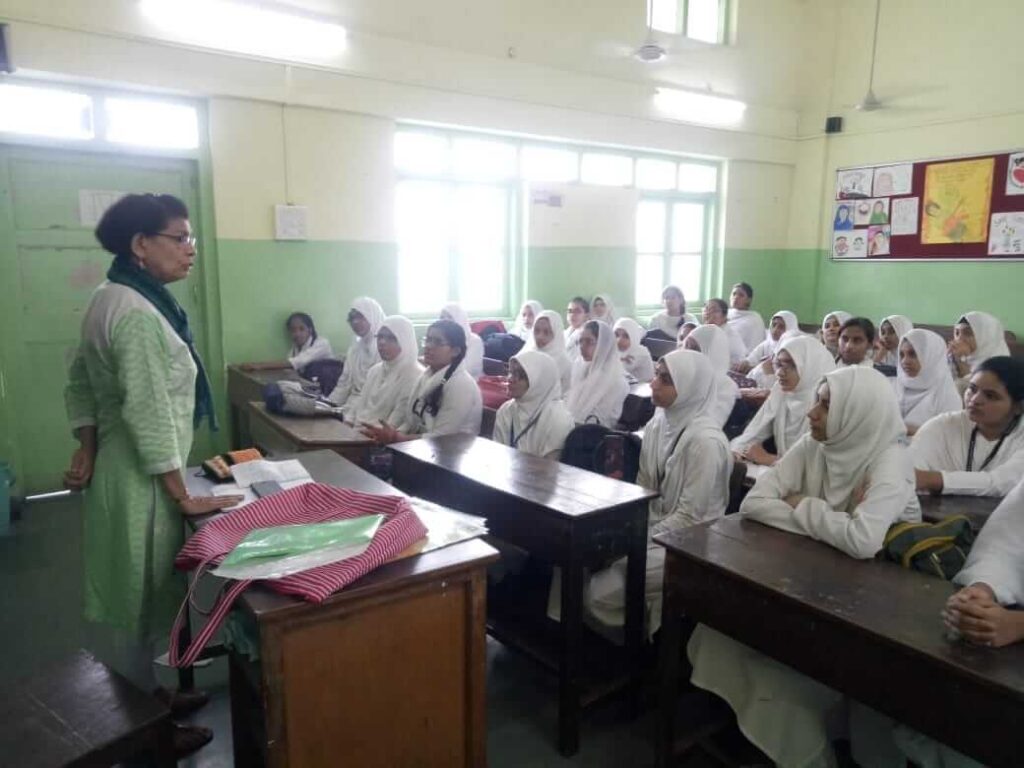
Then started what Shaheen labelled Operation Clean-Up. With amazing clarity and conviction and without much bitterness, she returned to Cotton Green. Almost all the Muslim families had fled from the area, with their homes either illegally occupied or sold at incredibly low prices. When she returned, people were shocked, and their stares of confusion, hate and suspicion followed her constantly. When she visited the police station, the police officers stood up in respect and regret. They requested her to identify the rioters from among those whom they had arrested and who were in police custody then. But Shaheen refused to file a complaint, saying that she had decided to move forward. When she first stepped into her house, she was numb with devastation. Slowly, she, with the help of a couple of friends, cleaned the entire house. A carpenter charged 2000 rupees to fit a door. On the first night, Shaheen slept on the floor with a knife under her pillow in case anyone attacked her. But more painful than living in a house without doors and windows, electricity, and water was facing her once-warm neighbours, who now treated her like an outcast. Many were scared to associate with her in any manner. Some expressed their bitterness openly. But others carried hidden guilt and shame.
Brick by brick, penny by penny, Shaheen restored her house and her life, bringing her mother back home. Surprisingly, Shaheen overcame traumatic days and sleepless nights, haunting memories, and unbearable grief. She had anger within her, but it had not translated into hatred for the Hindu community around her. Once, her little nephew visited her house and asked about the changes, and Shaheen told him she had renovated it. She says she did not want the younger generation to grow up hating the other community. Today, some of her relatives are happily married to non-Muslims, especially Hindus.
Nevertheless, something had changed within Shaheen forever. She became truly conscious of the plight of the Indian Muslim woman. This woman had to struggle against both her community and the majority community to lead a human life. She continued to help people across communities, but her focus was now on educating the Muslim girl so that she could educate her family against all forms of extremism so that she could have a better life, utilise her potential and overcome the attacks of communal forces with courage and resilience. Shaheen plunged into various issues affecting Muslim women, right from domestic suppression, abuse and violence to public opportunities for work and education. She also worked diligently in her profession and retired as a joint secretary in the Minorities Development Department of the Government of Maharashtra. Eventually, Shaheen moved away from Cotton Green to another locality after several years. She no longer wanted to stay with people who did not consider her as their own.
Today, Shaheen is committed to removing deep darkness from her community. First, the darkness in the lives of uneducated Muslim girls and, second, in the lives of unemployed and frustrated Muslim youth who are denied an opportunity for a dignified living on account of religious discrimination. She also told me of the deepest darkness – religious extremism that pits Hindus and Muslims against each other. She showed me the wall next to her apartment, which tacitly divides ‘For Hindus Only’ apartments from the apartments where non-Hindus stay. She is dejected not because history is forgotten, but because history is distorted.
The younger generation is taught a version of history that villainises the minority community. No one cares to know what really happens during riots, how religious fanatics and selfish politicians manipulate people experiencing poverty, or how common people, especially women, struggle every day in their slums and chawls to maintain peace and unity. The pathos is deepened against the backdrop of several court judgements in 2019 and 2020 which acquitted politicians charged with planning, aiding and abetting violence during the incidents of 1993-92 for want of evidence.
Today, Shaheen Kadri sits with a smile in her modest and tiny flat. But it makes a big difference in the wider world. Causes ranging from special children to meals for the hungry are close to her heart. She mobilises funds for the education of poor Muslim girls in some of the poorest Muslim slums like Cheetah Camp. She has conducted multiple workshops on women’s rights, communal harmony, and preventing domestic violence, reaching several scores of men and women. I had the privilege of meeting her mother, who passed away a few months back. Over ninety, she showed the same alertness and warmth that overflowed from Shaheen. She remained her daughter’s fount of strength.
That evening in June 2019, in that small flat in Mumbai, I could feel the silent power of two women whom the world had tried to crush repeatedly, only to see them emerge stronger each time, to see them battle hatred with love – the greatest force in the Universe. I thanked the Universe for enabling me to meet the inspiration called Shaheen Kadri.
Picture sourced by the author

Dr Rositta Joseph Valiyamattam is a Fellow of the Royal Society of Arts, U.K., a scholar, poet, author and educator with over two decades of experience in higher education. A former visiting research fellow at the University of Edinburgh, she is currently a consultant editor with Orient BlackSwan India and an English faculty member at prestigious institutions in Hyderabad. With a gold medal and doctorate from Andhra University, she has published widely and champions literature, youth engagement, translation, theatre, oratory, and socially committed education.


 By
By
 By
By
 By
By
 By
By