
Dr Basudhara reviews Afsar’s Sahil Will Come and Other Stories on DifferentTruths.com, exploring the poignant reality of Telangana Muslims.

AI Summary
- Afsar’s collection, translated from Telugu, offers an unflinching, authentic look at the socio-economic struggles and identity crises of Muslims in Telangana.
- The narratives masterfully reject simplistic stereotypes, focusing instead on internal psychological landscapes and the agonising daily negotiations of religious and cultural identities.
- This poignant work serves as a vital social record, highlighting the erosion of syncretic traditions while challenging readers to confront uncomfortable truths.
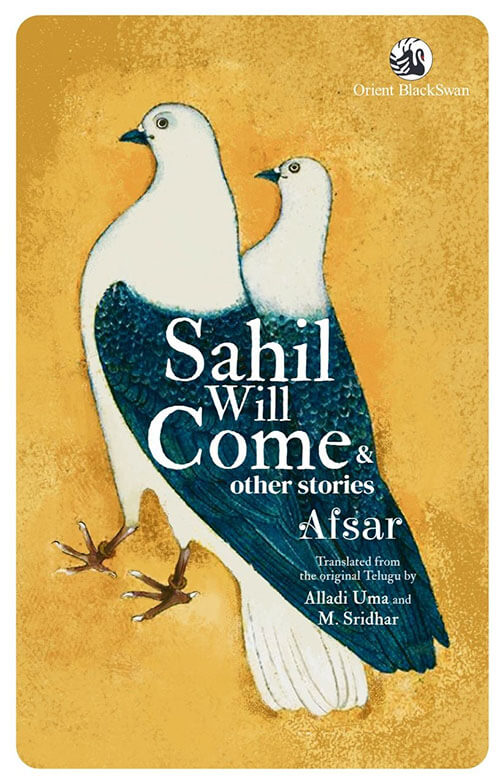
Sahil Will Come and Other Stories lands on the reader’s desk with a pair of doves on its autumnal yellow cover. One does not, at this moment, know who the Sahil of the title is, but the belief that he “will” come, combined with the symbolism of the doves, assures a certain sense of faith in a world marred by perplexing uncertainties. A collection of eleven stories written by Afsar (Mohammad) in Telugu and eloquently translated into English by Alladi Uma and M. Sridhar, the book can be looked upon as a regional short-story cycle that, with uncompromising realism, documents life lived within a particular niche, namely that of the poor Muslim in the Telangana region. Returning, tangentially, to the same ‘gaon’ or village and to the same cast of characters in story after story, the book takes its readers into the heart of this life of poverty, insecurity, deprivation, humiliation, and a crumbling relationship with mainstream society in which the Muslim perpetually stands out as suspicious and “other”.
In most of these stories, there is little to no plot and minimal physical action. Their entire action is rooted in the minds of their protagonists—in their introspections on political, cultural, and economic identity, in their painstaking understanding of history, in traumatic memories, and in the sharp edge of their grief that resurfaces, time and again, as the world stubbornly refuses to change. At the centre of each story is a rational narratorial voice that refuses to take appearances or destiny as given. Unconvinced that the state of things cannot be changed, it is willing to travel any distance and put anything at stake to confront the void of the times and ask of it the questions that have no simple answers, perhaps no answers at all.
In ‘The Forest, Afsar writes:
It had become a crow-like life. A wretched life. No village, no place gave them any certainty. If they did not get business, please move out and go to another place. Like this, there was no count of how many villages they had roamed about with those tattered mats, waist-thread sticks, woebegone faces and empty stomachs. He found certainty. I bargained disgustingly. If he said half a rupee, they would say a quarter! If he said “a quarter”, they would say “ten paise”! They would take his life. They would not have the brains to think if it were even possible to survive on so little!
Originally published in Telugu as ‘Adivi’ in May 1983, the story strikes us as sharply factual even forty-three years later. Poverty and religion are two themes that dominate the collection. On the face of it, there appears to be no logical relationship between one and the other, and yet, things are not as simple as they appear. While abject poverty indiscriminately engulfs our masses, conditions of abjectness can be heightened by the dense intersectionality of religion and caste. In ‘Dhedee’, for instance, the protagonist, haunted by his Muslim identity, fails to find suitable employment. Afsar’s stories reveal how identity markers can dominate, crush, and brutally destroy the humans that they mark with their labels.
Uncomplicated as it might appear to an outsider to the Telangana region, for Muslims here, as Afsar’s stories delineate, the negotiation between their religious identity and cultural identity is an arduous everyday task, especially for those who wish to be loyal to both. Choosing between Telugu and Urdu is itself a tough choice for many, since languages belong strictly to emotional, not religious, geography. The cultural adoption of Telangana identity in one’s everyday life, even while religiously practising Islam, is regarded by the Muslim community as a betrayal of their Muslim identity. In the story ‘Telengi Patta’, for instance, the mother fears that both Hindu and Muslim communities will refuse to acknowledge her little child if her husband does not decisively choose his Muslim identity over his Telugu one and choose accommodation within a Muslim khila. This choice is not as simple as the story makes it out to be. It involves a linguistic choice, a territorial choice of ghettoisation, a cultural choice of dress and social behaviour, and above all, a fanatical understanding of the idea of ‘us’ versus ‘them’.
While Afsar’s stories intricately portray the bewilderment, agony, and humiliation of being othered, it is to Afsar’s credit as a writer that he himself never succumbs to the literary strategy of portraying right and wrong through simplistic stereotyping and othering. A closer look at his stories shows a clear lack of judgement. Even in the title story of the collection, ‘Sahil Will Come’, the insinuations by the police against Sahil, whose disappearance immediately gets linked to his Muslim and, hence, terrorist identity, are allowed by the narrator to pass without the kind of rage or reverse anger that it invariably provokes. As a writer, Afsar gracefully undertakes the task of description, leaving response and judgement to his readers.
There are no flat characters in Afsar’s fictional world. Any character that seems to lack depth in one story is given full-fledged representational space in the other. The effect is that of a camera zooming in on each character in turn and revealing an entire, complex world of thoughts inhabited by seemingly unassuming humans. In Afsar’s characterisation, it is also interesting to note that he does not link the notions of fanaticism and communalism to gender. It would have been easy to portray men as fanatically religious and women as socially inclusive, or men as rational and women as superstitiously religious, but Afsar deftly avoids such simplistic generalisations. The mantle of rationality, in story after story, is borne alternately by men and women who debate the inheritance of history, ideology, and culture as they struggle to reconcile a humane vision of life with the scathing injustice of their times.
The mirror functions as an important motif in the collection. Characters in these stories frequently come upon mirrors, intentionally or inadvertently, and this, perhaps, is no coincidence, for the entire collection serves as a mirror in which, though characters see others, they see themselves first. It is the shock of self-awareness, the ache of confronting the motives behind one’s actions, and the trauma of living with self-knowledge that make looking into the mirror brave and revolutionary. These stories are not fearless in the sense that they offer radical solutions to human problems. They are fearless because they do not hesitate to look into the mirror and ask difficult questions.
If craft implies a conscious plan for literary technique and the ordering of characters and events, these stories embark on a total rejection of craft. Their brand mark is authenticity of experience, an intense living and being in the world they attempt to describe, and an acute experiencing of the agony of intellectual doubt and ethical survival. In his foreword to the collection, Afsar writes, “I believe that there are ways by which a story truly becomes a story: that is a writer’s technique and craft. I also believe that there exists a delicate, wonderful and magical bond between the writer who weaves the story and the reader who reads and interprets the life in the stories. ” Afsar’s stories make their way into the heart not through some cultivated fictional strategy but through the age-old technique of respecting the reader and laying bare the honesty of human thought and soul.
Sahil Will Come and Other Stories gnaws at the heart, shreds skin, and reveals our own complicity in the social structures that crush and annihilate humankind. It narrates the travails of not just the Telengi Muslim but the Muslim in India and abroad, who remains the subject of suspicion, surveillance, and discrimination. This is also a book about the erosion of the syncretic culture that India had known before the Partition and, to some extent, before the demolition of the Babri masjid.
A word must be said about the poignant authenticity with which this translation conjures and recreates the flavour of the original text. Afsar brings the linguistic worlds of Telugu and Urdu into collision in his original Telugu stories, bringing to life the particular linguistic and cultural flavour of Muslim life in Telangana. It is sheer brilliance that the translators have been able to keep this particular flavour alive in English, offering the reader a rare entry into a world little known until these stories were read.
In his very sincere foreword, Afsar writes, “If I could not communicate to my readers the daily predicament, turmoil and anguish of Indian Muslims, I would fail as a poet, a short-story writer, a researcher and a teacher, but more importantly, as a human being.” The stories triumphantly counter their author’s fears of failure by establishing their value as literature and as an honest social record of their times.
Cover visual sourced by the reviewer.

Basudhara Roy is a poet, academic and faculty member of English at Karim City College, affiliated with Kolhan University, Chaibasa. Her latest work is featured in Madras Courier, Lucy Writers Platform, Berfrois, Gitanjali and Beyond, The Aleph Review and Yearbook of Indian English Poetry 2020-21, among others. Her recent (second) collection of poems is Stitching a Home (New Delhi: Red River, 2021).
 By
By
 By
By
 By
By