
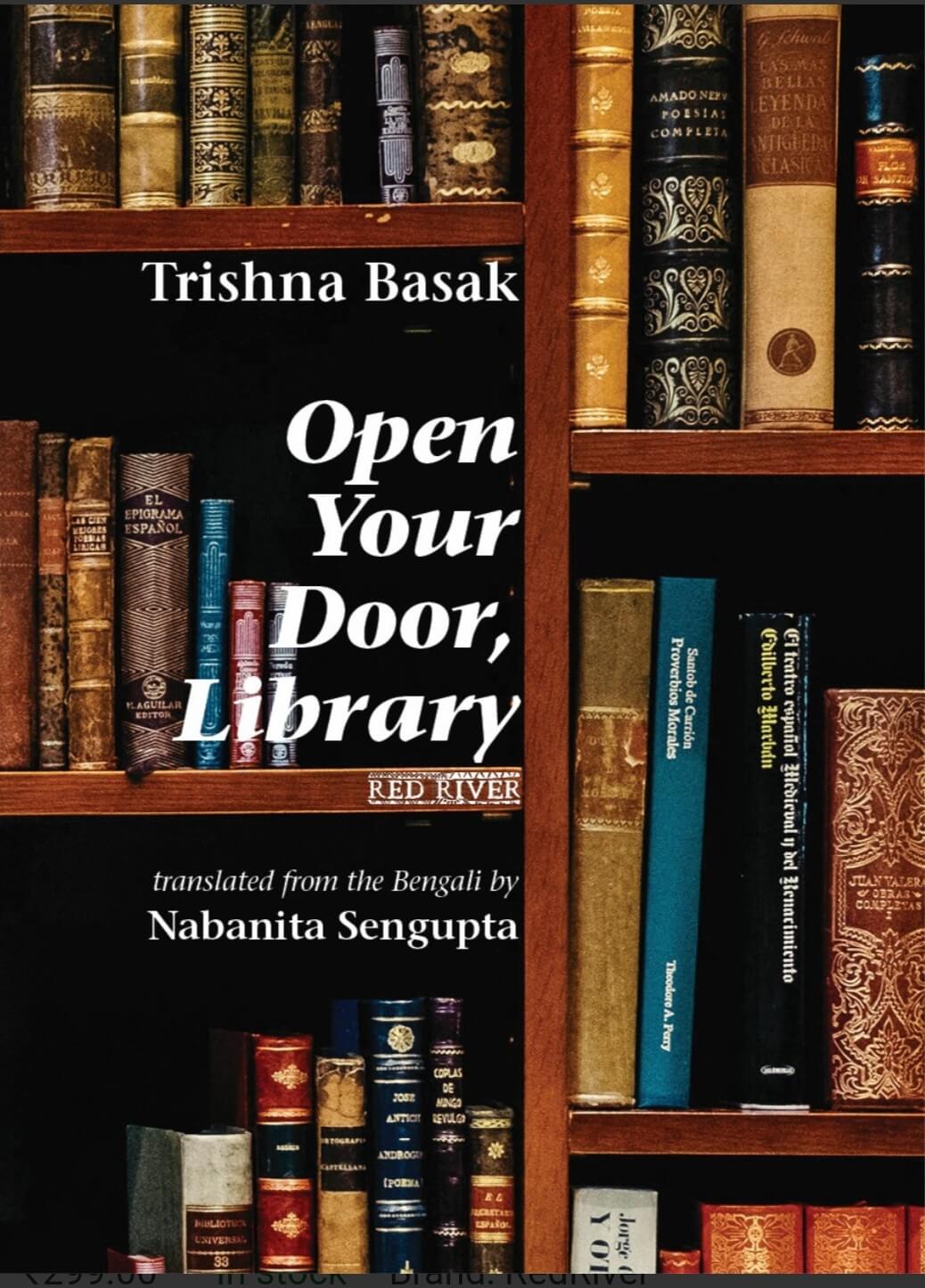
Aritrik explores Trishna Basak’s poetry in DifferentTruths.com, examining Nabanita Sengupta’s brilliant, post-structuralist translation that turns reading into intimate lovemaking.

AI-Summary
- Trishna Basak’s Bengali poetry anthology, translated by Nabanita Sengupta, uses the library and readership as powerful metaphors for intense emotional and sexual tension.
- Sengupta deftly navigates post-structuralist complexities, balancing linguistic liberties with cultural nuances to preserve the text’s inherent multiplicity of meaning.
- The collection reimagines reading as a deeply sensory, non-linear, and disruptive act, transforming the reader from a passive spectator into an active participant.
Roland Barthes writes: “Writing is that play by which I can turn around as well as I can in a narrow place. I am wedged in; I struggle between the hysteria necessary to write and the image repertoire, which oversees, controls, purifies, banalises, codifies, corrects, and imposes the focus of a social communication.”
Nabanita Sengupta does just that with her attempt to translate Trishna Basak’s Bengali anthology of poems, Library Shirt Kholo, which she has translated as Open Your Door Library. As a translator, she does her best to take the liberty she can to establish the essence and the sense of the post-structuralist collection of Basak. It is astounding for a reader to see how a poet concocts an intimate relationship with the library, the collection of books and readership. The concept of readership serves as a rich metaphor that suggests a complex interplay of sexual tension and emotional engagement, which subtly weaves through the entirety of the collection.
Translators typically seek a consistent “signified” (meaning) to convey when moving from one language to another. In poststructuralist poetry, the particular sounds, letters, or visual forms (the signifiers) become the main message. Translating a pun or a deliberate ambiguity involves finding a corresponding word in the target language that can preserve the same “multiplicity of meaning” without imposing a single, straightforward interpretation. The translator faces the choice of whether to offer a cultural equivalent or to maintain the “foreignness” of the text, thereby revealing the “unequal relations” and power dynamics among various language systems.
Sengupta skilfully captures this intricate tension in her translations, opting for precise language that resonates with the emotional turmoil and nuances that poet Trishna Basak sought to convey. Through her careful selection of words, Sengupta not only highlights the depth of Basak’s sentiments but also illuminates the underlying struggles and passions that inform the poetry, making the emotions more accessible and relatable to the reader. In doing so, she transcends mere translation, creating a bridge between the original work and its audience that deepens the understanding of its themes and layers of meaning.
As one reads through the poems, one establishes an intimate relationship and almost becomes a voyeur in the process of lovemaking and readership. It is not a social relationship; it is an intimately personal one where the poet falls in love with letters, obliterates portions, makes short and longer encounters with books and pages, and understands the non-linearity of the idea of narrative and library. The poet and the translator perceive books not merely as objects for analysis, but as a vibrant entity. The concepts of “intimate relationship” and “voyeurism” imply that for this writer, engaging with literature is a deeply personal and sensory experience. They go beyond simple reading to actively seduce the text. By obliterating portions and creating short and longer encounters, the poet demonstrates a disregard for the sacred integrity of a book. They act as an active disruptor—someone who dismantles the text to uncover its hidden rhythm, treating the page as a space for reconstruction instead of a completed artefact.
The poet dismisses the straight line of conventional narrative. By embracing the “non-linearity of the library”, they recognise that both knowledge and desire are disjointed. They likely regard a library as a maze where one meanders and gets disoriented, rather than as a filing cabinet that yields answers. The focus on this being a “personal” relationship rather than a “social” one suggests a poet who finds their true sense of community among ghosts and ink. The “letters” become more significant than the people in the streets, indicating a life experienced profoundly inward.
Postmodern art is art within the archive that takes the frontiers of a book beyond “the title, the first lines, and the last full stop, beyond its internal configurations and its autonomous form…” (Foucault) and engages it in a personified camaraderie with the reader. The poet envisages a vista where she feels quenched, satiated, reciprocated. Her desire is not desperate, rather organic. At times, she epitomises the “ocean’s tireless waiting”, where someone “turns a few leaves, some read a few pages…” while at other times she cherishes “the hungry haste of rivers”, as her “effort to read a full paragraph causes early ejaculation”; once she craves for the reader to “pick up these letters with your lips”, and again she tries to gauge the crevices between those letters; in another poem she traces the termite licking away the adhesive from old books. The reader, possessed and seduced, “makes love and then feels shame”; she chooses to “peck at the melancholy of their words” rather than being “cyber sweethearts in cafes” and scanning ‘barcodes in grief’.
The poet, Basak, does an incredible job in tracing poststructuralist discourses and playing with the frontiers of the linearity of a text. She reminds one of the opening lines of Ben Okri’s The Famished Road or Italo Calvino’s If on a Winter’s Night a Traveller… The poems, when read, make the reader surrender to the act of reading, and one transforms from being a voyeur to an act of lovemaking, one almost the sinner and the saint. Reading, as Barthes says, “is a march towards a possession…a caress or a complete intercourse”. But what the translator does with such a difficult form is commendable!
While she keeps the essence of quintessential Bengali foliage intact in the plethora of lovemaking and keeps “kalmi’,’kadam’,’mahua’, ashok’ intact; she excels in translating “bratyo pathok” into “pariah reader” or “bosontobowri” into “blue-throated barbet”. One of my personal favourites is “Subornokolosh stawney lekha holo nawkher khwoto”, being translated as “Claw wounds scripted on her well-formed golden breasts”! While she takes liberty with certain phrases or words like “swogotokti”, translated into “dialogue”, or “shirt kholo” in the title to “open your door”, and one is unsure of her intent, the translator but only ends up making her work autonomous and widens its readability.
The anthology, beyond being a wonderful reading experience, becomes a private voyage into the self that seeks love, sometimes in the tactile perceptions, or at times feels, “My whole body was books; I kept reading myself, /reading on, /forever…” The subtext of lovemaking enunciated through the verbs “do”, “rise” and “read” is enticing and unique! The “leela” that she urges us to read is the game she plays, casually, yet cautiously, with readers and the act of reading itself!
Cover photo shared by the reviewer

Aritrik Dutta Chowdhury is an English faculty member at Acharya Girish Chandra Bose College and Sanskrit College and University, currently pursuing a PhD at St. Xavier’s University, Kolkata. An avid writer, he has authored and edited multiple books, including From Bacon to Blog and Prohor Bhanga Prohori. Beyond academia, he is an award-winning public speaker and debate judge, recently honoured with the “Pride of the Profession” Award at the Eastern India Leadership Awards.


 By
By
 By
By
 By
By