Dr Molly at DifferentTruths.com confronts war’s human cost, urging urgent empathy, remembrance, and practical commitment to peace and justice.
AI Summary
- Dr Molly recalls Hiroshima and modern conflicts to spotlight war’s catastrophic civilian toll, long-term health harms, and cultural loss.
- She argues resources spent on warfare could alleviate global hunger, urging policymakers and the public to rethink priorities.
- The piece calls for remembrance, reconciliation, and concrete peace-building measures to prevent repeating history’s devastating mistakes.
“Did you know that the worldwide food shortage that threatens up to five hundred million children could be alleviated at the cost of only one day, only one day, of modern warfare?” ~ Peter Ustinov, actor, writer, and director (Apr 16, 1921-2004)
What this sane voice echoed way back in 2004 finds its deep resonance in human hearts when an unbridled war is unleashed on the world, unleashed by nations keen on domination and fostering their weapons industry. The helpless, caught-up victims are the innocents who have nothing to do with war or warmongering…
“As of late April 2026, the ongoing conflict has caused over 3,375 deaths in Iran and over 2,500 deaths in Lebanon, with thousands more injured. Casualties include a significant number of civilians, with reports indicating over 1,700 civilian deaths in Iran and widespread destruction across Lebanon.”
Look at the other side. Total deaths: 13 to 14 US service members have been confirmed killed in combat-related actions since the conflict began on February 28, 2026.
Casualty locations: These deaths occurred in Kuwait (6), Saudi Arabia (1), and a helicopter incident in Iraq (6).
War! War!
Man, revelling in a ruthless killing spree, destroying, demolishing, and erasing one culture, one community! Monuments, apartments, and offices all shattered in a split second, since you were gauging the capacity of the destructive power you fostered, be it nuclear, chemical or biological.
In your fit of fury, you seldom realise that it bounces back on you, your progeny. You are burning your own ship!
That fear is the one now dominating over the ones who started the present war. Causing a worldwide economic dip, now that the war is unleashed, it seems more difficult to contain it. Hope good sense prevails.
What does a war precipitate? I had a hands-on feel of the ferocity of war in my visit to Japan, especially when I visited Hiroshima.
How on an otherwise peaceful morning at 8:15 am, on August 6, 1945, America dropped its atom bomb, “Little Boy”, on Hiroshima and “Fat Man” on Nagasaki.
How awful it was, falling on little children going to school, farmers working in fields, busy housewives plying inside, and men and women commuting to their offices!
The atomic bombings of Hiroshima (August 6, 1945) and Nagasaki (August 9, 1945) used bombs of different sizes and types: “Little Boy” (Uranium-235) and “Fat Man” (Plutonium-239). The bombs destroyed areas of 11.4 \(\text{km}^{2}\) and 6.7 \(\text{km}^{2}\), respectively, with blast effects reaching ~1 mile in radius, causing over 200,000 total deaths (Source: Google).
The red fireball emitting nuclear impact remained for a few days, causing large-scale damage to people on faraway premises.
Visit to Hiroshima
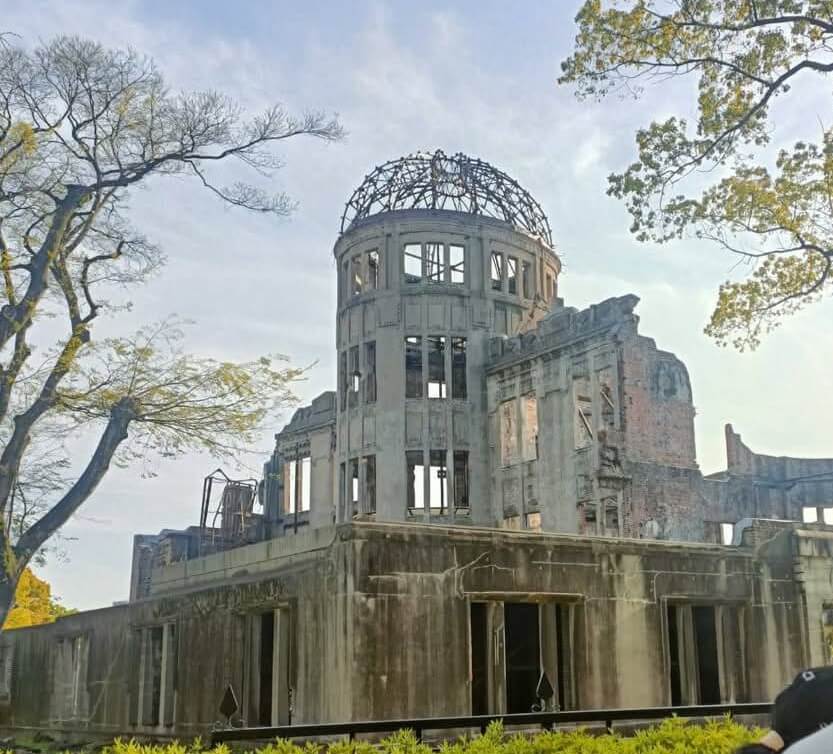
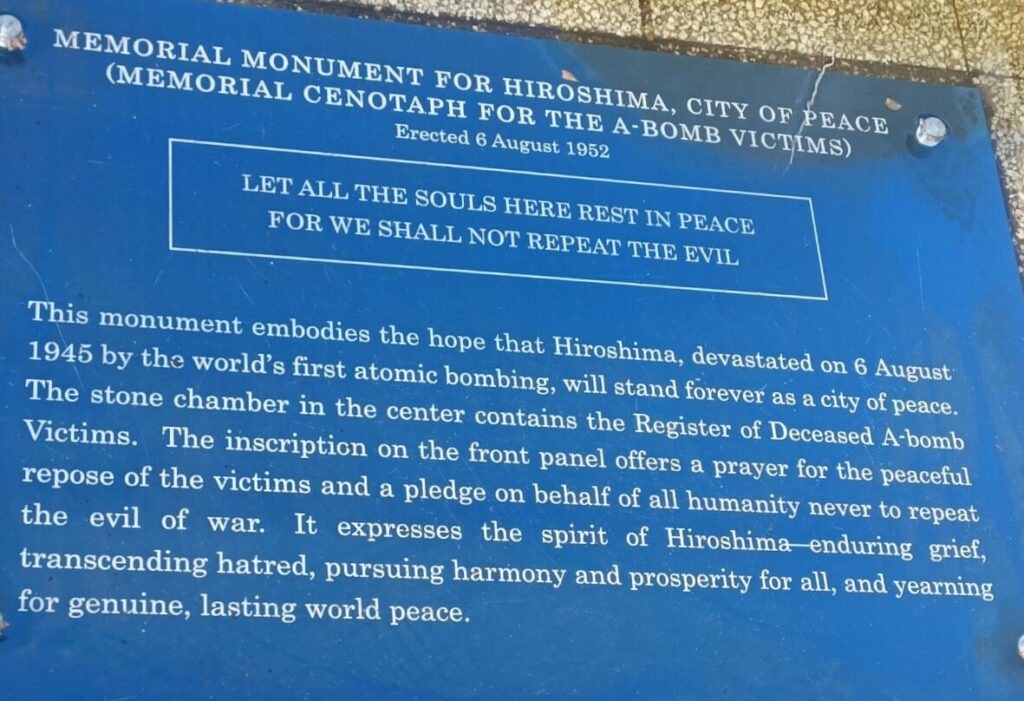
Now, at Hiroshima, which was burnt to nothing, devastation devouring the very earth, the Japanese have built up a ‘Peace Memorial’.
With new soil covering the old, they have nurtured a charming greenery with tall-looking trees and a garden.
The skeletons of the giant building still stare at us…. Those that underwent demolition and devastation are now kept in steel frame reinforcement.
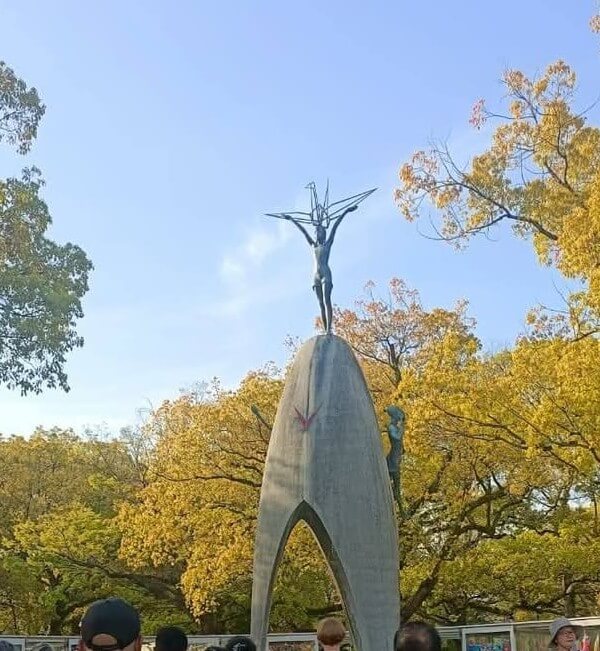
What of the people crushed and burnt beneath? The central part of the sanctuary holds that Amar Jyothi, the undying flames of memory, and they lead to the holy arch where people ring the bell and pray. The whole venue, pathways boulevarded with trees. Cherry blossoms, white and pink, that excited me elsewhere in Japan now appeared pale and strewn, well expressing the poignant insignificance of human life. There seeped in melancholic reminders of the undeserved sufferings inflicted on the innocents…
How these man-made, horrible wars leave behind scars of such an everlasting wound! Even now, some of the survivor progenies are alive, but they are being denied family and reproduction because children may come out with inherited genetic diseases.
Visiting the museum was a heart-rending experience. Rubbing against the broken relics, skeletons, bits of costumes consumed by fire and, above all, heart-rending photographs of the gory scenes where people scramble for escape, mothers with children clung to their breasts, fathers hovering over them like an envelope or shield, allowing and accepting the radiation, burns and all on their bodies, scenes and narrations of survivors deformed with broken parts of bodies, with empty eye sockets and hollowed cheeks …
God! You shuddered and shivered at this depth of human suffering! These genetically borne diseases took years to repeat. Shocking it was to hear of a two-year-old baby who escaped death at the time of the blast, living normally for ten years and then having to die with leukaemia at the age of twelve!
At the end of the museum, touching posters teem with powerful pleadings for love and peace! “Awake, arise, humanity, for a world of love and peace.”
Humans inflicting suffering on each other! Wars! Warmongers! What do you gain?
Ultimately, when you emerge from the museum, at the exit, there is a book for you to write out your thoughts in a line or two.
I scribbled:
“O, Japan!
You, a hapless victim
of human greed!
Forgive us!
Let us never repeat such a heinous act.”
Later felt I had to add something more, turned round and wrote the following:
With you, Japan!
You are the brave human spirit, the sterling hope of man!
Your resilience to rise like a phoenix from ashes marvels and inspires!
With you, Japan!
Photos by the author

Dr Molly Joseph, a bilingual professor and poet from Kerala, has published 26 books, including 18 poems, two novels, and two storybooks for children. She has edited “A Handbook of Contemporary Ethics” and works for values, global peace, and togetherness. Dr Joseph has won national and international accolades and represents India at SAARC and FOSWAL literature meets. She believes in the power of the word and writes boldly on contemporary matters.

 By
By
 By
By
 By
By