
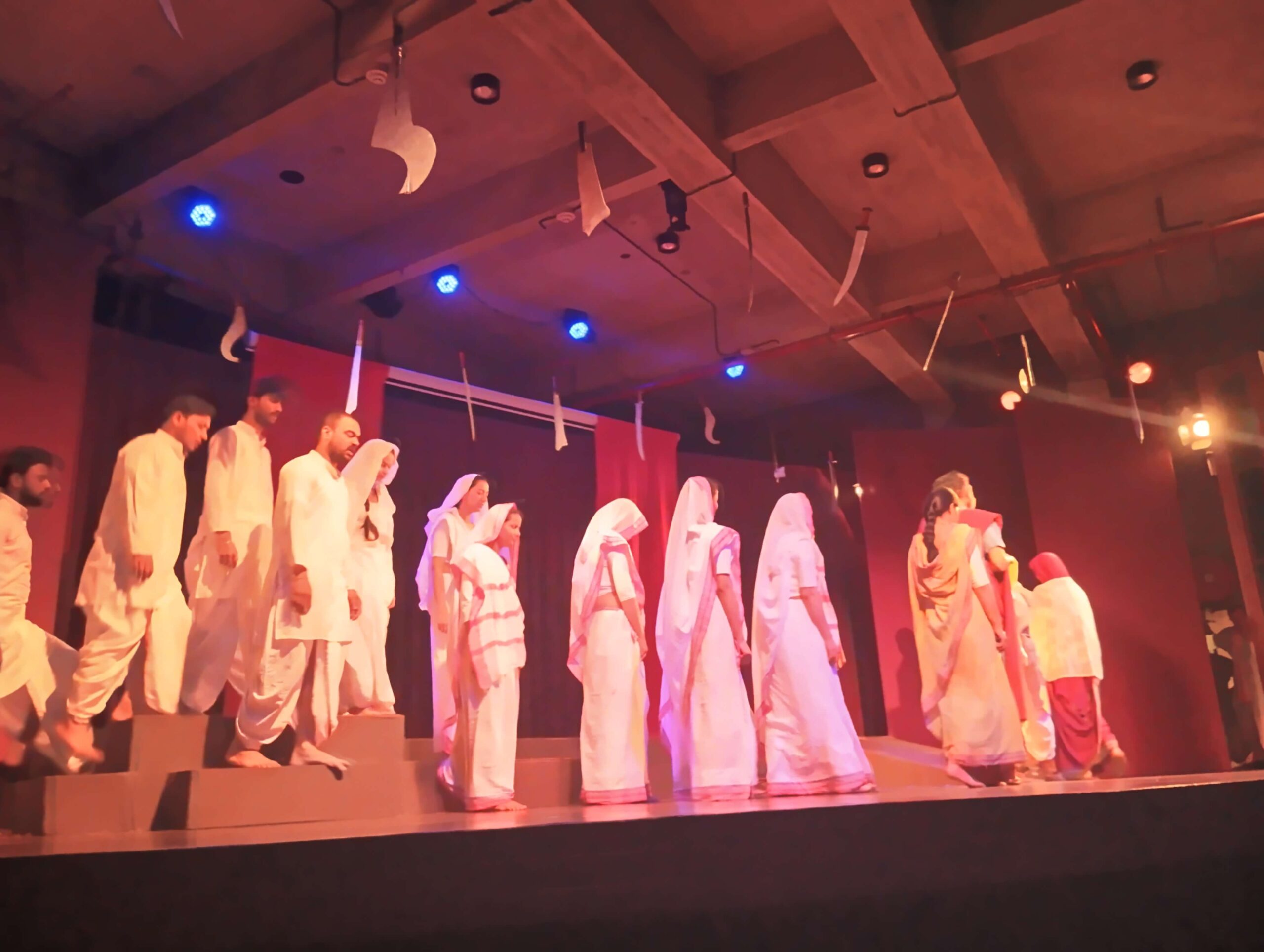

Ruchira in DifferentTruths.com celebrates Asmita Theatre Group’s riveting Andha Yug, echoing Mahabharata’s anti-war perils amid NCR’s theatre bonanza.

AI Summary
· A flawless staging of Dharamveer Bharati’s iconic Andha Yug, with perfect costumes, lighting, and sound evoking the Mahabharata’s tragedy.
· Explores Partition-era allegory: war’s dehumanisation, ethical collapse, and Ashwatthama’s Brahmastra amid Hastinapur’s ruins.
· Krishna’s ethical plea shines, warning against self-enchantment and blind ambition (Dhritarashtra). It urges moral introspection.
Theatre lovers in and around the National Capital Region (NCR) have lately been enjoying a bonanza of plays thanks to the recently concluded NSD festival and the ongoing platinum Jubilee of Triveni Kala Sangam. The other day, I watched Andha Yug, the iconic creation of renowned Hindi novelist, poet, and playwright Dharamveer Bharati.
Against the backdrop of the last day of the great Mahabharata war, this five-act tragedy was written in the post-1947 partition era. It is, in fact, an allegory for the destruction of human lives and ethical values during that time. The work illustrates how war dehumanises both individuals and society. Ultimately, both the victor and the vanquished suffer losses.
Based on the ancient Sanskrit magnum opus, the Mahabharata, written by Ved Vyasa, the story unfolds on the eighteenth and last day of the Great Mahabharata War, when the Pandavas and Kauravas were fiercely locked in feuds and bickering; meanwhile, the magnificent capital city of Hastinapur lay burning, utterly ruined. The battleground Kurukshetra was dotted with corpses, and skies above were filled with birds of carrion; mourning and lamenting by scores of widows and bereaved mothers rent the air. There were humongous casualties on both sides.
The survivors were left grieving and enraged as they continued to mudsling, blaming each other for the disaster. No one was willing to introspect or view it as the consequence of their own moral choices.
For instance, Ashwatthama, son of Guru Dronacharya, in one last-ditch act of revenge against the Pandavas, released the ultimate lethal weapon, the Brahmastra, powerful enough to annihilate mankind. Yet, sadly enough, no one came forward to condemn it. Ethics and humanity appeared to be stamped out of the soil.
Lord Krishna, who had all along mediated between the warring cousins, remains the central figure of the play. Even in his failure, he presents options that are ethical and just, suggesting that a much nobler, sober method is always viable, even in the worst of times. The play ends with the death of the Lord.
Andha Yug highlights the perils of self-enchantment; it further explores human capacity for moral action, reconciliation, and goodness in times of atrocity and reveals what happens when individuals succumb to the cruelty and cynicism of a blind, dispirited age.
A highly incompetent, inefficient monarch is symbolised by a blind Dhritarashtra. Apart from his physical handicap, his soaring ambition for his oldest offspring, Duryodhana, also blinds him.
Bharati uses the Mahabharata war to make an anti-war statement, raising questions about moral uprightness in the wake of Partition-related atrocities, loss of faith and national identity. The message that he wants to send across is: the perils that befall a society if it turns away from its wisdom culture, opting to succumb to impulsive logic or get swayed by emotions.
Although Andha Yug, as a play, has been staged by numerous theatrical groups at various locales, the one in question, presented by the reputed Asmita Theatre Group, did a highly commendable job. The costumes, lighting, and sound effects (to depict myriad moods and reactions), not forgetting the overall stage decoration, were done to perfection.
Visuals sourced by the reviewer.

Ruchira Adhikari Ghosh brings a liberal, wide-ranging outlook shaped by extensive travel across India and abroad. Educated at Holy Child School, New Delhi, Sacred Heart Convent, Ludhiana, and Panjab University, Chandigarh, she holds a Master’s in English Literature and a postgraduate diploma in Journalism and Mass Communication. With three decades in media, she writes on travel, books, music, performing arts, women’s issues, and especially food, drawing inspiration from rich life experiences. She is our Features Editor.


 By
By
 By
By
 By
By
Very nice article. However, to me Bharati really presents a view of the dark ages – andha yug- as bereft of all morality and ethical conduct; it is a world without God. If we read the original Hindi text, there are sufficient hints in it that even Lord Krishna isn’t the moral centre of the play’s universe. In a particular dialogue spoken by Balram, it’s clear that Lord Krishna could have prevented the dissent of the humankind into Andhra Yug but he didn’t despite being all-knowing. To me, the play echoes some sort of Shakespearean universe that turns unequivocally evil once evil enters the lives of human beings. The play is a powerful, unmitigated tragedy resulting from an internecine battle; the only one who was on the side of virtue and morality, who didn’t compromise at all, was Yuyutsu, a Kaurava who is shown as weak and is mocked by everyone, including his mother too, after the Kauravas are defeated. He stands as a symbol of Yeats’s contention that the evil have passionate intensity and the virtuous are weak. We seem to have entered that age, the blind age. As it is, the play was written in the aftermath of India’s participation attended by death, miserly and forcible exile to millions of people, as well as the Second World War. Today, we are standing on the brink of theThird World War. The times are such that insanity seems to rule the world drowning, to invoke Yeats again, ceremony of innocence in evil.
Enightening: thank you!