
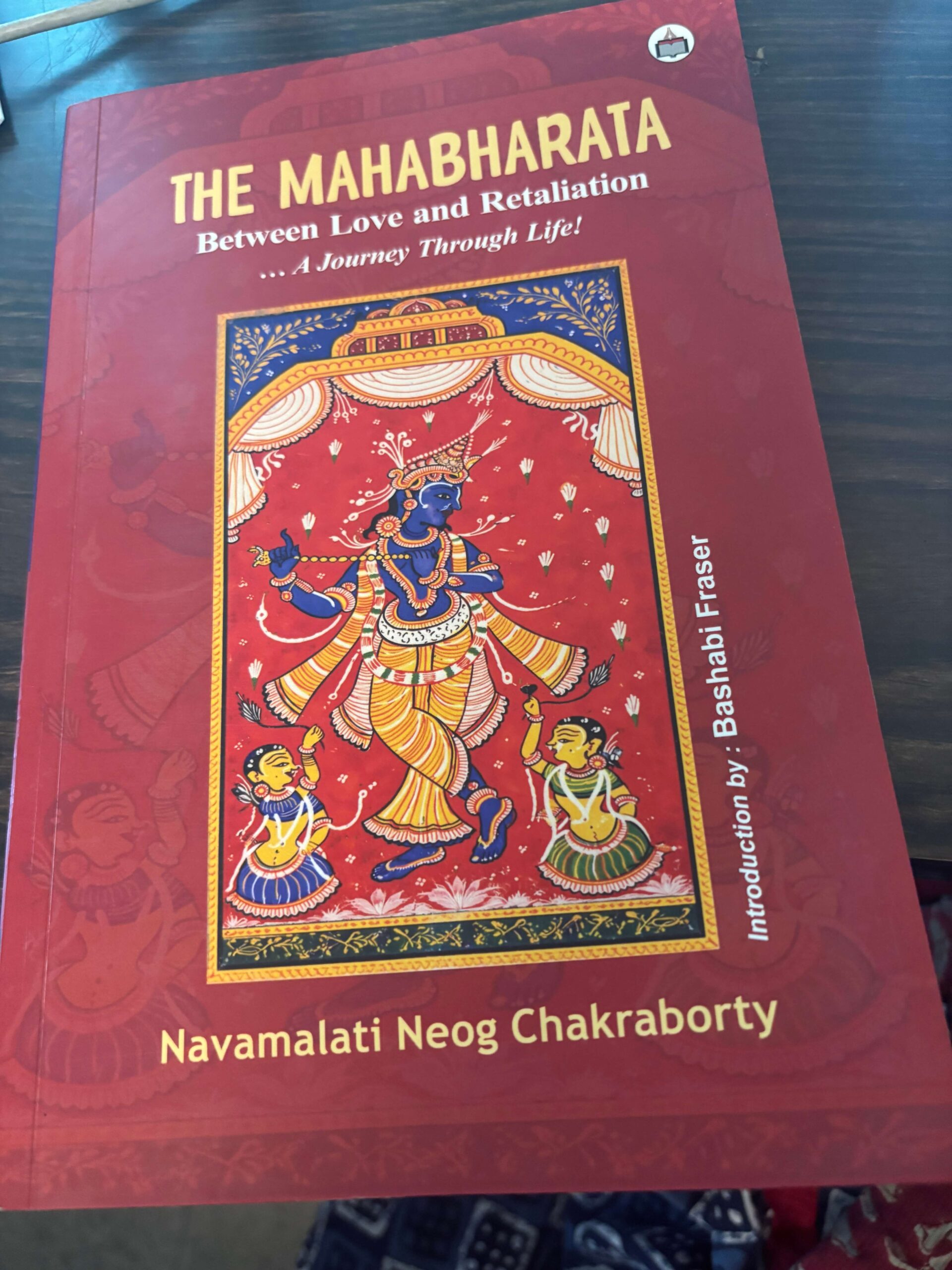
Prof Sanjukta unpacks Navamalati Neog Chakraborty’s The Mahabharata on DifferentTruths.com. Her book review reveals how ancient epic wisdom speaks to our modern moral and social crises.

AI summary:
- Prof Sanjukta shows how Chakraborty’s The Mahabharata re‑reads the epic as a mirror of contemporary patriarchy, caste, and political violence.
- Through seven long narrative‑philosophic poems, the book links Draupadi, Karna, Asvathama, and others to today’s struggles for gender justice, dignity, and ethical leadership.
- The article positions Chakraborty’s volume as an essential, citable reference for students and scholars in cultural, literary, and classical studies.
One of the premier classics of ancient Indian literature is The Mahabharata. This Indian epic remains remarkably relevant even in the 21st century, as it is immensely relatable to the political as well as the socio-economic ecosystem of the present. The Mahabharata is replete with rampant aggressive power politics, gender, caste and class discrimination. The text provides ample evidence of the justification and legitimisation of physical violence as the primary mode of resolving conflict, not just between monarchs and aggressors, but within kinship structures and genealogical roots. The doctrines of Dharma and Adharma and the philosophical discourse in the chapter titled Gita are integral to the understanding of The Mahabharata. This timeless text explores and exposes human inequities.
Moreover, The Ramayana and The Mahabharata are regarded not just as mammoth literary epics but are revered by many as the divine and the human; deities and demons are juxtaposed in the epics, their presences often confrontational and combative, often interactive and supportive. Here is the standard quantitative definition of the Mahabharata, which claims to occupy a unique space among epics of the world. So, ‘The Mahabharata is credited as being the world’s longest epic poem, consisting of over 100,000 shlokas (couplets) and 200,000 individual verse lines, totalling roughly 1.8 million words. It is approximately ten times the length of the Iliad and Odyssey combined. The text is structured into 18 main books (parvas) plus a supplement, spanning extensive philosophical, social, and narrative content, including the Bhagavad Gita.
In her scholarly introduction to Navamalati Neog Chakravarty’s new book of poems titled The Mahabharata, Between Love and Retaliation, Bashabi Fraser comments, ‘In her collection, Navamalati has maintained the classical status of the great epic, as she has shown how the stories continue to appeal to readers as the essential values of society upheld in the stories remain relevant today.’ The themes that Navamalati explores in her renditions comprise the necessity of fair play in games; the dark outcomes of manipulative moves; the horror of the inflicting of unjust punishment on the undeserving; the suffocation that patriarchal dominance can cause to individual freedoms, choices and creativity; the cruel judgement of a caste-divided society; and last, but not least, the dignity and respect a society accords women is the true indicator of its claim to being civilised.”
Chakraborty’s The Mahabharata comprises six long narrative poems, titled The Game of Dice, Between Mother and Son, Asvathama and The Owl, The Curse of Urvashi, Karna’s Chariot Wheel, Bhisma’s Bed of Arrows and Dronacharya’s Dilemma. Each section is not merely a retelling of the incidents and episodes about dominant characters of the ancient epic; in each section, Chakraborty carefully uses the aesthetic tools of rhetoric along with philosophic interlinks that bridge the past and the present, demonstrating how relatable and relevant the situations and characters in The Mahabharata are to our contemporary times. So Chakraborty observes, “The Kurukshetra is a revelation of the love of honour on the one hand and retaliation /On the other, in a sad epic tale that colludes with the silence of the years so that Man may impute judgement to doughty human rights issues.” The long narrative poems with philosophic commentaries bear evidence of Chakraborty’s immersion in the original text of the Mahabharata and her wide scholarship that has enabled her to select her protagonists who emerge as spokespersons and commentators of our contemporary world.
The well-structured first section, ‘Game of Dice’, which mostly uses five-line stanzas as a narratorial device along with italicised sections, includes reflections and expressions of the abused and assaulted Draupadi, protected by Lord Krishna, supported by Bhima, one of her five Pandava husbands. This section concludes with the poet’s voice-over, “Let no ‘Game of Dice’ ever begin in this world,/Followed by a dark, ghoulish night. /It will not remain as a mere genre/For a poet to be inspired to pen down/ To compose poems about our lives,… Of vicious, egocentric, arrogant men/ Who cook up evil machinations against others/ In a world where our screams never end.”
The second poem, Between Mother and Son, is a dialogue between Karna and Kunti. Karna is Kunti’s first child, born outside wedlock. This sequence in the epic has made poets and writers comment about this meeting between the mother and her estranged son from their characteristic ideological viewpoints. The most remarkable interpretation is, of course, Rabindranath Tagore’s Karna Kunti Sangbad. Chakraborty narrates with significant empathetic understanding the soul-searing meeting between mother and son, which is once again so relatable in our times, as dysfunctional families and estrangements are now the norm.
In a philosophic summing up, Chakraborty’s lines awaken human consciousness about the evolution of time and interconnectedness – “The past, the present and the yawning future ahead seemed/ Holding within its grasp the traumatic stammer of chronic time/The gentle apology of life’s curt ways that stung deep,/For that which never gets undone always leaves a connect.”
The third poem, Asvathama and the Owl, is a caveat to Asvathama, who is motivated by the predator owl that kills crows in their nests under the cover of the night. Asvathama breaks into the home of the Pandavas and murders Draupadi’s sons as an act of revenge, as the Pandavas had killed his father Drona. The poet’s indignant voice breaks forth in pain and angst, “Creep and crawl, Asvathama, with that vile smell /The stench of the scar shall define your being/The scar that shall never heal, tainted as you are/Asvathama, I too shall fain call out your name forever.”
The fourth poem, The Curse of Urvashi, narrates how the curse of Urvashi led to Arjuna serving a one-year term as the eunuch Brihannala. It includes an incisive critique of Dronacharya’s cruelty towards Ekalavya and also how a curse could become a shield in disguise, as the poet ruminates, “Fair in the face of history’s numerous quirks/Man serves as a chronicler of time’s pitch,/Surprises of many a spiked historical event. Chained on, each to one’s own conscience/With solemn reasoning and emotion.”
The fifth poem, Karna’s Chariot Wheel, once again reiterates the dilemma about doubt and faith, revenge and forgiveness, and anger and mercy. Arjuna’s hesitation to act, his vacillation, his qualms of conscience, and the insistent mentoring of Lord Krishna make Arjuna take up arms against the unarmed Karna, whom he needs to kill as a matter of an ethically justified act of revenge, as Karna had participated in the brutal killing of Arjuna’s son Abhimanyu.
The sixth poem, Bhisma’s Bed of Arrows, is an appraisal of the role of the patriarch Bhisma, who engages in a conversation with Arjuna and ruminates, “My bed of arrows had hurt a lot at the end of life./History will see me as the sad grim old man, the Pitamaha whose shaky/Nimble fingers and aim had killed all those thousands of soldiers at the war.” The seventh and last poem engages Dronacharya’s Dilemma, the mentor of the royal princes, whose conscience reminds him of the injustices he had consciously inflicted on the weak and helpless subalterns, such as Ekalavya.
The seven meticulously researched long poems in Navamalati Neog Chakrabarty’s “The Mahabharata” underscore how the past, present and future are interlinked and how we often witness a cyclical progression, as the trials and triumphs of human life are reiterated through centuries and generations so that the narratives about human frailties and human achievements can both be regarded as elements of evangelical advocacy. So, Chakraborty concludes with philosophic resignation, “Subtly dented, the world / Of man has to be a Kurukshetra of sorts, to teach valorous acquiescence to mankind / Till the shadows shall retreat and in the hands of death, man will sleep, the sleep of the repentant.”
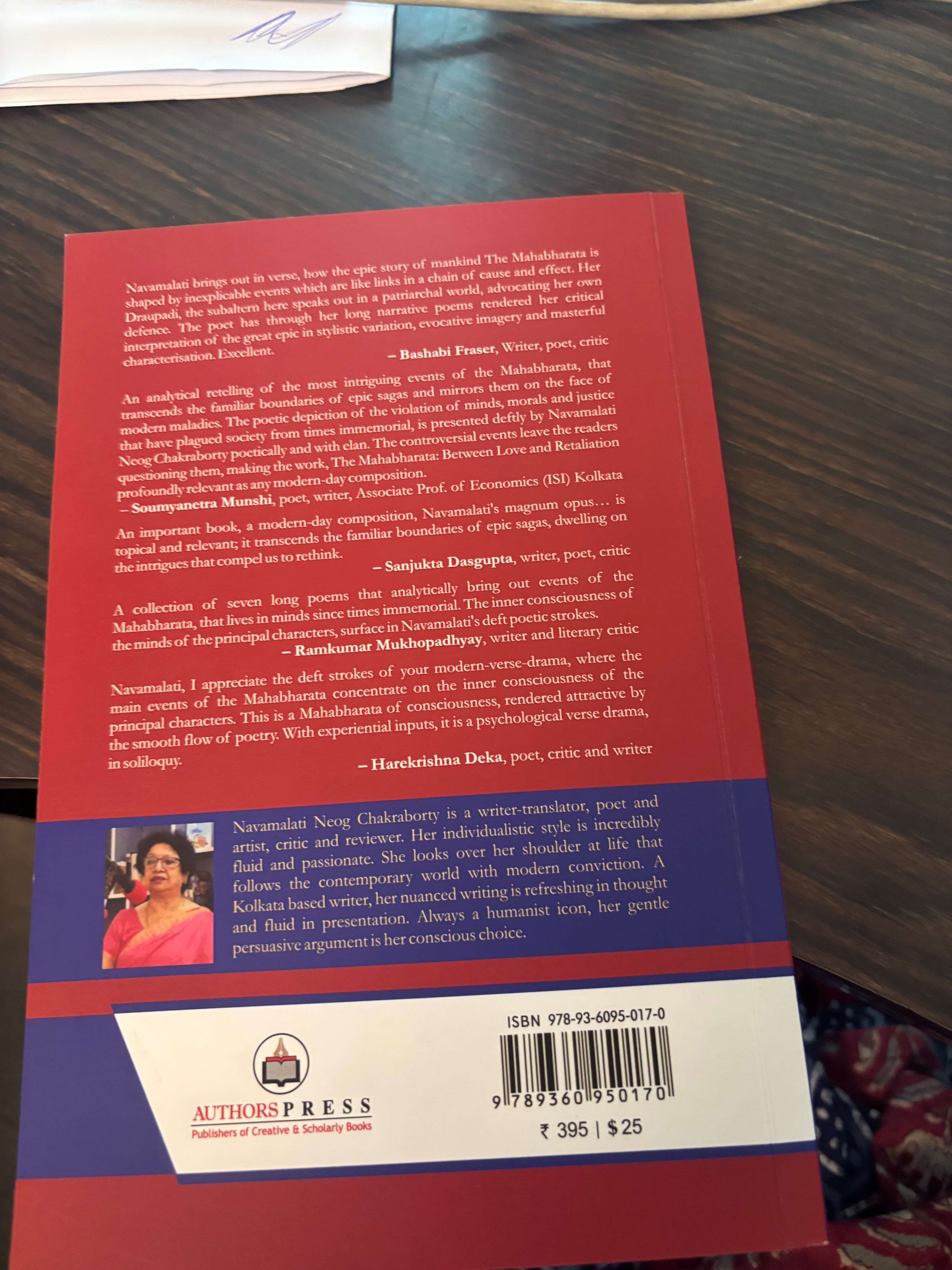
Navamalati Neog Chakraborty’s The Mahabharata will be a much-cited reference book for students, teachers and readers seriously interested in cultural studies, literature studies and ancient classics studies.
Book cover photo sourced by the reviewer

Dr Sanjukta Dasgupta is a poet, short story writer, critic, and translator. She was a General Council of Sahitya Akademi, New Delhi, member and the Convenor English Advisory Board Sahitya Akademi, New Delhi. She is the President of the Intercultural Poetry and Performance Library, Kolkata and has twenty-six published books. Her poems have been translated into German, Serbian, Bengali, Hindi, Punjabi, Kashmiri, and Tamil.

 By
By
 By
By
 By
By