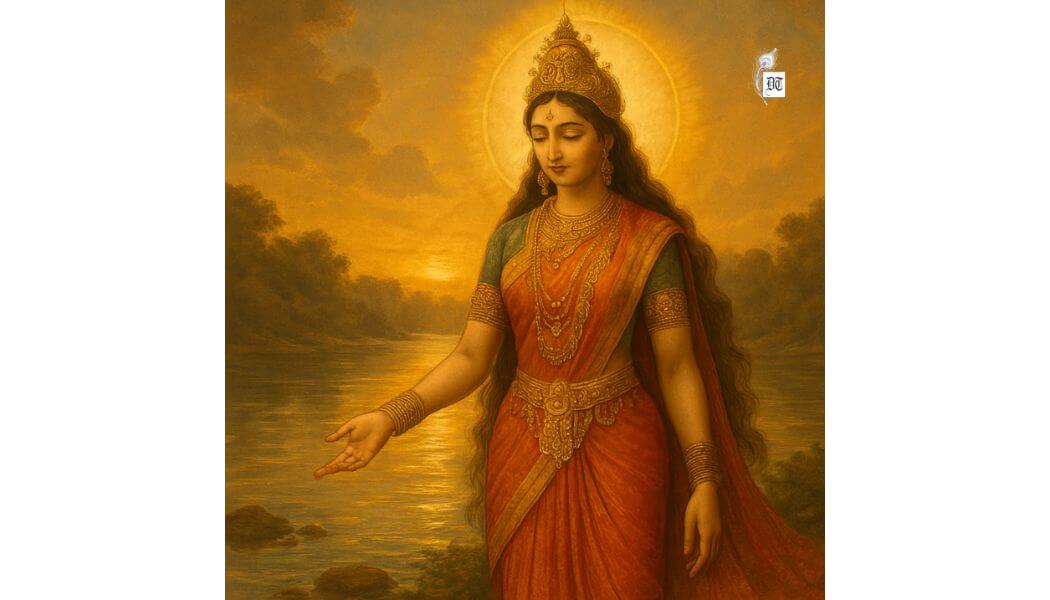
Presenting International Women’s Day’s special feature by Sohini in DifferentTruths.com: Ganga, the Mahabharata’s sovereign river, who set unbreakable terms, defying patriarchy with unapologetic power.

AI Summary
- Ganga enters the Mahabharata as a sovereign river, extracting a vow of non-interference from King Shantanu, inverting epic marriage norms for true autonomy.
- She drowns seven cursed Vasu sons to free them, redefining unsentimental motherhood and rejecting sacrificial tropes, acting without apology.
- When Shantanu breaks the vow, Ganga leaves, raises Bhishma independently, and flows on—embodying fluid feminism that erodes patriarchal containment.
Long before feminism had hashtags, Ganga walked into a kingdom, set her terms, and refused to explain herself.
In the Mahabharata, she is introduced not as a mother or a wife but as a river — vast, uncontainable, sovereign. When King Shantanu first sees her, she is not demure. She is dazzling. And when he proposes marriage, she does not blush or defer. She negotiates.
Her condition is startlingly simple: you will never question me. No matter what I do.
Shantanu agrees.
Let’s pause there. In an epic dense with vows extracted from women, here is a woman extracting the vow. She does not promise obedience. She demands autonomy.
And then she does something that has unsettled readers for centuries: she gives birth to seven sons and drowns each one in the river.
This is usually where Ganga is flattened into cruelty or mysticism. But what if we read her differently — not as a monster, not as a martyr, but as the most radical figure in the epic?
What if Ganga is the Mahabharata’s truest feminist?
The Woman Who Set the Contract
Ganga does not enter Hastinapur as property. She enters it as power. Her terms invert the usual architecture of marriage in ancient epics. She does not ask for protection or status. She demands non-interference.
In modern language, she insists on bodily autonomy and decision-making authority.
Shantanu’s agreement is not romantic — it is political. He wants her badly enough to surrender oversight. But patriarchy has a way of assuming that agreements made in desire can be renegotiated in discomfort.
When Ganga begins drowning their children, Shantanu watches in horror, but he remains silent. Because a promise was made.
We are uncomfortable with this story because it exposes something raw: men often celebrate independent women until independence disrupts their expectations.
Ganga does not soften her terms to preserve his comfort.
The Drowning as Defiance
The seven sons Ganga drowns are not ordinary children, either. They are the eight Vasus, celestial beings cursed to be born on earth. They beg Ganga to release them quickly from mortal life. She agrees.
In mythic terms, she is fulfilling a cosmic request.
In symbolic terms, she is rejecting the idea that motherhood must look one way.
The epic does not show her weeping. It does not show her apologising. It does not show her seeking permission. She acts with a clarity that terrifies the court.
Motherhood, in patriarchal storytelling, is supposed to be sacrificial, sentimental, and self-erasing. Ganga’s motherhood is purposeful and unsentimental. She chooses what she believes is right, even when it defies social expectations.
This is not easy feminism. It is not designed for applause. It is sovereignty without performance.
And that is precisely why it unsettles me.
When the Vow Breaks
The eighth time, when she moves to drown the last child, Shantanu cannot bear it. He stops her. He questions her.
The contract shatters.
Ganga does not argue. She does not plead. She does not negotiate a revised arrangement.
She leaves.
How many women in epic literature walk away from kings without consequence? How many leave power voluntarily rather than cling to status?
Ganga exits with the child – Devavrata, who will become Bhishma – and raises him herself. She educates him. She trains him. She shapes him into one of the greatest warriors and thinkers of his generation.
She does not need Hastinapur to validate her motherhood.
When she eventually returns Bhishma to Shantanu, it is not as a supplicant but as a woman delivering a fully formed heir.
Then she disappears again — back into the river, back into herself.
No clinging. No nostalgia.
Just flow.
Ganga vs. The Good Woman Archetype
Compare Ganga to the other women of the Mahabharata.
Gandhari blinds herself in solidarity with her husband.
Kunti absorbs the scandal in silence.
Madri immolates herself in devotion.
Draupadi is gambled away.
Each of them navigates patriarchy with varying degrees of resistance and compromise.
Ganga does not navigate it. She refuses to inhabit it fully.
She marries, yes. She gives birth, yes. But she never relinquishes her core identity. She is always river first, queen second.
That hierarchy matters.
Modern feminism speaks often of not losing oneself in roles – not dissolving into wife, mother, partner, or professional. Ganga embodied that centuries before the vocabulary existed.
She performs relational roles without allowing them to define her essence.
The Mother of Bhishma — and the Irony
Here’s the sharpest irony in her story: Ganga raises Bhishma, the man whose terrible vow of celibacy and loyalty to the throne becomes one of the structural causes of the Kurukshetra war.
Bhishma’s renunciation — taken so his father can remarry — destabilises succession politics for generations. His loyalty to the throne over justice allows the dice game to proceed. His silence in Draupadi’s humiliation becomes one of the epic’s most damning moments.
The son of the most autonomous woman in the epic becomes the enforcer of patriarchal continuity.
It is a tragic tension. Ganga teaches him discipline and duty. The system teaches him obedience to hierarchy over moral intervention.
And yet, even here, Ganga’s presence lingers as a counterpoint. Bhishma’s fall in the war — pierced by arrows, lying on a bed of steel — is not just the fall of a warrior. It is the collapse of a rigid vow that prioritised order over equity.
If Ganga represents fluidity, Bhishma represents rigidity.
And fluidity, in the end, outlives steel.
The Ecology of Feminism
To call Ganga a feminist is not to impose modern ideology on myth. It is to recognise patterns of autonomy, consent, and self-definition.
She chooses her partner.
She sets contractual boundaries.
She defines motherhood on her terms.
She leaves when those terms are violated.
She raises her child independently.
She returns power without attaching herself to it.
And beyond narrative symbolism, she is literally life-giving water — sustaining civilisations without belonging to any one of them.
There is something profoundly contemporary about that.
Women today are still negotiating contracts within relationships — explicit or implied. Still asserting that love does not nullify autonomy. Still punished when their choices disrupt comfort. Still asked to explain decisions that men are allowed to make without scrutiny.
Ganga never explains.
She acts.
Flow as Resistance
What makes Ganga radical is not defiance for its own sake. It is her refusal to calcify.
Rivers do not apologise for flooding. They also do not seek validation for nurturing. They move according to terrain, season, and internal force.
Patriarchy thrives on containment — on banks and boundaries. Ganga erodes them over time.
Even in cultural memory, she remains untamed. She is worshipped, yes, but never fully domesticated. Pilgrims come to her. She does not go to them.
There is power in that asymmetry.
Ganga in 2026
Read through a contemporary lens, Ganga feels startlingly modern. She would be the woman who signs a prenup without embarrassment. The mother who chooses what is right for her child even when relatives disapprove. The partner who leaves when boundaries are crossed. The professional who refuses to shrink to fit comfort.
She would also be criticised – called cold, selfish, and unnatural.
Women who refuse to perform remorse for autonomy often are.
But the Mahabharata does not punish her. It does not drag her back into submission. It lets her flow on.
That narrative of mercy is significant.
Never Sorry
In the end, Ganga is not a slogan. She is not soft empowerment packaged neatly. She is elemental.
She disrupts.
She nourishes.
She withdraws.
She returns.
And she is never sorry for being vast.
If the Mahabharata is a study of power, then Ganga is its earliest lesson: sovereignty begins with setting terms. And when those terms are broken, leaving is not failure. It is integrity.
Long before courts debated consent and contracts, long before women articulated the politics of autonomy, a river stood before a king and said, ‘Love me.’ But do not control me.
He agreed.
And history has been trying to catch up ever since.
Picture design by Anumita Roy

Sohini Roychowdhury is a renowned Bharatanatyam dancer, choreographer, artistic director, speaker, social activist, and professor of Natyashastra. She founded Sohinimoksha World Dance & Communications in Madrid/Berlin/Kolkata/New York. A visiting professor of dance at 17 universities worldwide, she won several awards, including the “Mahatma Gandhi Pravasi Samman” by The House of Lords, the Priyadarshini Award for Outstanding Achievement in Arts, and the Governor’s Commendation for Distinguished World Artiste. She has also authored several books, including ‘Dancing with the Gods’.
 By
By
 By
By