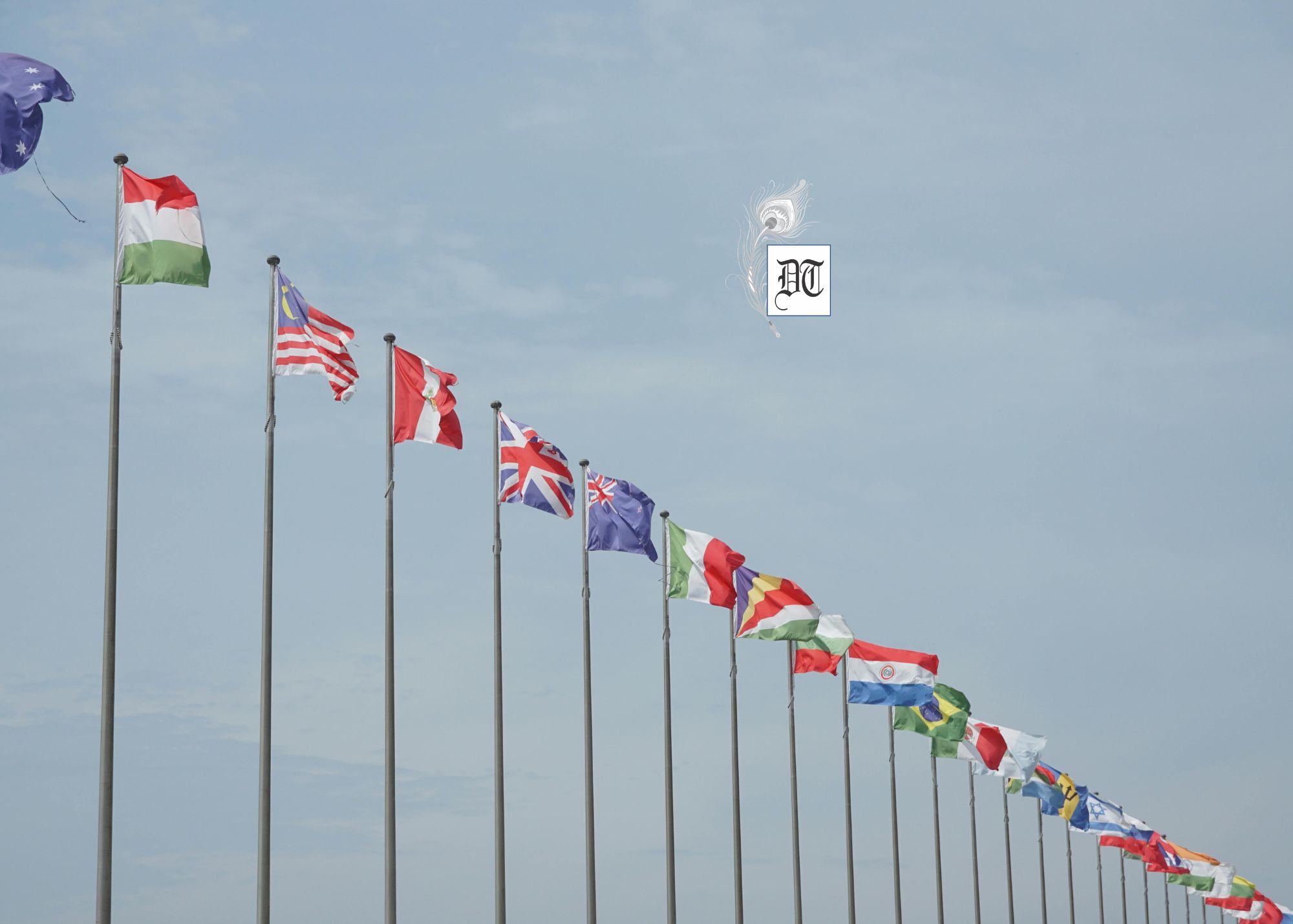
Dr Baljeet dissects NATO’s unity cracks on DifferentTruths.com—from Cold War triumphs to Trump’s bold threats, unravelling the alliance.
AI Summary
- NATO, born in 1949 for collective defence against Soviet threats, proved resilient during the Cold War but faced divisions over Iraq (2003) and Trump’s demands.
- Trump’s aggressive moves—like eyeing Greenland annexation and pressuring allies—widened rifts, culminating in NATO’s 2026 refusal to back US-Israel actions against Iran.
- Potential NATO collapse risks global geopolitics, empowering Russia and China while eroding the US superpower status and post-WWII security order.
The North Atlantic Treaty Organisation (NATO) was formed on April 4, 1949, by the United States of America and some Western countries. NATO currently has 32 member nations, including the United States, Canada, France, Germany, the United Kingdom, Spain and Italy. It was a sort of military alliance with collective security as its principle. Article 5 of its charter stipulated that an attack on one or more members would be considered an attack on all, and they would fight collectively against the common enemy. Initially, the sole purpose of this alliance was to deter the Soviet Union’s expansion with its communist ideology.
During the Cold War period (1949-1991) between America and Russia, this organisation gave proof of its solidarity and tenacity of purpose. For instance, during the Cuban Missile Crisis of 1962, the Soviet Union had to withdraw missiles from Cuba when threatened by America and its NATO allies. Similarly, when the Soviet Union invaded Afghanistan in 1979, the NATO allies indirectly supported the rebel Mujahedin to halt its expansion.
With the dissolution of the USSR in 1991, this alliance got further strengthened as the United States became the sole superpower of the world. In the wake of September 11, 2001, the incident when the World Trade Center Towers in New York were destroyed by the Al-Qaeda militants, NATO invoked Article 5 of its constitution and wholeheartedly joined America in its ‘War on Terror’. Consequently, all Al-Qaeda centres were dismantled in Afghanistan, and the Taliban regime was overthrown.
However, while pursuing his policy of ‘War on Terror’, when President George W. Bush attacked Iraq in March 2003 on the assumption that it possessed ‘Weapons of Mass Destruction’, NATO allies France, Germany, Greece, Norway and Turkey refused to participate, stating that it would create instability in the region and it had no United Nations authorisation. On the other hand, the United Kingdom, Australia and Poland participated in it. It was the first crack that appeared in the unity of NATO.
With the accession of Donald Trump as President of the United States, the gulf between it and NATO nations widened. Initially, in order to pressurise European nations to toe the line, Trump demanded they defend themselves and spend two per cent of their GDP on the military. He even threatened to withhold the weapons supply to them and withdraw American troops from their territory, stationed there for their protection. He pressured Germany to abrogate the Nord Stream 2 pipeline project, which would increase Germany’s dependence on Russia for energy. Further, warning the European nations of their liberal migrant policy, he said it would destroy Western culture and civilisation.
During his second term, President Trump announced to annex Greenland, an autonomous territory under Denmark, even by force, citing national security concerns. Denmark, NATO nations and some EU countries vehemently opposed this drastic move of the United States, stating that it could end NATO, and came to the defence of Denmark and Greenland. Trump threatened to impose a 10-per cent tariff on goods of Denmark, Norway, Sweden, the United Kingdom, France and Germany, which could subsequently be increased to 25 per cent if Denmark refused to sell Greenland to America. But sensing stiff resistance from NATO, he had to retrace his steps. Trump was also vocal in making Canada the 51st state of America, but here again, he faced severe criticism. Denmark and Canada are NATO states, and the annexation moves by President Trump regarding Greenland not only offended them but also drove them away from America.
On February 28, 2026, when America-Israel launched a military campaign against Iran, the NATO nations refused to support America, stating that Iran posed no immediate danger to America and that they had not been consulted beforehand. The prime minister of Spain, Pedro Sánchez, said in unequivocal terms that the invasion is illegal, unjust and against international law. Spain, therefore, denied permission to the United States to use its military bases and airspace for operations against Iran. President Emmanuel Macron of France also responded in the same way.
Kier Starmer, Prime Minister of the United Kingdom, said that for him, British interests are foremost and refused to bow to pressure. Prime Minister Giorgia Meloni of Italy also denied permission for the United States military aircraft to land at an air base in Sicily. Friedrich Merz, a candidate for Chancellor of Germany, said that they were not part of this war and therefore refused to participate in it. When the NATO nations refused to send their warships to open the Strait of Hormuz, a crucial shipping route, the President called them ‘cowards’ and the alliance a ‘paper tiger’.
Recent heightened tensions between the Trump administration and its NATO allies indicate a danger to the alliance’s unity and integrity. If, at last, NATO disintegrates or cracks, it could have profound repercussions on geopolitics. The post-World War II order of collective security would collapse, leading to the emergence of new strategic alliances. NATO nations would have to spend more on their defence as they could no longer rely on the United States for their security.
Right from the beginning, Trump has repeatedly threatened and warned them that if they do not toe the line of action in Iran, he would withdraw troops from their territory and halt weapons supply to them. In addition, he has said he would withdraw from NATO because it is of no use to the United States as it does not serve its interests.
Should this occur, European allies would be weakened, and Russia would likely exploit the situation to expand its power. It could pressure individual Eastern European countries to make deals with it. Moreover, if the United States cuts off the weapons supply to both Ukraine and NATO partners, Russia’s chances of early victory over Ukraine are likely to increase, as Kyiv relies heavily on Western defence support.
Furthermore, NATO’s collapse could also hit the United States’ superpower status because the latter’s all military and trade agreements with the former could be abrogated, affecting its strong economy. In that case, China, the second-largest economy, can take advantage of the prevailing situation to become the dominant global power.
Picture design by Anumita Roy

Dr Baljeet Singh Virk is an accomplished academic holding an MA degree in History and English, alongside an MPhil and PhD from Punjabi University, Patiala. A distinguished scholar in Sikh history and geopolitics, he combines historical wisdom with global affairs through rigorous scholarship. He possesses thirty years of extensive teaching experience in government colleges, instructing both graduate and postgraduate students. Additionally, he has served as a member of the Board of Studies in the Faculty of Social Sciences at Punjabi University and as an NSS Officer while maintaining a practical working knowledge of computer systems for his professional duties. He is our Associate Editor: Geopolitics, International Relations and History.



 By
By
 By
By
 By
By