
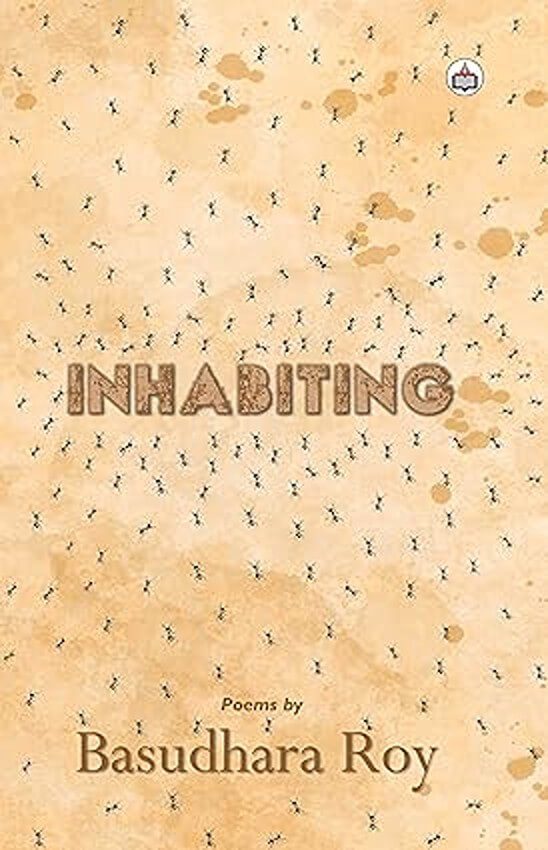
Basudhara Roy’s “Inhabiting” is a collection of poetry that explores the complexities of life through a deeply personal lens, reviews Dr Sutanuka, exclusively for DifferentTruths.com
Basudhara Roy is an academic and poet based in Jamshedpur. Inhabiting is her third collection of poetry. “..braided together in an existential exploration of the self in the world and the world in the self, Basudhara Roy’s deeply subjective poems skilfully fuse and yet
redefine and even transcend the known parameters of habitat, habit, and habitation,” writes Sanjukta Dasgupta in the blurb of the book. “The heart gathers,/ in this night’s moment,/ some pain—dark as kohl-/ from life’s full flame./ In oblivion, many days/ hence, a poem is born./Unfathomable to the / world, the poet alone/ knows, mother-like, where it comes from”. The opening poem “Nativity” sets the mood of the collection and is an exquisite display of poetical harmony and virtuosity. “Return” helps us to look at life from close quarters in a more inclusive, kind, and pragmatic way and changes the perception of returning to oneself. “I will sit tonight under my tree of words, / empty-handed, empty-hearted, ask to describe/ this exhaustion, this gash, this herb, this surfeit/ with the world and never having enough to hold”. There are 55 poems in this simply written collection of poetry that make accessible complex issues of life —cultural, social, and everyday struggles.
Modest and unpretentious, written with effortless charm Inhabiting is a collection of poetry that will arrest the interest and attention of any reader who is interested in poetry. Roy puts pertinent questions through these poems—how is it that no one ever speaks of the hours of labour that break the resistance of the fabrics worn by women to give them their womanly smoothness? –“lingering with the smell of cheese, corn,/ capsicum, takes up so much room that/ some questions I am content to leave/ to time and unregretfully go without”. The readers are struck by the fact that what most changed readers’ views are the day-to-day struggles that peppered the collection with– “One must allow for bad weather/ except that, with you, the weather/ is mostly bad./ Bad seasons run/ down your skin, the better ones/ determinedly burrow in and rise/ locust-like, to claim your ease.”
“This collection, sensitively, articulates the many trials that women face every day, their claiming of moments, shifting of moods, and their perception of society,” writes Jaydeep Sarangi in the Foreword to the book. “Epiphany” proves that Roy’s forte is building up poetic
textures that lend a contemplative quality and tranquillity to her poetry. “Was I changed in a dream/ or did I wake up inhabited/ or could I have/ by any chance/ been disposed again”. ‘Kitchen’ is a leitmotif in her works it is a constant that adds stability to them—“The last
time you spoke of ice,/ I was knitting a shawl, beside/ me a couple of scented promises/freshly lit, while in the kitchen,/ the stew gurgled merrily for/ dinner”—these metaphors used by Roy to birth her unique vision of ‘feminine’ labour. The constant attempt of the poet to
play fast and loose with memory might remind the readers of a cinematic style—“ a body adorned by gold fetters of every sort/ and a talisman that she would never lack anything/ as long as she did not lag,/ my grandmother hustled to tie in her anchol,”. Memory is a
mnemonic reservoir –it is a powerful tool to negotiate the unstipulated relationship between the past and the present.
Roy constantly creates a web and her simple statements — “Woman-to-Woman” is the signpost of a formidable mind, “only when the/ earthworm in your soil; only when the/ sky stretches above you free, and winds/ from all four directions lap against your/ limbs; / only
then, know you’ve arrived”. “Rules for a Rape Republic” tries to explore the emotional churning of the social stigma associated with sexual violence through the interrogation of a gendered subject. “The ruins won’t speak, you see. It will be/ difficult to conjure from ashes the story of/ gags, rips, mauls, thrusts; to discover trails/ of blood-semen branded on thighs. On the/ brighter side, your clothes will retain dignity/ in death”. The poem delivers a compelling reprimand of society’s penchant for moral judgement. The titular poem
“Inhabiting” is a compelling duet of the poetic persona and the woman that she is—“It is to find/ words for forgetting,/ to find sufficiency/ for what is frayed, disfigured,/ flawed”. Women perhaps throughout their lives try to ‘inhabit’/’co-habit/ occupy a place or space in
their own flawed ways. Inhabiting rings true to the soul of the readers.
Picture procured by reviewer

Dr. Sutanuka Ghosh Roy is an Associate Professor in the Department of English at Tarakeswar Degree College, The University of Burdwan, India. She is a reviewer, a critic, and a poet. The titles of her books are Critical Inquiry: Text, Context, and Perspectives and Commentaries: Elucidating Poetry, Rassundari Dasi’s Amar Jiban: A Comprehensive Study, Asprishya (The
Untouchables, a novel by Sharan Kumar Limbale translated into Bengali). Opera is her debutant collection of poetry.



 By
By
 By
By
 By
By