
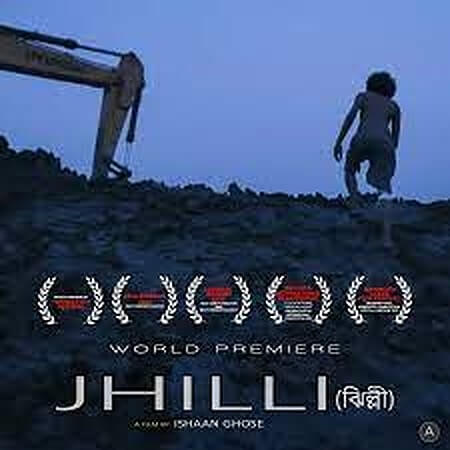

Ruchira reviews the film Jhilli, a shocking cinematic masterpiece that explores the struggles and endurance of marginalised populations in Indian metros – an exclusive for Different Truths.
This is one movie the viewers will not forget in a hurry. Indeed, it is a one-of-its-kind artistic piece that powerfully depicts on celluloid the seamier side of modern life in Indian metros. For the bourgeoisie, the bold, beautiful, and influential individuals of society, this is undoubtedly going to be a revelation in the sense that it vividly portrays how the have-nots, the flotsam population eke out their livelihood, and the level of human endurance instilled in their mortal frames.
It would be no exaggeration to say that debutante director Ishaan Ghose’s Jhilli (trans: discards) is one of the most revolting, stomach-churning, gut-wrenching, nauseating films ever made. And therein lies its success.
The dramatic events of Jhilli unfold in and around Dhapa, the iconic dumping ground cum sanitary landfill …
The dramatic events of Jhilli unfold in and around Dhapa, the iconic dumping ground cum sanitary landfill – one of the largest in the country – in the vicinity of Kolkata. Never has the underbelly of a vibrant, pulsating city been captured so meticulously.
The story revolves around the sordid, dreary lives of a handful of humans whose very existence is inextricably linked with Dhapa’s ambience and scheme of things. Bokul (Aranya Gupta) earns a living from whatever he can lay his hands on, including rubble and bones, and what have you! He is an excessive stoner, so much so that the narcotics almost paralyse his brain and nerves; the difference between reality and illusion is blurred, and days melt into nights…however, he is blissfully unaware of it all! Ganesh (Bitan Biswas), a highly enterprising guy, teams up with Guddu (Sayandeep Guha) to sell second-hand goods on the streets. A desperate bid to escape the oppressive atmosphere of Dhapa. Other prominent characters include the boys’ libidinous elderly companion Shombhuda (Shombhunath), an epitome of frustration, and lastly, the transgender Chompa (Sourav Nayak), who is perpetually mocked, harassed, and ridiculed by the denizens of Dhapa.
The youth are stupefied to learn that the trash yard will soon be cleared to make space for modern infrastructure. Sheer frustration and angst become palpable in their speech, body language and movements. And Bokul is hit the hardest. Even though these guys lead a sub-human existence, they can’t reconcile with renovation and redevelopment. While the bulldozers are shown furiously clearing the garbage, Bokul is heard screaming in their direction, “Sorkar tomader ki diyeche?” (What has the government given you?) Here you have the crux of their penury that will rankle everybody’s conscience.
A word of caution. The movie is not for the delicate, sensitive, or faint-hearted.
A word of caution. The movie is not for the delicate, sensitive, or faint-hearted. The discerning viewers must brace for horrific, gruesome, and lurid scenes. At the same time, the film runs viz the burning corpse of a fellow worker amidst Himalayan filth, Bakul and Ganesh’s bawdy jokes and ribaldry with Shombhuda, Bakul rifling through putrid carcasses of animals to extract.
Their bones and eating tidbits with grimy hands, to name a few. I confess I shut my eyes several times. Hideous is an understatement.
By mastering strokes of his artistic craft, the director weaves an element of symbolism into the story. The scenes where the protagonist and his friends look up at the flying overhead aeroplanes highlight the stark contrast between their miserable, darkened lives and urban civilisation. Their thwarted hopes, aspirations, their savage struggle for existence are juxtaposed with opulence, modernity, and sophistication. That, concisely, dear friends, is the ultimate reality of life.
The most poignant scene of all is the concluding one. Following their eviction, a considerable length of time has elapsed. Bokul returns to the familiar area only to find that not even a faint trace of his past life remains. The humongous piles of garbage have yielded places to high-rises, parks, and metallic roads. He is too stunned to react!
The title Jhilli is aptly dedicated to all the faceless humans whose voices remain unheard…
The title Jhilli is aptly dedicated to all the faceless humans whose voices remain unheard, but they do exist. “It features the underdogs of society whom we spot out of the corner of our eyes but never actually notice,” Ghose was quoted as saying in one of his interactions with the media.
Picture of the movie poster from the internet

Ruchira Adhikari Ghosh brings a liberal, wide-ranging outlook shaped by extensive travel across India and abroad. Educated at Holy Child School, New Delhi, Sacred Heart Convent, Ludhiana, and Panjab University, Chandigarh, she holds a Master’s in English Literature and a postgraduate diploma in Journalism and Mass Communication. With three decades in media, she writes on travel, books, music, performing arts, women’s issues, and especially food, drawing inspiration from rich life experiences. She is our Features Editor.


 By
By
 By
By
 By
By