
Dr Roopali reviews Neelam Saxena Chandra’s novel, Karmic Threads, exclusively for Different Truths.

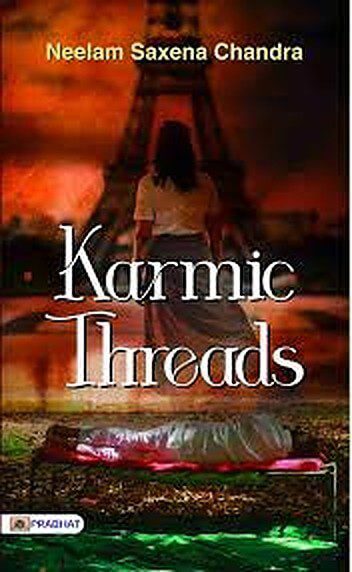
Neelam Saxena Chandra’s novel Karmic Threads is dedicated to “all those who are abused or in pain but can carve their path with the thousand splendid suns in their soul.” While in Paris, Saxena encountered immigrant women abandoned by their spouses. This stirred her mind and led her to write one such story, which in a way, tells their stories.
In many parts of the world, societal inequities continue due to obscurantist religious and customary practices. Women are held prisoner in the name of dharma and karma.
The internalising of patriarchy by women has led to acceptance and surrender.
The internalising of patriarchy by women has led to acceptance and surrender. This has been detrimental to their fulsome development as citizens with equal rights.
In India, marriage is at the core of social relationships. Marriage is also central to the narrative of Saxena’s novel. Marrying off girls to unknown Indian men living in foreign countries is common, especially in the northern Indian state of Punjab.
This has caused much grief and misfortune in many families. The lure of money and the expectation of a good life draw women and men into risky marital alliances. Most times, these are fraught with tragic consequences.
One frequently reads of wife murders committed by educated greedy young men.
Dowry is the main motive in such alliances. One frequently reads of wife murders committed by educated greedy young men.
The first chapter in Karmic Threads situates at the Eiffel Tower in Paris. It is painted in stark black and white. Steeped in shock, fear, deception, abandonment, grief and estrangement, the novel begins on a deep tragic note.
We embrace the emotions that the female protagonist Monika is going through. At the same time, our curiosity and concern are also aroused. What will happen to Monika? How will she overcome this fearful situation?
The story moves in a cinematic flashback.
Monika’s husband, Tanishq, turns out to be a conman.
Monika’s husband, Tanishq, turns out to be a conman. A scoundrel whose job is to win the affection of eligible women, negotiate a large dowry, abandon them in foreign countries, and vanish!
But he is not the only man in her life to deceive her. Her greedy paternal uncle, chachaji, takes charge of her after the death of her father and brother in a horrible car accident. The mystery of the accident is revealed in the concluding chapter.
We must look at Saxena’s understanding of human frailty. That good can also cause pain.
The male protagonist is a Sikh boy, Gurpreet. He is loving and caring and keen to marry Monika. His goodness and kindness are obstacles. His lack of courage pushes Monika into a horrifying situation with her conman husband. She is unable to forgive Gurpreet.
The narrative is a crisscross of human relationships.
The narrative is a crisscross of human relationships. Friendship plays a redeeming role beyond blood. There is plenty of ironies as we watch the wicked, greedy uncle’s children.
Every character must undergo suffering resulting from untangling the karmic threads. Monika is educated but cannot resist others controlling her life. She has no career and is dependent. She must undergo suffering before finding happiness.
But life’s experience strengthens the female protagonist. We begin to see an empowered woman who makes her own decisions. For her, it is a transformative journey.
The novel rushes, weaving its way through episodes and characters.
The novel rushes, weaving its way through episodes and characters. Its film script-like narration brings to life people and places. It builds the reader’s curiosity to know what lies ahead.
Karmic Threads cautions us and heightens our concerns about married immigrant women abandoned in foreign countries.
It is a book difficult to put down.
Cover photo by the reviewer

Dr. Roopali Sircar Gaur is a poet, travel writer, and social justice activist. A former professor of English Literature at Delhi University, and a creative writing professor at IGNOU, she is a widely published academic and creative writer. Her book Twice Colonised: Women in African Literature, is a seminal text on women’s socio-political empowerment. In 2020-21, she co-edited two poetry anthologies – In All the Spaces: Diverse Voices in Global Women’s Poetry, and Earth Fire Water Wind.


 By
By
 By
By
 By
By