
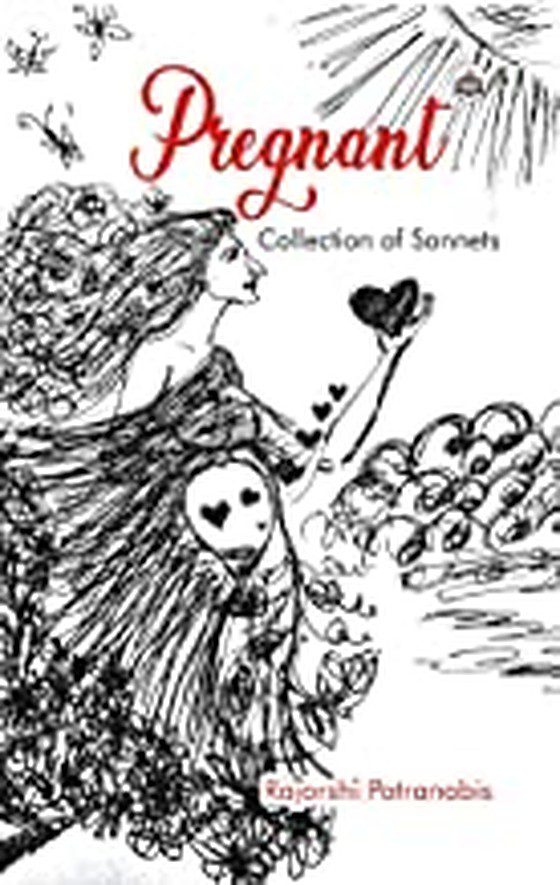
Dr. Sutanuka reviews Pregnant: Collection of Sonnets by Rajorshi Patranabis. An exclusive for Different Truths.

Title: Pregnant: Collection of Sonnets
Author: Rajorshi Patranabis
Page: 72
By profession, Rajorshi Patranabis is a food consultant. However, he forayed into poetry from an early age. He is a multilingual poet writing in English, Bengali, and Urdu. He is also a translator and has translated Assamese poetry into Bengali. He’s widely published in national and international online journals. His Bengali poetry has also been translated into Assamese. His collection of poems includes Crossover, Feriwala – collection of Bengali love poems, Nirjon Saikat-Luit Hooghly — his maiden translation project where he translates Assamese poems to Bengali. The present book Pregnant is a collection of sonnets.
Rajorshi Patranabis… is a multilingual poet writing in English, Bengali, and Urdu.

A sonnet writes M.H. Abrahams (A Glossary of Literary Terms), is “a lyric poem written in a single stanza, which consists of fourteen iambic pentameter lines linked by an intricate rhyme scheme”. In English, the rhyme follows one of two main patterns: the Italian or Petrarchan sonnet – an octave (eight lines) rhyming abbaabba and a sestet (6 lines) rhyming cdecde or some variant like cdccdc. The English sonnet or the Shakespearean sonnet falls into three quatrains and a concluding couplet: ab ab cd cd efef gg. When a contemporary poet chooses to write sonnets and experiments with the rhyme scheme naturally the readers are intrigued. The poet writes in the Poet’s Note that he “had personally never believed in deep technical nuances of poems. This collection is of sixty poems, each bound in fourteen lines and the positions of quatrains and couplets have experimented within some of them”.
In the Foreword to the book, Ampat Koshy writes, “his poems follow a pattern he has evolved over the years of three or four stanzas with a closing couplet where the lines are longer than the rest of the lines in the poem”. He also experiments with the rhyme scheme. In a poem called “Cross,” he follows a different pattern. The title of the collection immediately draws our attention, apart from (of a woman or female animal) having a child or young developing in the uterus, “pregnant” also means full of meaning; significant or suggestive. As we go through the poems the meaning of “pregnant” becomes more reflective. The opening poem “Unstoppable” narrates a story in each word and line, “Closed doors nurture a story/ Of myriad nuances, subtle and gory/ Meticulous ploys to create distance/ Crowned hegemony pampered substance” (13).
Patranabis has looked at the ‘sonnet’ form in many ways.
As one flips the pages one is reminded of Wallace Stevens’s poem Thirteen Ways of Looking at a Blackbird. Patranabis has looked at the ‘sonnet’ form in many ways. As the poem’s title Pregnant suggests, these poems feature different perspectives full of meaning, significant or suggestive, with the sonnet taking on many disparate meanings as the poems unfold. The poems are more about evoking certain feelings in the reader than in making any particular argument about sonnets. Overall, though, the poems do seem to suggest that reality is always a matter of perspective — that each person looks at and understands the world in their way. Rejection of the singular perspective has of course been the standout singular trend in this collection of poems. “Devastation deviates, withered drain/ A new beginning, afresh we start again” (“Start Again”, 17).
“Eclectic remains define your eyes/ Your pragmatic views on my fragility” (“Fault”, 18). The poet retrieves from the ensnaring clutter of his social milieu and asserts his individualism. His Muse fills his abundance. The title poem “Pregnant (22)” speaks of a fragile, reflective, feminine sensibility — “Evening ushered, my water broke/ Eyes gave vent, tasted salt/ Bled through my heart, the very last drop/ I saw a life, hungry for me”. “Completion (29)” speaks of his strident clarity in images — “Crooned in silence/Silence, that devours. /Cuckoo’s lonely song/Song, that springs./ Closed my eyes/Eyes dream you.” The dashes, dots, small lines repeated all over this collection of sonnets to define volume correspond to the love for his Life/Muse. Poems like “Ravan (30)”, “Reminiscence (33)”, “Uncaged (40)” are visual fragments, rife with suggestions that float through one’s unbidden musings. In “Flash(64)” the poet dreams of an impending dream or “Of years beyond”, he lies in “circles of whirlwind”, in pain and flash of pain, happy nostalgia, and waits till he loves again. Patranabis grapples with the multiple layers and random juxtapositions that run through memory without following a set pattern.
Pregnant is surely impregnating its readers with more meaning of life.
Cover Photo sourced by the reviewer and visual by Different Truths

Dr. Sutanuka Ghosh Roy is an Associate Professor in the Department of English at Tarakeswar Degree College, The University of Burdwan, India. She is a reviewer, a critic, and a poet. The titles of her books are Critical Inquiry: Text, Context, and Perspectives and Commentaries: Elucidating Poetry, Rassundari Dasi’s Amar Jiban: A Comprehensive Study, Asprishya (The
Untouchables, a novel by Sharan Kumar Limbale translated into Bengali). Opera is her debutant collection of poetry.



 By
By
 By
By
 By
By
 By
By