
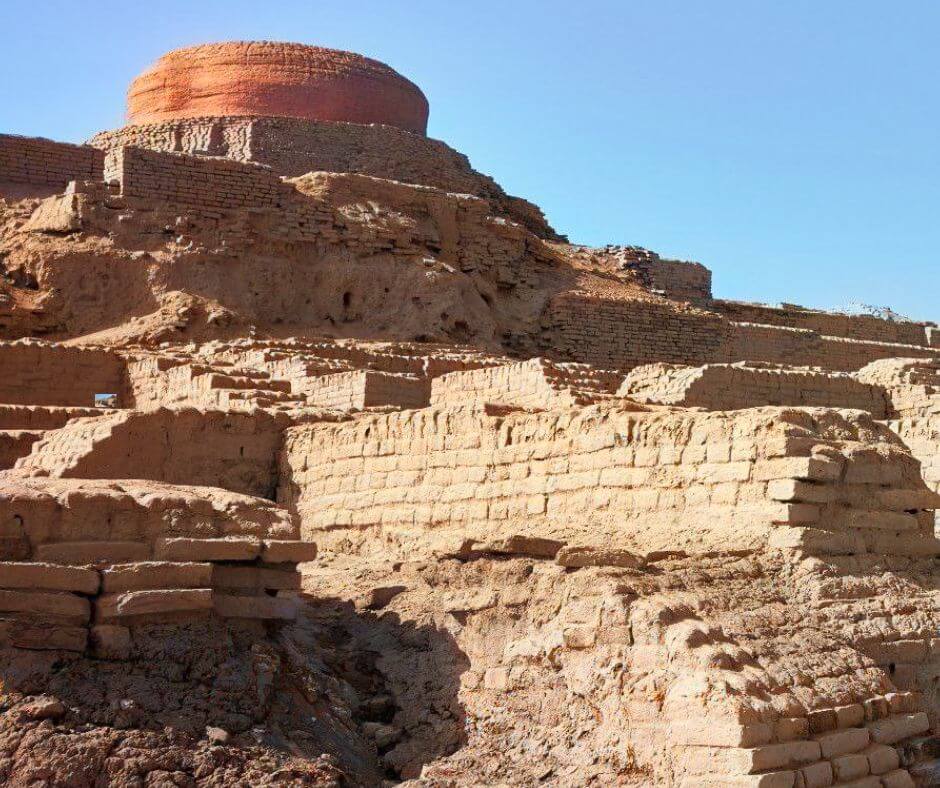
The Harappan people developed the most precise measurements people had six thousand years ago. Harappan people developed the most precise measurements people had six thousand years ago, informs Tapati, in the regular column, exclusively in Different Truths.

This morning seemed to be a one of great achievement as I stepped off the weighing machine with a smile of happiness; I thought the machine had become redundant since the needle refused to move for a long time. But today it worked and moved to show a reduction, a result of sincere efforts of munching salads and fruits and walking unearthly hours in morning and evening.
“It’s wrong, the machine at the clinic shows the right one”, the comment from another corner shattered my zeal.
The calling bell rang and the delivery boy brought a tiny packet of a loaf I had ordered.
“I ordered for the bigger pack?” I exclaimed.
“Yes aunty, the package has been changed; now it has 385 gram instead of previous 450 gram.” The boy smiled and left me in a mathematical quiz in counting the lesser supply and the price ratio!
The size of the bread slices have become smaller and thinner but whom to complain?
No standardisation prevails in this land!
“Older times were much better” I was frustrated to declare.
“Yes, indeed on some occasions they were far better.” It was the voice of my historian friend on his weekly visit on Sundays. “To talk about standards, I have interesting things to share.” He was ready with his data and this time, I was looking for it!
Harappan people developed the most precise measurements people had six thousand years ago. They used a standardised system of weights based on the ratios: 1/20, 1/10, 1/5, 1/2, 1, 2, 5, 10, 20, 50, 100, 200, and 500, with the unit weight equalling approximately 28 grams (and approximately equal to the English ounce or Greek uncia). A total of 558 weights were excavated from various cities in Sindhu valley.
Indus traders weighed their goods on scales, using stone weights. The scale pans were made of copper. Standard weights and measures were developed by them. The centralised weight and measure system served the commercial interest of Indus merchants as smaller weight measures were used to measure luxury goods while larger weights were employed for buying bulkier items, such as food grains etc. Weights existed in multiples of a standard weight and in categories.
They used a standardised system of weights based on the ratios: 1/20, 1/10, 1/5, 1/2, 1, 2, 5, 10, 20, 50, 100, 200, and 500, with the unit weight equalling approximately 28 grams (and approximately equal to the English ounce or Greek uncia). A total of 558 weights were excavated from various cities in Sindhu valley. There are not many significant differences between the weights that were excavated from different periods and layers. This was evidence that strong control existed. The 13.7-g weight seems to be one of the units used in the Indus valley. The notation was based on the binary and decimal systems.
Archaeologists have found stone cubes which are clearly used as weights which increase in a ratio of 5:2:1 with weights of 0.05, 0.1, 0.2, 0.5, 1, 2, 5, 10, 20, 50, 100, 200, and 500 units. The actual weights do not match with any of the systems of Egypt or Mesopotamia and look like it has been a locally invented system. Their craftsmen took care to ensure durability and accuracy of stone weights by blunting edges before polishing. In order to maintain one standard, they mass produced weights in different geometrical shapes.
“Amazing”, we were left awed by our historian friend.
Picture design Anumita Roy
#Scale #NowAndThen #Egypt #Mesopotamia #Weights #Scale #History #Craftsmen #GreekUncia #Accuracy #Harrapan #DifferentTruths

Tapati Sinha is educated from schooling to Post-Graduation from Visva-Bharati University with a Doctoral degree from Nagpur University in A.I.H.C.A. She loves Indian literature, Indian and world history and continues her personal research. She picks her subjects from various spheres including historical data, daily experiences of life and varied work places. Tapati is passionate to pursue her writings, novel, poetry, short stories on multifarious topics, past and present under the pen name Anjali.

 By
By
 By
By
 By
By
 By
By
Mrs.Tapati Sinha
what a wonderful ~ all the hidden facts & figures around.
Amazingly portrayed… as usual we all get enriched ( DIDI)
Heartiest Congratulations
Thank you so much
Subho Sarkar
Thank you, Dr. Tapati Sinha, for reminding us of who we are!
Lest we forget …