
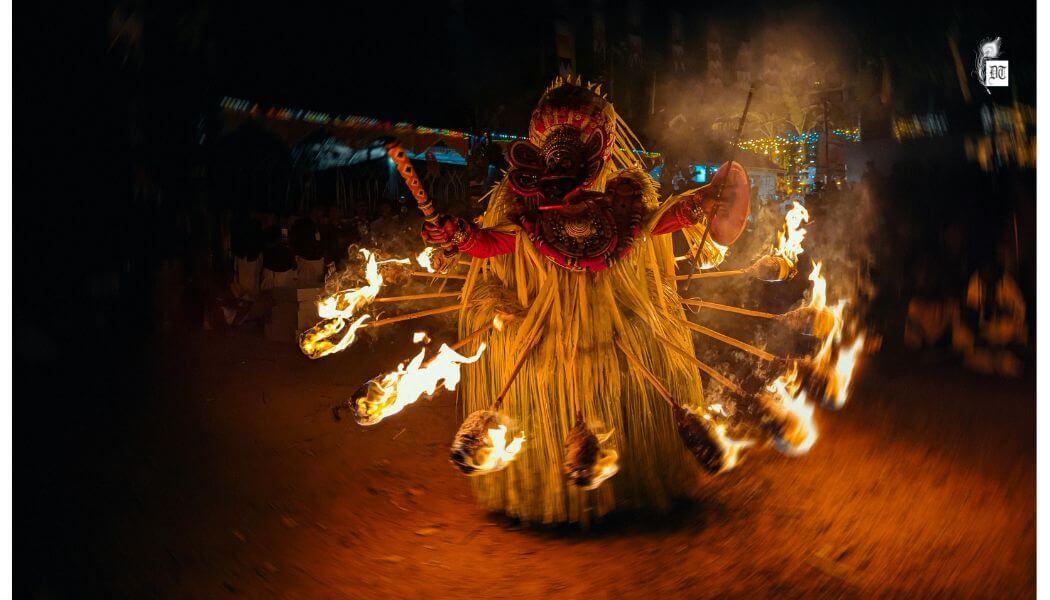
Sohini explores the ancient, electrifying ritual of Theyyam for DifferentTruths.com, capturing a living cosmology where humanity and divinity converge.
AI Summary:
- Social Inversion: A radical tradition where marginalised communities become vessels of divinity, temporarily collapsing rigid caste hierarchies.
- Embodied Theology: More than a performance, it is a visceral transformation involving intricate face art, heavy costumes, and fire.
- Cultural Archive: Preserves local histories of deified ancestors and warriors through immersive, nocturnal rituals in Kerala’s sacred groves.
On certain nights in northern Kerala, the air itself seems to hold its breath. The coconut palms stand still. Oil lamps tremble in the dark. Drums begin — not as music, but as invocation. And then, from within the flicker of flame and vermilion smoke, a figure emerges: towering, incandescent, crowned in impossible architecture of cloth and bamboo and mirror. His face is a mural of red, white, and black — geometry sharpened into divinity.
This is Theyyam — a ritual performance so immersive, so visceral, that the word “performance” feels inadequate. In this moment, a man does not portray a god. He becomes one.
Practiced primarily in the districts of Kannur and Kasaragod, Theyyam is one of India’s most ancient and electrifying ritual traditions. The term derives from daivam, meaning “god.” Yet to describe Theyyam simply as devotional theatre is to misunderstand its audacity. It is theology embodied. It is history in motion. It is a social revolution disguised as ritual.
And in a world increasingly hungry for authenticity — for traditions that refuse to flatten into spectacle — Theyyam stands as one of the last living cosmologies.
Origins: A Ritual Without a Single Founder
Unlike codified classical forms such as Kathakali or Bharatanatyam, Theyyam has no single founder, no treatise, no royal court that claims its invention. Its origins stretch back over a millennium, evolving from the animistic and hero-worship practices of Kerala’s indigenous and agrarian communities.
Scholars trace its early forms to pre-Brahmanical Dravidian traditions — rituals honouring mother goddesses, serpent spirits, forest guardians, and ancestral heroes. Over centuries, these local deities were absorbed into a wider Hindu framework, intertwining folk cosmology with Shaivite and Shakta theology.
Communities such as the Vannan, Malayan, Velan, and Pulayan castes became hereditary custodians of the art. In a profound social inversion, those historically placed at the margins of Kerala’s caste hierarchy became the ritual vessels of divinity.
Theyyam did not begin with a king or a saint. It began with the people.
A Stage Without Walls
Unlike the proscenium dramas of classical dance or the polished symmetry of temple festivals, Theyyam unfolds in intimate village shrines and sacred groves known as kavus. There are no velvet curtains, no ticket counters, no backstage.
The night sky is the ceiling. The earth is the stage.
Preparations begin long before the drums. The performer, often from hereditary Theyyam families, observes ritual disciplines — fasting, prayer, abstinence. The transformation is meticulous. Hours are spent painting intricate patterns on the face, each line sacred, each colour symbolic. The costume — layered skirts, metallic breastplates, towering headgear — can weigh over 30 kilograms.
By the time the final mirror is fixed onto the headdress, the man beneath has already begun to dissolve.
The drums crescendo. The performer circles the shrine, feet stamping in escalating rhythm. The air thickens with chant and fire. And then, somewhere between breath and beat, something shifts. His eyes blaze. His movements sharpen into something both human and not. The crowd murmurs: the deity has arrived.
From that moment until dawn, he is no longer addressed by his given name. He is Bhagavati, or Gulikan, or Pottan Theyyam. He listens to grievances. He blesses children. He dispenses justice. Upper-caste landlords bow before him. Devotees touch his feet.
For a few incandescent hours, hierarchy collapses.
The Gods of the People
Unlike the sanitised pantheon of formal temple worship, the deities of Theyyam are startlingly local — and radically democratic. Many are deified ancestors, warriors who died unjust deaths, women who resisted oppression, spirits of forests and serpents and boundaries.
One of the most striking figures is Pottan Theyyam, often associated with an incarnation of Shiva who challenges caste arrogance. His narratives critique social injustice and mock hollow ritualism. Another powerful form, Muchilottu Bhagavati, honours a woman wronged and deified. Kathivanoor Veeran commemorates a fallen warrior whose story blends heroism and tragedy.
Through these figures, Theyyam becomes an archive of memory — preserving stories that official histories often omit.
Fire as Language
Fire is central to Theyyam. Performers dance through flames, circle burning torches, and leap across embers. The crackle of fire is not a spectacle but a metaphor: transformation, purification, danger.
There is a Sanskrit aesthetic term — adbhuta — for the rasa, or emotional flavour, of wonder. Theyyam lives in that register. It exists between theatre and trance, choreography and possession.
Masters of the Form
While Theyyam remains rooted in hereditary lineages rather than celebrity culture, certain artists have become widely respected for their mastery and for bringing the tradition to national and global attention.
Among them:
- Kannan Peruvannan, one of the most renowned Theyyam performers of the late 20th and early 21st centuries, known for his commanding presence and efforts to document and teach the art form beyond Kerala.
- Sadanandan Peruvannan, celebrated for his precision and dedication to ritual authenticity.
- KP Raman Peruvannan, remembered as a master performer whose interpretations shaped modern understanding of several major Theyyam forms.
- Members of the Peruvannan and Vannan lineages more broadly, who have carried forward the hereditary knowledge across generations.
It is important to note: in Theyyam, fame is secondary to lineage and ritual responsibility. The performer is revered not as a star, but as a vessel.
A World Watching
For decades, Theyyam remained largely regional — embedded in agrarian rhythms and village patronage. But in recent years, the world has begun to take notice.
Photographers and anthropologists from Europe and North America have documented its chromatic intensity. Performance theorists cite Theyyam as a rare example of a ritual where the boundary between actor and role dissolves entirely. Cultural scholars reference it in discussions on embodied spirituality and social inversion.
Its influence ripples outward:
- Contemporary visual artists draw on its geometric face patterns and monumental silhouettes.
- Fashion designers reference its towering headgear and dramatic symmetry.
- Filmmakers borrow its nocturnal palette of crimson and shadow.
- Scholars of decolonial studies examine its inversion of caste hierarchy as ritualised resistance.
In an age fascinated by immersive theatre and experiential art, Theyyam offers immersion not as entertainment, but as a metaphysical event.
The Politics of Becoming
Perhaps the most radical aspect of Theyyam is its social choreography.
For centuries, performers from marginalised communities have embodied deities before audiences that historically excluded them from power. During the ritual, landlords kneel. Priests fold their hands. The village listens.
It is temporary, yes — but it is transformative.
In global conversations about equity and representation, Theyyam feels startlingly contemporary. It enacts what many societies are still debating: that dignity can be reclaimed, that authority can shift, that the sacred is not the monopoly of the privileged.
The performer’s body becomes altar and argument.
Fragile Continuities
Modernity presses in. Younger generations migrate. Patronage shifts. The physical demands are immense, and financial stability is uncertain. There is always the risk that tradition becomes aestheticised for tourism, stripped of context.
Yet Theyyam endures.
Villagers still gather through the night. Children still stare wide-eyed. Elders still recount the origin myths. The ritual persists because it is not merely art. It is a relationship.
A Cosmology in Motion
At dawn, when drums are quiet and oil lamps dim, the towering headdress is removed. The paint is washed away. The man who was god returns to himself.
But something lingers.
For the devotee, the blessing was real. For the performer, the becoming was real. For the witness, the boundary between human and divine has thinned.
Theyyam has no single founder because it belongs to a continuum older than authorship. It belongs to memory, to land, to fire.
And in a century marked by fragmentation — of ecosystems, of communities, of belief — Theyyam insists on interconnectedness. Human and forest. Story and body. Past and present.
On that Kerala night, beneath palms and constellations, culture does not sit in a museum. It burns.
And somewhere in the hush before sunrise, you realise: Theyyam is not merely a ritual from India’s southwestern coast. It is a living argument for the power of embodied myth — a reminder to a restless world that sometimes, the oldest forms carry the most radical truths.
Picture design by Anumita Roy
Sohini Roychowdhury is a renowned Bharatanatyam dancer, choreographer, artistic director, speaker, social activist, and professor of Natyashastra. She founded Sohinimoksha World Dance & Communications in Madrid/Berlin/Kolkata/New York. A visiting professor of dance at 17 universities worldwide, she won several awards, including the “Mahatma Gandhi Pravasi Samman” by The House of Lords, the Priyadarshini Award for Outstanding Achievement in Arts, and the Governor’s Commendation for Distinguished World Artiste. She has also authored several books, including ‘Dancing with the Gods’.

 By
By
 By
By
 By
By
 By
By