
Ruchira explores Bangla onomatopoeia on DifferentTruths.com, showing how sound-imitating words make language vivid, sensory, and beautifully expressive.
AI Summary
· Ruchira’s piece on DifferentTruths.com celebrates Bangla onomatopoeia, revealing how sound words add texture, rhythm, and emotional colour to everyday speech.
· From rain and wind to food, fashion, and human actions, these expressions make language feel more alive, memorable, and deeply cultural.
· She highlights onomatopoeia as a powerful literary device that enriches communication, especially by turning ordinary descriptions into vivid sensory experiences.
Grammar, regardless of the language, has two main components: parts of speech, i.e., nouns, pronouns, adjectives, and so on. At a slightly elevated level, we encounter figures of speech that enhance the beauty of the language. These include simile, metaphor, oxymoron, euphemism, allegory, hyperbole and more. My personal favourite, however, is onomatopoeia.
Onomatopoeia is a figure of speech in which words phonetically imitate, resemble, or suggest the natural sounds they describe, e.g., “buzz”, “bang”, or “meow”. This makes writing and speech more vivid and sensory, allowing the sound of the word to reflect its meaning.
While onomatopoeia is present in many languages, including English and Sanskrit, I recently rediscovered that these sound-imitating words are also plentiful in the Bangla language.
Some examples in common parlance: thaash kore chowr is a resounding slap… dhawpis when you sit down with a thud. “Duum kore refers to a hasty, thoughtless action, such as quitting a job or leaving home.” To depict uncomfortable stickiness while handling glue, honey, jam, etc., use chawt-chawte. Patch-patche is synonymous with discomfort caused by sweating, excessive humidity, and the muck on the roads after a spell of rain.
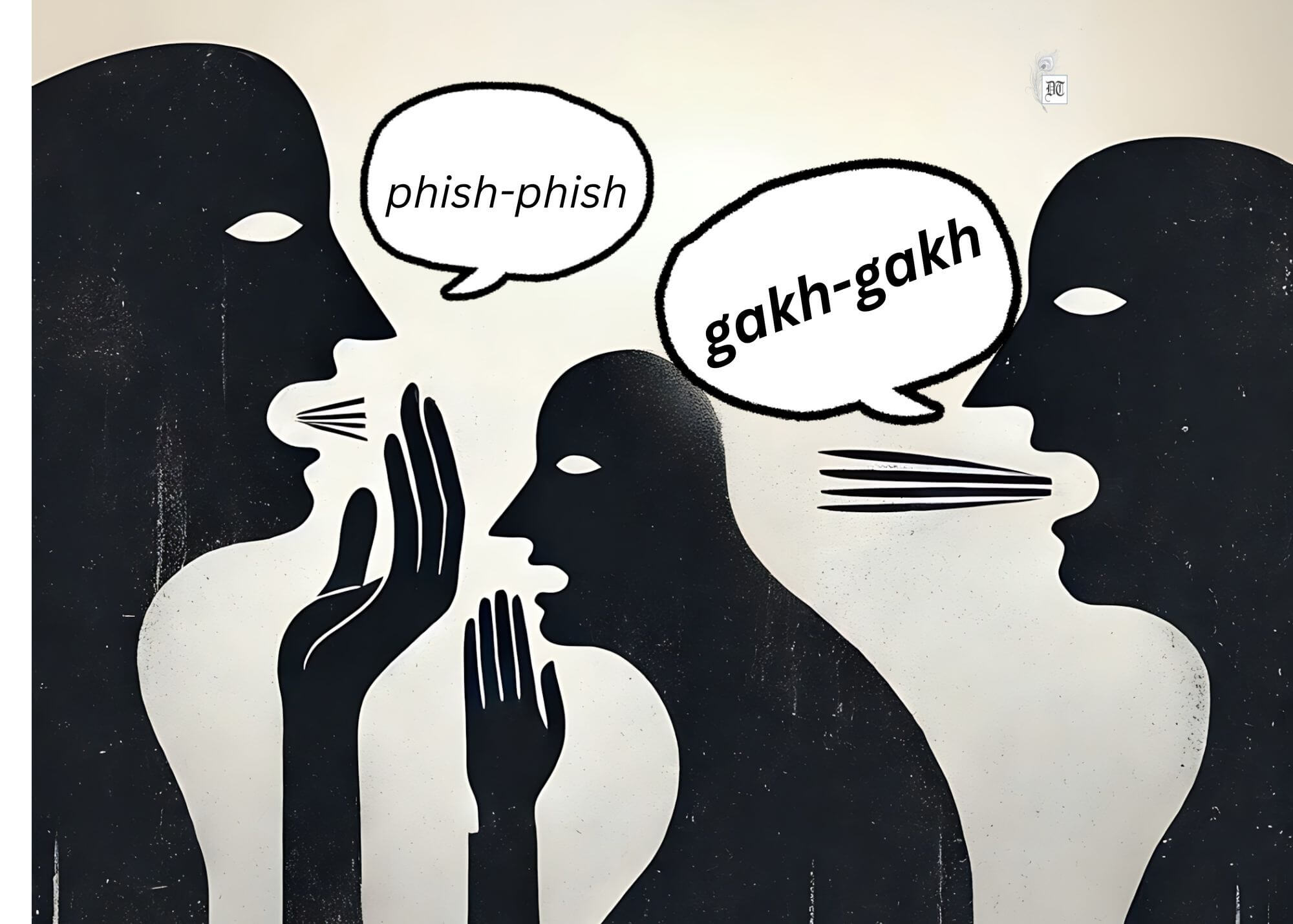
When you are talking in an undertone or whispering, it is termed ‘phish-phish or gujj-gujj, fush-fush’. Bright crimson is laal tok-toke. If you are at the peak of health, exuding a ruddy, healthy look, then you are laal tuk-tuke. Anything that sports an exceedingly oily look, be it hair or face, is tel chup-chupe. This may also refer to a smooth, flat surface, such as a tabletop or floor.
The subcontinent’s fair sex is known for their long, flowing hair. The term used for their crowning glory is ‘kuch-kuche’ or ‘mish-mishe kalo’ (black). Dhob-dhobe forsha has a snow-white complexion.
Small knocks with a hammer are thuk-thak. The daily vocabulary also includes ‘roga lik-like’, ‘thol-thole mota’, ‘fin-fine kapor’, and ‘tyal-tyale jhol’ – skinny, quite tall, obese, thin fabric, and watery soup – in that order.
Add to the list: ‘khat-khate’ (bone-dry), ‘chwak-chawke’ (shiny), ‘jhak-jhake’ (sparkling), and ‘nor-boray’ (rickety/wobbly). ‘Fit-faat’ may denote a well-groomed look as well as apparel with a good fit. In contrast, dhol-dhole means loose, baggy, or oversized. Meanwhile, “faata-fati” is a synonym for excellent, brilliant, or superb.
For the foodies, there is an exclusive range of expressions: ‘much-muche’ (crispy) kadh-madey, kur-murey (crunchy), tul-tuley (melt-in-the-mouth), and jhur-jhurey (light) are a selection of light snacks and savoury treats to enjoy with your tea or for a quick bite. You might be hauled over the coals if the vegetables in your curry are found to be kotch-kotche (undercooked)
Onomatopoeia is a useful tool for describing nature, particularly in connection with weather and its diverse moods. Does the kichir-michir (chirping/twittering) of birds wake you each morning? It’s a nice way to begin the day! Tapur-tupur is the pitter-patter of raindrops. ‘Fur-fure hawa’ is a balmy breeze, while ‘jhar-jhare’ or ‘jhama-jham’ are sounds of heavy downpours. If you are drenched to the bone, you are bhije chap-chape or shop-shope. Biting cold (kon-kone thanda) is the time to grab your blankets.
Stormy wind whistling through trees makes a ‘shNow-shNow’ sound. Dhadam is the sound that emanates when you stomp out of a room, banging the door behind you. When you tiptoe, you are doing it chupi-chupi. When a toddler or young child takes slow, unsure, and unsteady steps forward, “guti-guti” is the appropriate expression.
Now, for some more mundane sounds. If a door is jammed, it opens with a creaking sound, ‘kyaanch’. Again, ‘kyanch-kyanch’ is snipping with scissors, while ‘ghyachang’ is plunging a very sharp knife or chopper to sever or chop something, and the change is irreversible.
Then, as you grow old and infirm, malicious people might use a highly derogatory term, thurthurey, while referring to you!
Phew! The list is already growing too long … albeit many more examples have not been touched upon. Nonetheless, putting it in a nutshell, figures of speech such as these make any language more enchanting and lovable.
Picture design by Anumita Roy

Ruchira Adhikari Ghosh brings a liberal, wide-ranging outlook shaped by extensive travel across India and abroad. Educated at Holy Child School, New Delhi, Sacred Heart Convent, Ludhiana, and Panjab University, Chandigarh, she holds a Master’s in English Literature and a postgraduate diploma in Journalism and Mass Communication. With three decades in media, she writes on travel, books, music, performing arts, women’s issues, and especially food, drawing inspiration from rich life experiences. She is our Features Editor.


 By
By

 By
By