
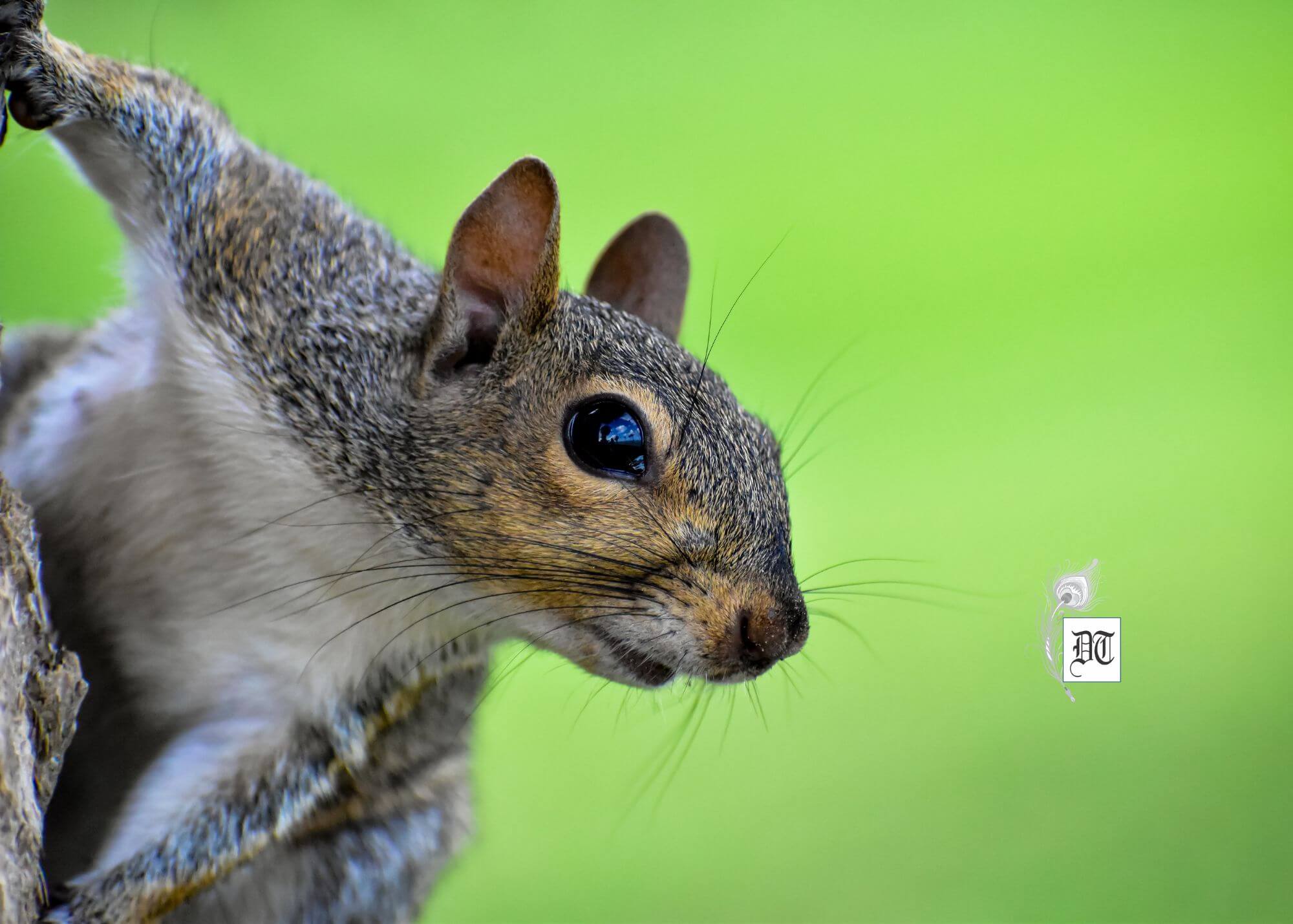

Dr Gill reminisces that at fourteen, he shot a squirrel out of spite—its lifeless eyes haunted him, marking his journey from reckless instinct to conscience, exclusively for Different Truths.
The mauve and white Kachnar blossoms were in their early-spring buds, ready to be simmered with minced lamb. The thick shade of the regal Kachnar appeasing my sweat, the sight of the trimmed lawn and the heady scent of flowers pervading my nostrils should have worked their magic, but they didn’t.
A trickle of blood dripped into the brickwork enclosing the garden tap.
My slug hadn’t exploded the squirrel’s head. The bewildered, lifeless eyes held a lifelong question.
Why — a soundless scream, embedded in the eyes.
My Diana (or was it the BSA?) air rifle leaned in disgrace against the tree trunk.
At age fourteen, with two double promotions, I was in my last year at school. The Punjab University on Lahore’s canal banks was still on the drafting tables. The future lecture halls, spinmeister academics and violent political battlegrounds were still fields and mango orchards, owned by Ranghardhs and syncretic Meos of Haryana and Gurgaon origin. They let me hunt pigeons and quails. There were doves, but I never shot the birds of peace. Not that the others were war-birds, but shooting doves would have been like killing the peace.
Not done.
The orchard owners even let me eat fallen mangoes — the naturally ripened tapkay daa ummb (dropped mango), with a single bruise, and not ‘cooked’ in a basket filled with straw!
At that time, the film Malangi, about the 19th/20th-century legendary dacoit of the same name operating from Changa Manga jungle eighty-odd kilometres from Lahore, was a box-office hit. It was produced and directed by Lahore’s most powerful Don, Choudhary Muhammed Aslam a.k.a. Acha Shukarwala, who also wrote the lyrics and hummed out the tune of its runaway hit song crooned by Noor Jahan: “mahi way sonoon p’hul na’an jaween” Oh my lover, forget us not — the ‘us’ being the smitten damsel’s royal plural.
It was this song I had been singing loudly on a loop while cycling on the bridle track bordering the canal, my air rifle strapped to the horizontal top tuba, hoping to return home with game for at least my dinner!
I didn’t.
I mean, I did.
That is, I had to return empty-handed: hot, sweaty, frustrated and mad at myself and the world.
And then I saw it, lying on a branch of the Kachnar. I was convinced it was sniggering at me. Well, that wouldn’t do. I aligned the front and back sites, breathed in and out, blocked, and lemon-squeezed the trigger, just as Bad-dad and his orderly, Bashir, a World War II veteran, had taught me.
In the millisecond after I squeezed the trigger, a flash of truth blazed across my developing brain, and my heart dropped into my stomach.
I knew it had all gone wrong.
This time, I had given impulsive spite an easy victory.
The last time was an accident, in Sialkot, where bad-dad had been posted.
At the age of ten, I had made myself a very powerful bamboo longbow which bent equally at both ends. A pavement artisan had cut me sharp, pointed, long arrowheads from a thick tin plate and sharpened the edges on a foot-powered grindstone. I was shooting them into a tree trunk, and my bow was drawn, taut and ready, when a hand-sized squirrel came around the trunk, and, before I could retract, my arrow flew. It pierced the squirrel’s body and pinned it to the tree. The squirrel started squirming and thrashing against the trunk, giving high-pitched screeches of pain which unnerved me.
I ran into the house in a complete state and blurted out my perfidy to bad-dad.
He got out his .38 calibre revolver, and we ran to the tree where the squirrel was still screeching and squirming. The single shot ended its pain, flesh and fur exploded, and there was nothing left to bury.
Bad-dad looked at my face, then put his arm around me.
I told him the bowstring had been at maximum pull, and the arrow sped off on its own volition before I could register a living target.
He nodded: “It was an accident. Nothing mala fide,” he said, in his jurist’s judgement. Then he gently took the bows and arrows. “You haven’t made a toy but a weapon. I’ll keep these.”
I had no appetite for dinner that night.
A week later, bad-dad bought me an air rifle. The first time I fired it, I hit the little tin box.
Still, he and Bashir trained me. Shortly after, when bad-dad went duck shooting with his friends, they deployed me at the other end of the body of water. With a .22 Remington rifle, I would shoot in their direction but around the ducks — to make the murghabis fly so bad-dad and the ‘uncles’ could take their honourable flying shots and we could have ghee-roasted murghabis and fresh tandoori rotis for lunch.
After some time, the squirrel hibernated into a comfortable corner within me, even though squirrels aren’t bears.
A few years later, under the Kachnar tree, in that late Lahore afternoon bathed in the golden rays of the Punjab’s setting sun, my heart had plunged into midnight. I sat by the dead squirrel, opened the garden tap, and sat washing my hands until bad-dad came and broke my reverie of self-loathing. He knew I was punishing myself and that anything from him would only be double jeopardy and not reconstructive.
That, I would have to do myself.
I did, by praying, reading the Holy Bible, abjuring hunting, and protecting, whenever I could, those I felt needed my protection or asked for it.
When I was old enough to shave and occasionally got a cut, it wasn’t because I couldn’t face myself but due to inattentiveness.
Eventually, time put the squirrels in their resting place, and I was able to liberate myself.
Picture design by Anumita Roy

Dr Azam Gill, novelist, analyst, and retired Lecturer from Toulouse University, France, has authored nine books, including four thrillers: Blood Money, Flight to Pakistan, and Blasphemy and JADINY. He also writes for The Express Tribune and The International Association of Thriller Writers and blogs. He served in the French Foreign Legion, French Navy, and Punjab Regiment. His latest thriller is JADINY: Just Another Day in New York, a historical, counter-factual thriller about the 9/11 Twin Tower attacks.



 By
By
 By
By
 By
By
 By
By
Congratulations on your powerful piece, The Echoes of a Squirrel’s Cry! The opening line alone—“A trickle of blood dripped into the brickwork enclosing the garden tap…”—immediately compels the reader to read the full story.