
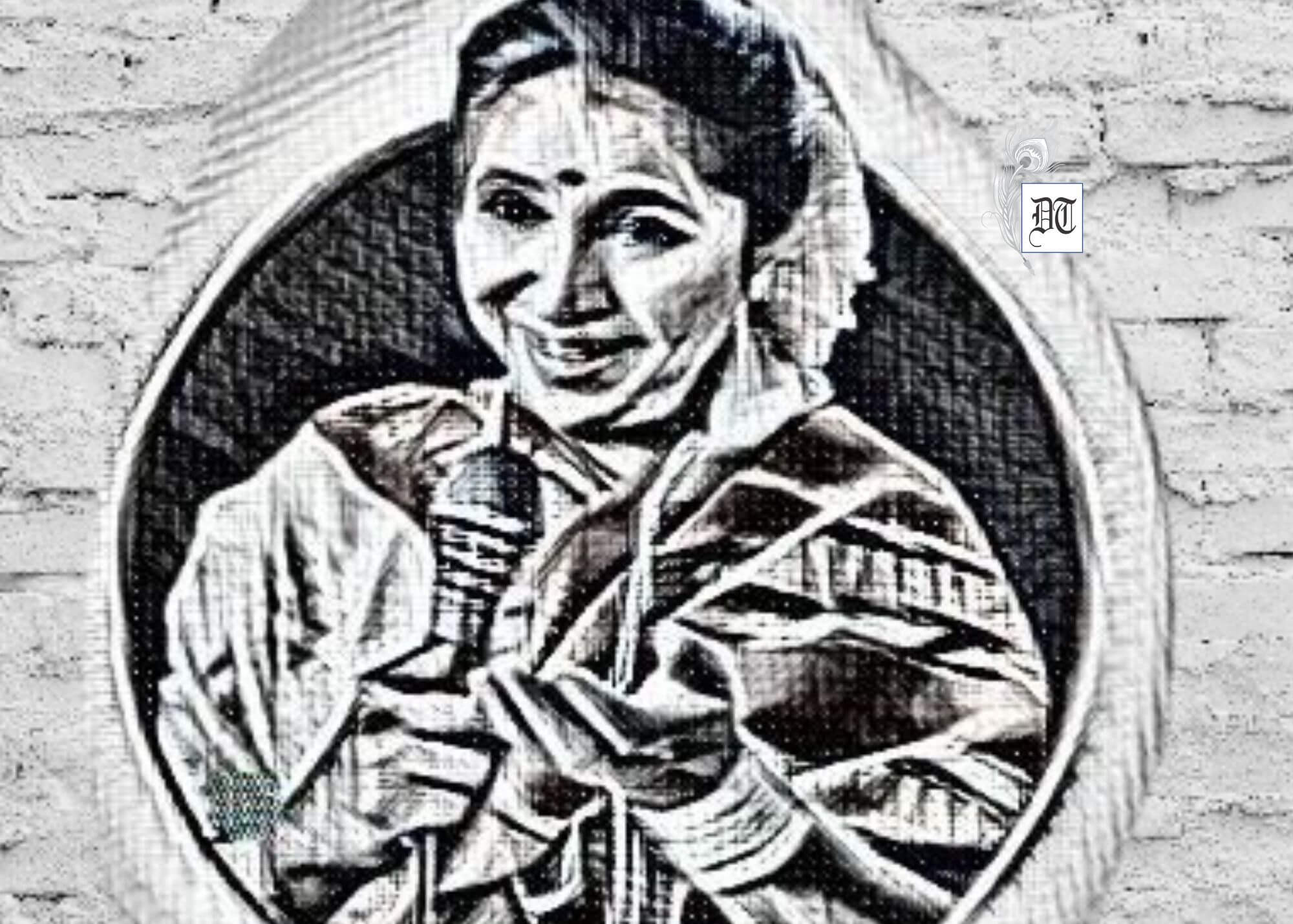
Sohini explores Asha Bhosle’s legendary career in DifferentTruths.com, celebrating her as a versatile interpreter of complex, plural emotional archetypes—a tribute.
AI Summary
- Artistic Shapeshifter: Asha Bhosle transcends the “playback singer” label, masterfully inhabiting diverse archetypes from the devotee to the rebel.
- Emotional Intelligence: Her work across genres like devotional, maternal, and seductive tracks reveals a nuanced, pluralistic portrayal of femininity.
- Enduring Legacy: By recalibrating the “emotional architecture” of songs, Bhosle provided Hindi cinema’s female characters with unprecedented depth and agency.
Asha Bhosle has never been easily contained by the categories that critics and historians tend to prefer. To call her a playback singer, even one of extraordinary longevity and range, is to miss the deeper truth of her artistry. Over a career that has stretched across decades, languages and musical forms, she has functioned less as a voice assigned to characters and more as an interpreter of emotional archetypes—inhabiting, with rare precision, the devotee, the mother, the rebel and the siren.
It is this shapeshifting ability, rather than the sheer volume of her output, that explains her enduring hold on the Indian imagination. In a film industry that often relied on typecasting, Bhosle resisted fixity. She moved restlessly across genres, composers and moods, refusing to allow her voice to be reduced to a single register of feeling. What emerged instead was a body of work that reads like a study in emotional intelligence—one that reveals how femininity, in her rendering, could be plural, contradictory and unapologetically complex.
Consider first her work in the devotional idiom, where Bhosle’s approach diverged from the grand, often formalised expressions of piety that defined much of mid-20th-century film music. In “Tora Man Darpan Kehlaye” from Kaajal, her voice is marked not by distance or reverence alone, but by intimacy. She sings as if engaged in a quiet, internal dialogue—her tone reflective, searching, and gently insistent. The divine, in her interpretation, is not an abstraction but a presence encountered in moments of self-scrutiny.
A similar quality can be heard in the title track of Jai Santoshi Maa, a song that became an anthem of popular devotion. Here, Bhosle modulates her voice to evoke a collective experience of faith—particularly that of women whose spirituality is intertwined with endurance. There is softness in her phrasing, but it is undergirded by a steadiness that suggests devotion as a form of resilience rather than submission. In these songs, she avoids ornamentation for its own sake, allowing emotion to emerge with clarity and restraint.
If her devotional work is marked by inwardness, her rendering of maternal affection reveals a different kind of subtlety. Bhosle’s “mother” is neither overly sentimental nor idealised to the point of abstraction. In “Chanda Mama Door Ke” from Vachan, she crafts a lullaby that feels at once intimate and playful. Her voice carries a gentle warmth but also a lightness—an almost conversational quality that suggests a living, breathing relationship rather than a symbolic one.
This refusal to flatten maternal emotion into cliché is central to her interpretive strength. Even in songs that are not explicitly about motherhood, Bhosle often introduces a tonal layer of care—an attentiveness that conveys emotional maturity without sacrificing individuality. The effect is to render nurturing not as self-effacement but as a conscious, textured form of love.
Yet it is perhaps in her more defiant, boundary-pushing songs that Bhosle most clearly disrupts expectations. While she is frequently associated with playfulness and sensuality, her voice has also carried a sharp undercurrent of rebellion. In “Dum Maro Dum” from Hare Rama, Hare Krishna, she adopts a deliberately unvarnished tone, infusing the song with an energy that feels both liberating and confrontational. The performance resists moral framing; instead, it inhabits a space of refusal—of societal norms, of judgement, of prescribed roles.
Similarly, “Yeh Mera Dil” from Don, often remembered for its seductive surface, reveals a more controlled and strategic dimension of her singing. Bhosle’s phrasing suggests not vulnerability but awareness. The character she voices is fully conscious of her effect, and the song unfolds less as an expression of desire than as an assertion of power. In these moments, Bhosle’s artistry complicates the binary between agency and objectification, offering instead a portrayal of femininity that is self-aware and self-directed.
Her most iconic performances as the “siren” further illustrate this complexity. In “Aaiye Meherbaan” from Howrah Bridge, Bhosle’s voice glides effortlessly between invitation and irony. She elongates syllables with a precision that feels almost tactile, creating an atmosphere of allure that is at once immersive and controlled. There is a knowingness here—a sense that the performance itself is a kind of game, one in which she remains firmly in command.
“Piya Tu Ab To Aaja” from Caravan further pushes this theatricality. The now-famous interjections and breathy inflexions could easily have tipped into excess, but Bhosle anchors them in rhythm and intention. Each pause, each whispered phrase, is calibrated to sustain tension. The result is a performance that feels exuberant without losing coherence—a testament to her technical discipline as much as her expressive range.
In “In Aankhon Ki Masti” from Umrao Jaan, however, the siren is transformed. Here, seduction is tempered by introspection. Bhosle softens her tone, allowing a hint of melancholy to seep into the melody. Desire is present, but it is accompanied by detachment, even weariness. The voice does not reach outward so much as it draws the listener inward, creating a space where longing and restraint coexist.
Across these varied performances, what remains constant is Bhosle’s meticulous attention to intent. She does not merely adjust pitch or tempo; she recalibrates the emotional architecture of each song. A slight roughness in tone can signal defiance; a delicate modulation can evoke vulnerability; a measured pause can transform a line into a moment of revelation. These choices, often subtle, accumulate to produce performances that feel inhabited rather than executed.
In this sense, Asha Bhosle’s legacy extends beyond the songs themselves. She expanded the expressive possibilities of playback singing, demonstrating that the voice could serve not just as an instrument of melody but as a medium of characterisation. Through her, the women of Hindi cinema—devotees, mothers, rebels, enchantresses—acquired depth, ambiguity and agency.
To listen to her today is to encounter not a single artist, but a constellation of selves. And in that multiplicity lies her enduring power: a refusal to be singular in a world that so often demands it.
Picture from IMDB

Sohini Roychowdhury is a renowned Bharatanatyam dancer, choreographer, artistic director, speaker, social activist, and professor of Natyashastra. She founded Sohinimoksha World Dance & Communications in Madrid/Berlin/Kolkata/New York. A visiting professor of dance at 17 universities worldwide, she won several awards, including the “Mahatma Gandhi Pravasi Samman” by The House of Lords, the Priyadarshini Award for Outstanding Achievement in Arts, and the Governor’s Commendation for Distinguished World Artiste. She has also authored several books, including ‘Dancing with the Gods’.

 By
By
 By
By
 By
By
 By
By