
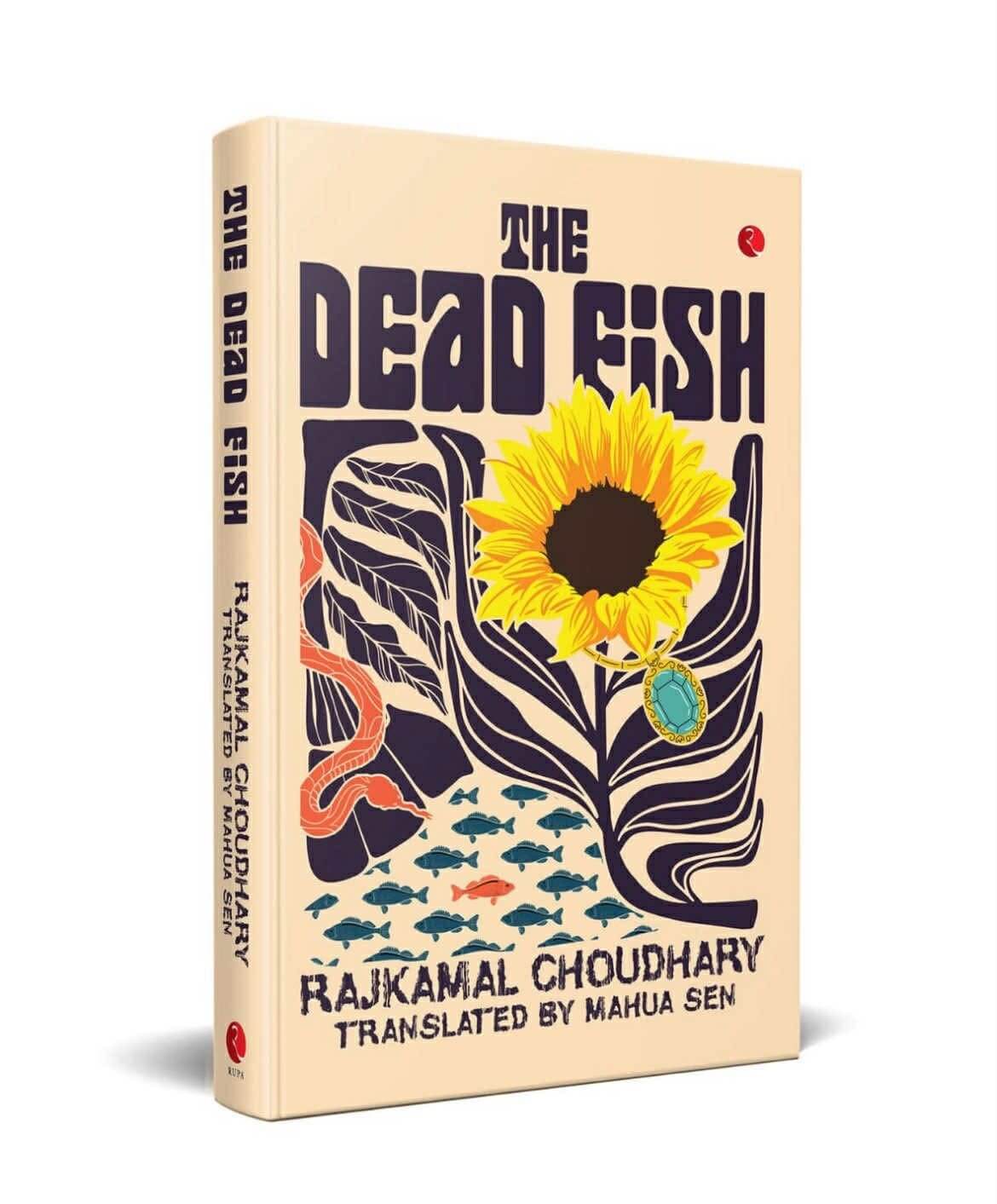
Dr Kumar Malay reviews Mahua Sen’s translation of Machhli Mari Hui, delivering Rajkamal Chaudhary’s original’s raw, powerful, and timeless literary genius, for Different Truths.

I first read Rajkamal Chaudhary’s novel, Machhli Mari Hui, back in 1989, and it instantly turned me into a devoted admirer of his writing. The version I read then was in Hindi. Now, after thirty-seven years, I’ve read The Dead Fish, the English translation by Mahua Sen, and it was like reliving that powerful literary experience all over again.
The same mesmerising thrill and emotional jolt I had felt three and a half decades ago came rushing back while reading this translation. The theme of the novel—bold, unflinching, and psychologically rich —was undoubtedly much ahead of its time. It reinforced my belief that Rajkamal Chaudhary was a writer far ahead of his era.
As I turned the pages, my faded memory of the plot, the subplots, the sequence of events, and the urgency of the characters’ unexpressed desires came alive once more. It transported me back to the time when I first encountered Chaudhary’s powerful storytelling.
Often, translated works lose the emotional depth, cultural nuance, and original essence of the text. But in this case, I must say that Sen has preserved everything that breathed life into Rajkamal Chaudhary’s original work. Nothing feels lost; rather, the translation feels astonishingly authentic.
The portrayal of Nirmal Padmavat’s internal chaos and his complicated relationships with Kalyani, Shirin, and Priya—the blend of his desires and his profound suffocation—is so precise and deeply sensitive that its status as a translated work is completely invisible. This reads with the authentic voice of Rajkamal Chaudhary writing natively in English.
I was originally captivated by the narrative style of Machhli Mari Hui — fragmented, unconventional, and strikingly raw, as if one were witnessing real moments rather than reading a crafted novel. That experimental narrative style, reflecting the dislocation and fragmentation of the characters’ inner lives, became a hallmark of Rajkamal Chaudhary’s writing. I was delighted to find that Sen has preserved this aspect with great care and fidelity. Her translation captures the intensity and emotional turbulence of the original, making the story feel just as relevant today as it must have felt in the 1960s. If I recall correctly, the original novel was published around 1966.
I thank Sen for breathing new life into Rajkamal Chaudhary’s work. Her translation does not feel like a mere linguistic exercise. It echoes the original voice, tone, and soul of the author in every line, and even between the lines.
Through this brilliant translation, Rajkamal Chaudhary lives again. I sincerely hope Sen continues to translate his other works as well, since the world needs more of Rajkamal Chaudhary. And Sen seems uniquely equipped to bring him to a wider platform.
Cover image sourced by the reviewer

Dr Kumar Malay Jha, a native of Bhagalpur, Bihar, is a dedicated educator who rose to the position of Principal in the Kendriya Vidyalaya system. Driven by a deep passion for self-expression, he cultivated talents in poetry, short story writing, and public speaking, earning widespread love and respect. He believes in the magic of words, which can make a tearful face smile.

 By
By
 By
By
 By
By
 By
By