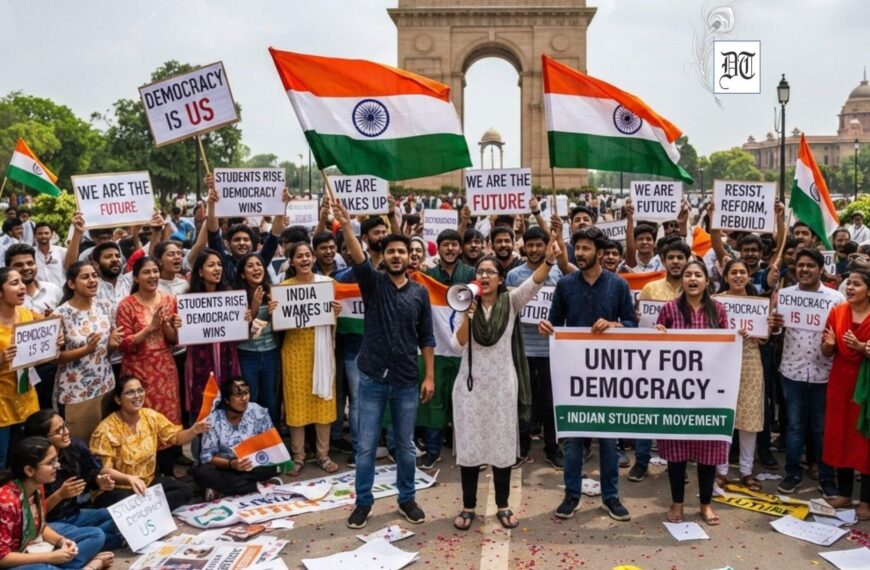

Sayantani’s sharp satire on Bengal’s election circus, featured on DifferentTruths.com, captures politics, adda, and enduring public hope.
AI Summary
- Sayantani’s satire portrays Bengal’s elections as a noisy cultural theatre where tea stalls, WhatsApp, and street posters become political battlegrounds.
- It mocks repeated promises, online misinformation, and post-result excuses, while highlighting how ordinary people juggle hope, inflation, and daily struggles.
- Beneath the humour, the piece celebrates Bengal’s resilience, poetry, football, and adda, suggesting that chaos may change, but the spirit endures.
The grand Mahabharata in Bengal is over. As Bengalis say, “Shesh porjonto, maach-er raja ilish“—in the end, Hilsa is king, just as politics always takes centre stage.
The loudspeakers, now in forced exile, are surely plotting their next noisy coup.
The walls are finally free of campaign posters and paint.
The mics have retired, dreaming of comeback rallies.
The Intellectual People
For months, Bengal observed a relentless political spectacle: Dance Bengal Dance—with flags.
Every evening, tea stalls became war rooms. Every corner was a debate studio. Every person, armed with tea and WhatsApp-based information, became a political analyst.
During elections, every lane and para turns into a mini-UN Security Council. Retired uncles at tea stalls, cemented to their seats by age, offer more strategy than actual strategists. One sip of tea—and suddenly everyone’s proposing world peace solutions.
“America is watching our election.”
“China is involved from the back.”
“Delhi is scared.”
“You can write it down as to who will win, as I said!”
Meanwhile, Raju from the local club—still dodging last year’s biriyani bill—sits in judgement, teacup in hand, rating the performances in political debates like an award show.
The walls of the streets become galleries for the art of democracy. Hoardings, posters, banners, and flags blanket houses so densely that future archaeologists may uncover political eras preserved beneath them, like layers in ancient ruins. Historians studying Bengal politics will rely less on written archives and more on the records revealed by these poster layers.
The Same Chanting
Before the elections, each party promised change and development. Bengalis, wise to such pledges, recall old headlines promising to turn Kolkata into London or marvelling at new trams.
One leader promises safety and security, others talk about jobs and development, and some say they will offer everything together. In reality, though, people end up with potholes in the roads that serve as reminders of earlier promises.
People swear off politicians, but one rally with free biriyani and bus rides makes them forget bills and ideologies.
Nothing unites Bengal like free food and political drama.
Social Media War
All social media bursts into action, becoming battlegrounds. Lounging under ceiling fans, Facebook and X users debate democracy day and night.
Someone unable to fix a leaking tap crafts 45 furious, flag-waving online manifestos.
WhatsApp University spreads knowledge faster than any candidate’s CV or Nobel list.
- 10 conspiracy theories
- 15 AI videos
- 20 fake statistics
Armed with all this comes an emotional Tagore quote—one he never made!
Even Netaji Subhas Chandra Bose, looking down from heaven, might wonder, “Did I fight against the British for these scenes?”
Perhaps Satyajit Ray is scribbling film notes, while Kazi Nazrul hums a revolutionary tune, now a WhatsApp forward.
The funniest part? After the results, everyone is a clairvoyant—they saw it coming all along, of course.
If their party wins, the people’s mandate
If their party lose, the EVM is hacked.
It may be better to say that in Bengal, democracy is only welcome when it aligns with personal opinions.
Especially those who were silent observers of the war, whom you can safely put in the category, as said in Hindi, ‘na ghar ka na ghat ka’!
The Satire of Reality
In reality, fish prices rise much faster than the pace of election promises.
Now, buying Hilsa isn’t just a meal—it’s a financial adventure requiring courage, cunning, and sometimes negotiation.
In real life, ordinary Bengalis wrestle with joblessness, inflation, and never-ending crises, clinging to the belief that politics will somehow fix it all. Hope is doled out with every election, like the legendary Hilsa—always promised, never quite served. Solutions may be postponed in Bengal, but hope never misses the chance to campaign again, usually with a wink and a smirk.
Yet Bengal endures. Its survival spans war, famine, partition, violence, decline, and blackouts—countered by football passion, poetry, festivals, and endless adda fuelled by tea.
Another New Era
As a new era begins, leaders change, ministers arrive, speeches echo, and banners appear, but old yet grand roads remain part of Bengal’s story. New committees will investigate past policies, just as their predecessors did.
Somewhere in Kolkata, under the harsh sun, as the scent of tea drifts and tram bells ring, tea stalls and benches echo: even if the government changes, chaos can’t outshine Bengal’s heritage.
With this statement, no one will deny it, and everyone will nod.
Then, just like the government orders another round of cups of tea, it will be ordered – of course, on credit!
Picture design by Anumita Roy

Sayantani Mukhopadhyay is a writer with a bold passion for journalism and empowerment. She holds a background in English Literature, Human Resource Management, and Mass Communication and Journalism. Her work blends critical inquiry with people-focused insights, centring on sustainability, social issues, and conscious living. Through authentic and research-driven storytelling, she strives to amplify voices, challenge norms, and inspire collective awareness and action.

 By
By
 By
By
 By
By