
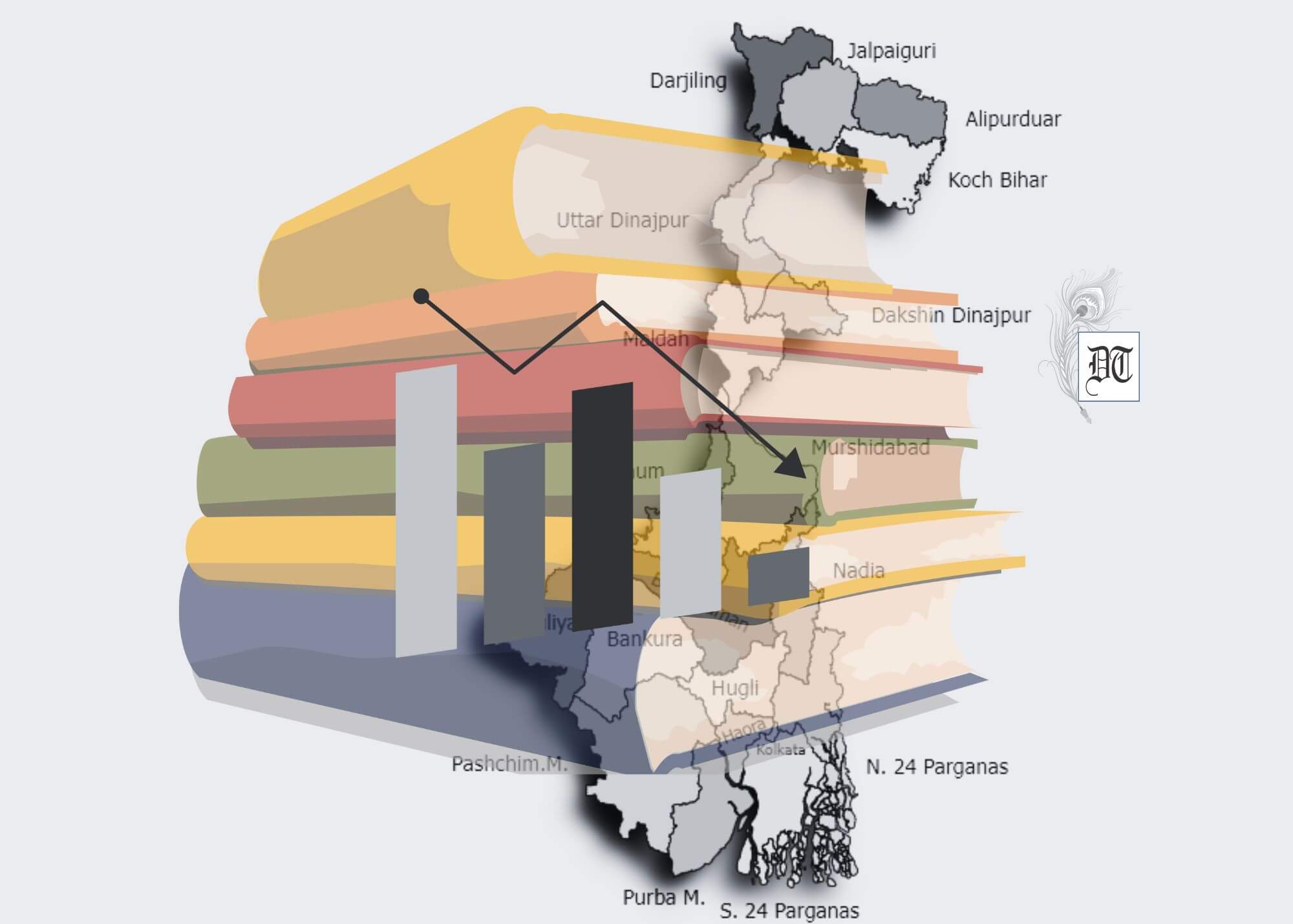
Prof Bhaskar opines that education’s true value, beyond just earnings, faces decline, impacting society and culture significantly, exclusively for Different Truths.
If education is seen only as a means to earn money for livelihood, the corollaries will be of one type; if education is seen to respect humanity, the corollaries will be of a different type. Let me pose the problem in detail.
Let me focus here on the processes and consequences of education as people perceive it; they perceive it based on their aspirations, time plan, and constrained understanding. Constraints come from family background, local socio-cultural environment and related factors.
Based on my observations and communications with the elderly people in different urban areas of West Bengal in the recent past, summarised narratives follow.
Narratives in Brief
One, it is not illiteracy but an education deficit that has been leading to revealed ‘nuisance value’ like public statements around ‘who is Bengali in West Bengal’, ‘what role the Chief Minister of West Bengal should have performed in Bangladesh’, ‘speaking in the Bengali language does not imply that they are Bengali’ and all unwarranted culturally polluting statements. Some of those sentences are grammatically correct, with no credibility in private or public life.
Two, the conversations between the passenger and the rickshaw puller, while the rickshaw is in motion on a public road, mostly about the intra-family antagonistic relations of the passenger, are public-polluting conversations.
Three, the spread of gossip is like fire.
Four, a belief of people or hearsay that remains untested or evidence-less.
Five, social determination by the semi-literate musclemen, tacitly supported by the ruling power.
Six sane people, including teachers, are hiding in a safe home or remaining cocooned.
Seven elderly people wait to be taken care of by the able-bodied youth.
The above are a few reflections of cultural poverty or poverty of education.
Core Point
It seems education has lost its glitter or glory in West Bengal, as may be elsewhere, over the past few decades. It may seem surprising how the Renaissance of undivided Bengal had to tarnish its glory because of the turmoil in West Bengal, mainly because of education, with exceptions, of course. It may seem shocking to find the semi-literate dictating to the educated people what to do and what not to do. The partial answer may lie in the formation of a society that is political or a political society based on fear and foul.
The foul society is nourished by the core state for many reasons, like mobilisation of vote-bank through fair means or foul. In a changing political scenario, this foul society changes hands or umbrellas. The elite society may also take support from this foul society for money-based commercial reasons. Education takes a back seat or no seat at all – the condition of Vidur in the Mahabharata.
Education vs Other Priorities
For the income-poor people, who struggle to survive, biologically get engaged in wage employment in adolescence to support household income. Hence, either they do not enter the domain of education or drop out early, even if the cost of education is low in public schools. Often, the non-ending limit to education is not comprehended by the job seekers at the bottommost layer – they remain manual workers, often termed as unskilled workers. The terminology does not matter much because many of them are self-engaged, earning income in cash for exchangeable goods or collecting from common-pool resources (CPR), which is earning in kind. Whatever the method of survival, the education deficit persists for these people.
For the people in polity, particularly in the ruling party, it is not education but access to the chair or power that matters. For these people, earnings are of different types, like cut-money, collection from trade and business through extra-legal means, and all that is gossiped to get patronised by the authority in ruling power.
What remains is the tiny middle section that considers education as a means to get elevated in life through job and culture. The problem for the past few decades in West Bengal, as may be elsewhere, is ridiculing teaching and teachers. It seems teachers are also not very conscious about being stigmatised and ridiculed. One reason may be the role of money in teaching.
Education as a Stepping-Stone?
It is difficult to examine the question of whether education is a means to attain success in life or a stepping-stone or ladder to achieve some goal. For livelihood, of course, education is where people invest – expenditure on education thus may be seen as an investment for return in stream as income flows in the future – economists also calculate the present value of future income streams. In India’s civilisation, education was seen not as an investment or a commodity for sale and purchase. As soon as one talks about education deficit or poverty of education, one skips the oral education of the remote past and centres on post-British formal or institutional education. Whatever be the nature of education – oral or formal – poverty of education exists and is often not estimated by the consequences.
Process-poverty or Consequence-poverty?
Poverty of education has persisted in West Bengal for the past few decades; it is state patronised, befitting its goal to rule by hook or by crook – this hook is the stagnated, immobile people who like to live a life of a snail or live happily in a low-level trap, for sure, not understanding the long-term consequences of the trap. This process is neither ‘success breeds success’ nor ‘failure breeds failure’, for the success of one section is the failure of the other section. At present, wisdom fails in West Bengal, or treachery succeeds. I don’t have any idea if any wise individual tacitly supports the treacherous game plan to stagnate the society at the bottommost layer – God forbid.
Summing Up
Poverty of education is not to be enumerated as a number because education is not a number. This poverty is not based on headcount. It reflects a state of affairs in which the conscious people find themselves, whether they accept it or reject it. What is acceptable for A may be unacceptable for B. If A is in power or determines power, B either joins A or withdraws from the situation. The consequences of poverty in education are thus often indecisive.
Source: Participatory and disguised observations.
Picture design by Anumita Roy

Prof. Bhaskar Majumder, an eminent economist, is the Professor of Economics at GB Pant Social Science Institute, Allahabad. He was the Professor and Head of the Centre for Development Studies, Central University of Bihar, Patna. He has published nine books, 69 research papers, 32 chapters,15 review articles and was invited to lectures at premier institutes and universities over 50 times. He has 85 papers published in various seminars and conferences.
He also worked in research projects for Planning Commission (India), World Bank, ICSSR (GoI), NTPC, etc. A meritorious student, Bhaskar was the Visiting Scholar in MSH, Paris under Indo-French Cultural Exchange Programme. He loves speed, football and radical ideology.


 By
By
 By
By

 By
By