
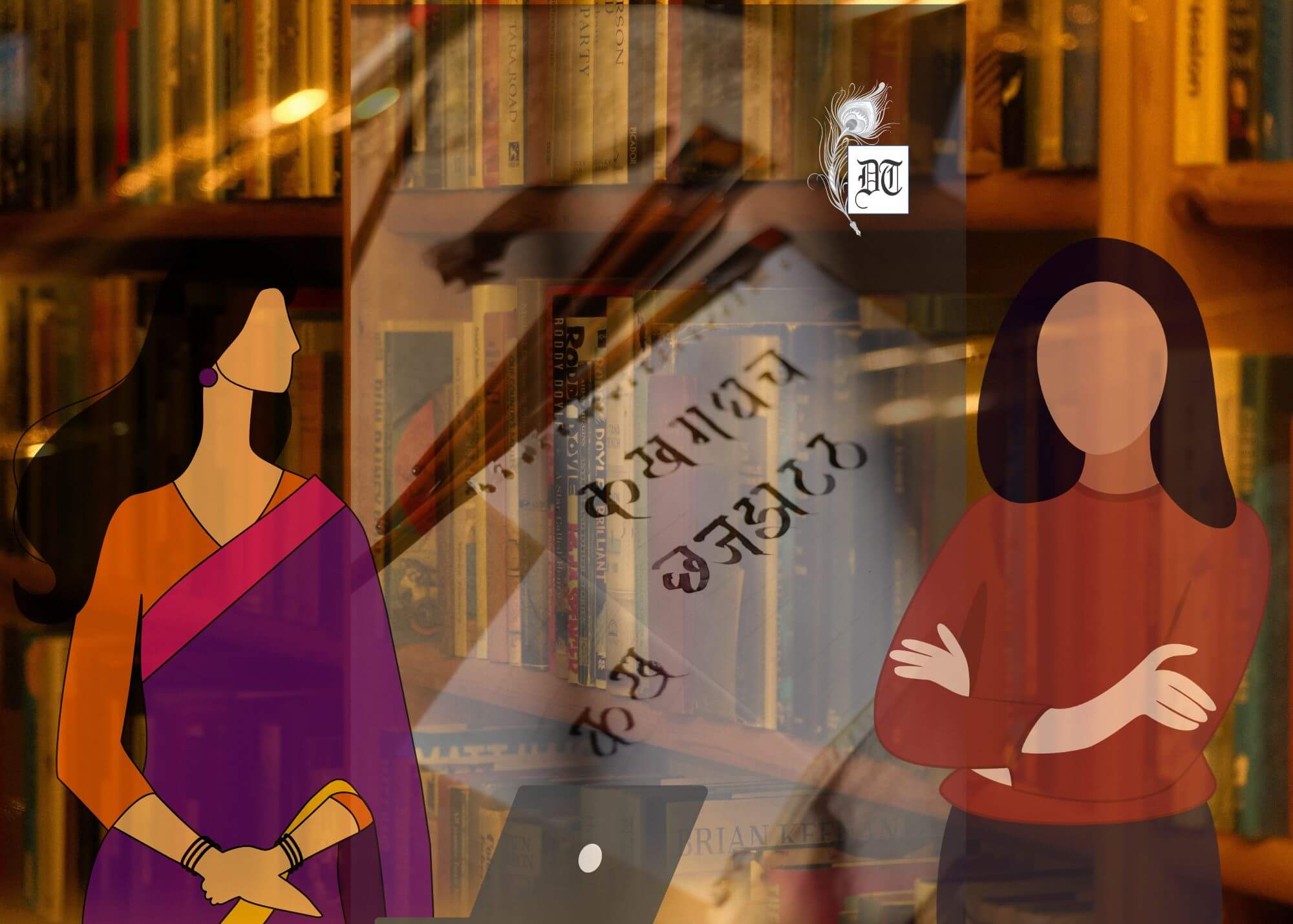
Dr Madhumita explores and analyses the evolution of patriarchy and women’s status in Hindi literature, exclusively for DifferentTruths.com.
AI Summary
- Historical Evolution: Traces depictions of women from the spiritual resistance of Mirabai to Premchand’s gritty social realism.
- Modern Perspectives: Highlights how trailblazers like Krishna Sobti and Mannu Bhandari reclaimed female agency, identity, and psychological depth.
- Intersectional Struggles: Examines contemporary feminist discourse, including Dalit and tribal voices, challenging systemic gender and caste-based oppression.
Hindi literature has long served as a mirror of Indian society, reflecting its cultural values, social structures, and power relations. One of the most significant themes that repeatedly appears in Hindi literature is patriarchy and women’s status. Patriarchy refers to a social system in which men hold primary power in political leadership, moral authority, property ownership, and control of social institutions. In such a system, women are often placed in subordinate roles, and traditional norms and expectations limit their freedom, identity, and rights.
From its early phases to contemporary writings, Hindi literature has explored this issue in diverse ways, revealing both the struggles and resilience of women within patriarchal structures. In the early periods of Hindi literature, such as the Bhakti era, women were often portrayed within traditional frameworks. Society largely confined women to domestic roles such as wives, mothers, and caretakers.
However, even within these limitations, some voices challenged the prevailing norms. For example, poets like Mirabai expressed deep spiritual devotion while also asserting their personal independence. Mirabai’s poetry demonstrates how a woman could resist societal expectations by prioritising her spiritual identity over patriarchal authority, including family and marital obligations.
Moving forward to the modern period of Hindi literature, particularly during the late nineteenth and early twentieth centuries, writers began to address social reform and women’s issues more directly. The works of Munshi Premchand, one of the most influential Hindi writers, portray the harsh realities faced by women in a patriarchal society. In novels such as Nirmala and Godaan, Premchand highlights issues like child marriage, dowry, economic dependency, and the emotional suffering of women. His female characters often struggle against societal constraints but also display moral strength and dignity. Through such portrayals, Hindi literature began to question traditional social structures and advocate for change.
Another important development occurred with the emergence of women writers in Hindi literature, who brought authentic female perspectives to literary discourse. Writers such as Mahadevi Verma, Mannu Bhandari, Krishna Sobti, and Maitreyi Pushpa explored the psychological, emotional, and social experiences of women living within patriarchal systems.
Mahadevi Verma’s essays and literary works often focus on women’s inner lives and the silent suffering caused by social restrictions. Her famous work, Shrinkhala Ki Kadiyan, examines how women are bound by invisible chains created by social expectations and patriarchal values.
Similarly, Mannu Bhandari’s fiction portrays women who struggle to define their identities beyond traditional roles. In her novel Aapka Bunty, the emotional turmoil of a broken family is portrayed through a child’s perspective, while also revealing the pressures faced by a woman seeking to maintain her dignity in a patriarchal society. Krishna Sobti’s works, on the other hand, boldly address themes of female desire, independence, and resistance against oppressive norms. Through strong and complex female characters, Sobti challenges conventional notions of femininity and womanhood.
Contemporary Hindi literature has further expanded the discussion of patriarchy and women’s status by incorporating ideas from feminist discourse. Modern writers examine how patriarchy affects women’s education, employment, sexuality, and personal autonomy. Authors like Mridula Garg, Usha Priyamvada, and Maitreyi Pushpa depict women who question traditional roles and seek independence in various spheres of life. Their works often highlight the conflict between traditional expectations and modern aspirations.
In addition to mainstream literature, Dalit and tribal writings in Hindi have also brought new dimensions to the discussion of women’s status. Dalit women writers reveal the double oppression faced by women due to both caste and gender discrimination. Their works emphasise that patriarchy operates differently across social classes and communities, making the struggle for equality even more complex.
Despite the persistence of patriarchal values, Hindi literature also offers powerful examples of women’s resistance and empowerment. Female characters in many works challenge injustice, seek education, demand equality, and assert their individuality. Literature thus becomes a medium not only for exposing social inequalities but also for imagining possibilities of transformation.
In conclusion, the theme of patriarchy and the status of women occupies a central place in Hindi literature. Through various genres such as poetry, novels, short stories, and essays, writers have depicted the struggles, aspirations, and evolving identities of women in Indian society. While earlier works often reflected traditional norms, modern and contemporary writings increasingly challenge patriarchal structures and advocate for gender equality.
Hindi literature, therefore, plays a crucial role in raising awareness about women’s issues and inspiring social change, making it an important platform for understanding and addressing the complexities of gender relations in Indian society.
Picture design by Anumita Roy

Dr Madhumita Ojha, a Hindi literature scholar, specialises in folk literature, cultural studies, gender, and marginalised narratives. She earned an MA and PhD in Hindi from Presidency University, plus a BEd from Mahatma Gandhi International Hindi University, Wardha. Author of Folk Literature and Culture, she has published extensively on Kinnar narratives, LGBTQ representation, women’s studies, and Dalit literature. She serves as a guest lecturer at the Hindi University, Howrah, Kolkata.

 By
By
 By
By