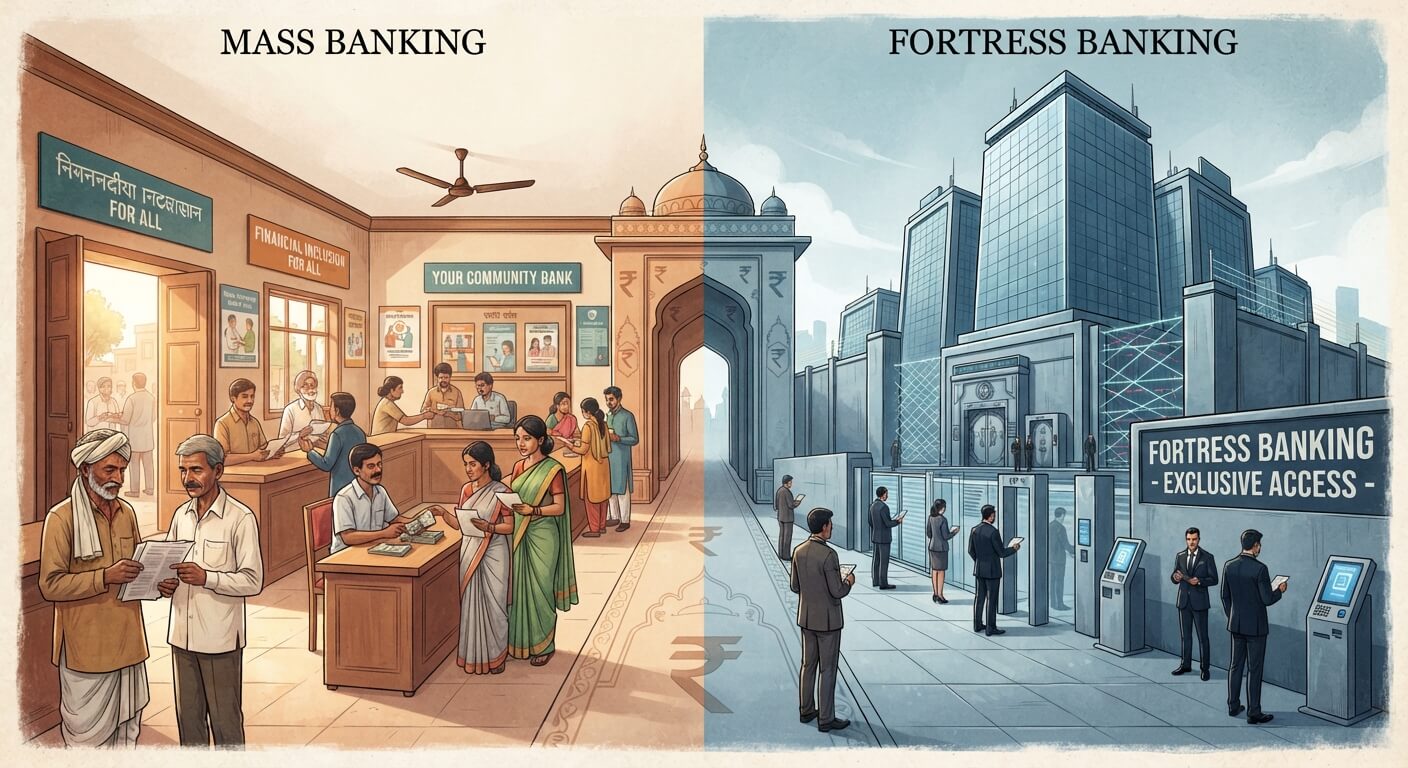

As India transitions from mass banking to fortress banking, Dr Dhiraj examines the structural evolution of public sector banks for DifferentTruths.com.

Key Takeaways
- The structural landscape of Indian banking is shifting from geographical expansion and social credit delivery to capital strength, technological resilience, and institutional consolidation.
- The High-Level Committee on Banking for Viksit Bharat under Suresh N. Patel highlights key reforms balancing global competitiveness with financial resilience.
- Building a resilient banking architecture requires addressing governance challenges and systemic risks and maintaining credit access for rural and small borrowers.
Introduction: Indian banking is entering another important phase of transformation. More than five decades after the nationalisation of major commercial banks in 1969, the policy debate has shifted from expanding access to institutional consolidation, operational efficiency, technological resilience and global competitiveness.
The transition from what may be described as Mass Banking to Fortress Banking captures this changing orientation—the former emphasised geographical expansion, social banking and the democratisation of institutional credit. The latter places greater emphasis on capital strength, technological capabilities, risk management, economies of scale and the ability to withstand financial shocks.
The Union Budget 2026–27 has given this debate fresh momentum by announcing a High-Level Committee on Banking for Viksit Bharat. The government subsequently constituted the committee on October 30, 2026, under the chairmanship of former Central Vigilance Commissioner Suresh N. Patel. Its mandate includes recommending structural, institutional, regulatory and legislative reforms to make Indian banking globally competitive, financially inclusive and resilient (Government of India, 2026a, 2026b).
Importantly, this initiative does not amount to an announcement of another round of public sector bank mergers or a predetermined reduction of existing banks to four national champions. Rather, it opens a wider policy discussion about the future structure of Indian banking.
The central question is therefore not simply whether India needs fewer and larger banks. It is whether consolidation can produce stronger institutions without weakening competition, public accountability and the social obligations historically associated with public sector banking.
The 1969 Legacy: From Class Banking to Mass Banking
To understand the contemporary consolidation debate, it is necessary to revisit the circumstances that shaped Indian banking after independence.
Before nationalisation, commercial banking was predominantly concentrated in urban and metropolitan centres, with credit availability heavily skewed towards established businesses and trading interests. Agriculture, small industries and rural enterprises had limited access to formal institutional finance.
On July 19 1969, the government nationalised 14 major commercial banks. Six more banks were nationalised in 1980. The objective was to redirect banking resources towards broader developmental priorities and extend institutional credit to sections of society that had remained underserved.
The expansion of rural branches accompanied the nationalisation initiative, the Lead Bank Scheme and the formalisation of priority sector lending. The priority sector lending target was subsequently raised to 40 per cent of adjusted net bank credit, with a target date of March 1985.
This transformation was significant. Banking was no longer viewed merely as a commercial activity but also as an instrument of economic development and social transformation. Small farmers, rural entrepreneurs, transport operators, artisans and small-scale manufacturers gradually gained greater access to formal credit (Reserve Bank of India [RBI], 2008).
The achievements of this period should not be underestimated. The geographical expansion of banking infrastructure helped mobilise household savings, strengthen institutional credit delivery and connect previously underserved regions with the formal financial system.
However, the developmental orientation of public sector banking also created institutional challenges over time. Political interference in lending decisions, inadequate risk assessment, operational inefficiencies and weak accountability mechanisms contributed to deteriorating asset quality.
The problem became particularly visible during the Non-Performing Asset (NPA) crisis of the 2010s. The gross NPA ratio of public sector banks reached approximately 14.58 per cent in March 2018. The problem was associated with a combination of aggressive corporate lending, infrastructure-sector stress, governance weaknesses and delayed recognition of bad loans (Department of Financial Services, 2026).
The crisis exposed the limitations of a banking system in which developmental responsibilities were not always accompanied by corresponding improvements in institutional governance, risk management and operational autonomy.
The Consolidation Journey: From 27 to 12 Banks
The consolidation of public sector banks was not a sudden development. It emerged through successive restructuring initiatives.
The first major phase began in 2017, when five associate banks of the State Bank of India and Bharatiya Mahila Bank were merged with SBI. This was followed by the amalgamation of Vijaya Bank and Dena Bank with Bank of Baroda, effective April 1, 2019.
The next major exercise was announced in 2019 and became effective on April 1, 2020. It involved the merger of ten public sector banks into four larger institutions:
- Oriental Bank of Commerce and United Bank of India were merged with Punjab National Bank.
- Syndicate Bank was merged with Canara Bank.
- Andhra Bank and Corporation Bank were merged with Union Bank of India.
- Allahabad Bank was merged with Indian Bank.
These changes reduced the number of public sector banks to 12. The government’s stated rationale included improving operational efficiency, strengthening risk management, expanding lending capacity and creating institutions with greater national and international reach (Government of India, 2020).
The results have been encouraging in several respects. However, the contribution of mergers must be distinguished from the effects of wider banking reforms, improved economic conditions, regulatory intervention and balance-sheet repair.
The latest available FY 2025–26 performance figures indicate that public sector banks recorded an aggregate net profit of approximately ₹1.98 lakh crore, their highest ever. Their gross NPA ratio declined to 1.93 per cent and the net NPA ratio to 0.39 per cent as of March 31, 2026. Their aggregate business reached ₹283.3 lakh crore, with gross advances growing by 15.7 per cent during the year (Government of India, 2026c).
These developments indicate that the Indian public sector banking system has become considerably stronger than it was during the crisis years. Nevertheless, improved financial indicators do not automatically establish that consolidation alone has produced these gains.
The next phase of reform must therefore be assessed on the basis of institutional performance rather than the number of banks remaining in the system.
Fortress Banking: The Emerging Strategic Philosophy
The concept of Fortress Banking provides a useful framework for examining the direction in which large financial institutions are moving.
The term is used here as an analytical description of a banking philosophy that places emphasis on balance-sheet strength, capital adequacy, liquidity, risk controls and technological preparedness. It draws on the broader global banking emphasis on resilience and financial preparedness, often associated with the philosophy articulated by JPMorgan Chase Chairman and CEO Jamie Dimon.
A fortress bank is not simply a large bank. It is an institution capable of absorbing economic shocks, managing unexpected credit losses, maintaining adequate liquidity and sustaining operations during periods of financial uncertainty.
This distinction is important. A bank may possess a large balance sheet but remain vulnerable because of concentrated lending, inadequate governance, poor asset-liability management or excessive exposure to particular economic sectors.
For India, the concept has three major dimensions.
First, capital resilience. Larger banks need sufficient capital buffers to absorb unexpected losses without depending repeatedly on government recapitalisation. The quality of assets, provisioning practices and the ability to generate sustainable profits are equally important.
Second, technological resilience. The growing dependence on digital transactions, data analytics, artificial intelligence and interconnected financial infrastructure has made cybersecurity an essential component of banking stability.
Third, strategic lending capacity. India requires substantial long-term financing for infrastructure, manufacturing, renewable energy, housing and emerging industries. Strong banks can contribute significantly to this financing requirement, provided their lending decisions remain commercially and prudentially sound.
However, the argument that a handful of mega-banks can single-handedly finance India’s infrastructure ambitions would be unrealistic. Infrastructure financing requires a diversified financial ecosystem involving commercial banks, development finance institutions, insurance companies, pension funds, bond markets and specialised lenders.
The objective should therefore be to build resilient banks that complement, rather than replace, the wider financial system.
Digital Resilience and the RBI’s Technocratic Mandate
One of the strongest arguments for institutional scale comes from the rapidly changing technological environment of banking.
Digital transformation has changed the economics of financial intermediation. Cybersecurity, fraud prevention, data governance, artificial intelligence, regulatory reporting and technology infrastructure require sustained investments.
The RBI’s Commercial Banks – Cybersecurity, Technology: Risk, Resilience and Assurance Framework Directions, 2026, issued on July 31 2026 and updated on October 1 2026, reflects the growing regulatory importance of these issues. The framework establishes requirements concerning technology governance, cybersecurity arrangements, continuous monitoring and mechanisms for identifying and responding to emerging threats. Its applicability is defined for specified categories of commercial banks, rather than uniformly across every category of financial institution (RBI, 2026a).
This development has two important implications.
The cybersecurity challenge: Banks must maintain effective security arrangements, monitor suspicious activities and ensure that critical systems remain operational during cyber incidents. Such requirements involve considerable financial and managerial resources. Larger institutions may enjoy economies of scale in deploying advanced security systems, although size alone does not guarantee cybersecurity.
The digital lending opportunity: The RBI’s Unified Lending Interface (ULI) represents another significant development in India’s digital financial infrastructure. Initially developed as the Public Tech Platform for Frictionless Credit, ULI enables lenders to access relevant financial and non-financial data through consent-based digital arrangements.
The scale of its development is noteworthy. According to the RBI’s Annual Report 2025–26, 64 lenders, comprising 41 banks and 23 NBFCs, had been onboarded as of December 12, 2025. These institutions were using more than 136 data services across 12 different loan journeys (RBI, 2026b).
The importance of ULI lies in its potential to reduce information asymmetry, improve credit assessment and extend formal lending to borrowers who may lack conventional collateral or extensive credit histories.
Unlike a conventional consolidation strategy, however, ULI is not dependent on the existence of a few mega-banks. Its architecture allows different categories of lenders, including public sector banks, private banks, small finance banks and NBFCs, to participate.
This suggests that technological progress may actually strengthen the case for a diversified banking ecosystem rather than an exclusively concentrated one.
Constructive Critique: The Political Economy of Consolidation
While consolidation offers potential advantages, its political-economy implications deserve closer examination. Three issues are particularly important.
1. The Ownership–Governance Paradox
The fundamental problem of public sector banking is not necessarily institutional fragmentation. It is the relationship between state ownership, managerial autonomy and accountability.
The P.J. Nayak Committee (2014), constituted by the RBI to review the governance of bank boards, highlighted weaknesses in the governance structure of public sector banks and recommended significant changes in ownership and board functioning. Similarly, the Second Narasimham Committee (1998) emphasised the need for stronger banking institutions, improved governance and greater operational autonomy. These recommendations remain relevant. Merging several public sector banks does not automatically eliminate political interference, improve credit appraisal or strengthen internal accountability. If the governance architecture remains unchanged, consolidation may centralise existing weaknesses within larger institutions. The challenge is therefore to separate the government’s role as owner from the operational responsibilities of bank management.
2. The ‘Too Big to Fail’ Moral Hazard
Consolidation can also increase systemic concentration. A banking system dominated by a few very large institutions may become more vulnerable to the failure or financial distress of any one of them. Such institutions are deeply interconnected with financial markets, payment systems, businesses and households. Their failure could have consequences extending well beyond their own balance sheets. The problem is not merely the possibility of bank failure but the expectation that the government would be compelled to intervene because the institution is too important to fail. This creates a moral hazard. If creditors, depositors and management believe that the state will inevitably rescue a large bank, the incentives for prudent risk-taking may weaken.
India therefore needs credible resolution arrangements, effective supervision, deposit protection and contingency planning for systemically important institutions.
The experience surrounding the Financial Resolution and Deposit Insurance (FRDI) Bill, which was withdrawn in 2018 following public concerns, also demonstrates the political and social sensitivity of bank-resolution reforms. A modern resolution framework must protect depositors and financial stability while ensuring that losses are allocated transparently and that public money is not treated as an automatic solution to managerial failures.
3. The Risk of Marginalising Rural and Small Borrowers
Perhaps the most important concern relates to the original social purpose of public sector banking. Large institutions often seek operational efficiency through centralised decision-making, standardised lending procedures and technology-driven credit assessment. While these measures can reduce costs, they may disadvantage borrowers whose financial circumstances are not adequately captured by conventional credit-scoring systems.
Small farmers, micro-enterprises, artisans, self-employed individuals and businesses operating in remote regions frequently require relationship-based lending and local knowledge. If consolidation results in the closure of rural branches, reduced local decision-making or excessive dependence on automated credit assessment, the gains in efficiency could come at the expense of financial inclusion.
The objective should not be to reverse the achievements of mass banking but to make them more sustainable through technology, better governance and innovative lending arrangements.
Building a Resilient and Inclusive Banking Architecture
The success of India’s next banking reforms will depend on how effectively the country balances institutional scale with public accountability. Three policy priorities deserve particular attention.
1. Institutional Autonomy and Professional Governance
Public sector banks need greater operational freedom, particularly in appointments, credit decisions, technology investments and internal administration. The Financial Services Institutions Bureau (FSIB) can play an important role in strengthening professional appointments and leadership selection. However, meaningful reform requires more than an improved selection mechanism. Bank boards must be empowered to exercise genuine oversight, management must be held accountable for performance, and lending decisions must remain insulated from extraneous political considerations.
The government’s ownership role need not disappear, but it should be exercised through transparent institutional mechanisms rather than day-to-day operational intervention.
2. A Credible Bank Resolution Framework
The growing importance of large financial institutions makes a credible resolution mechanism essential. India should strengthen its existing legal and regulatory arrangements to facilitate the orderly resolution of financially distressed banks. Such a framework should clearly define supervisory intervention, recovery planning, resolution responsibilities, depositor protection and the treatment of different classes of creditors. The objective should be to reduce the likelihood of disorderly failures and avoid unnecessary dependence on taxpayer-funded bailouts.
3. A Hub-and-Spoke Model for Financial Inclusion
One possible way to reconcile institutional scale with local credit delivery is a hub-and-spoke banking model. Large public sector banks can serve as financial and technological hubs, providing capital, liquidity management, risk-management systems and digital infrastructure.
Smaller financial institutions, regional rural banks, cooperative banks, small finance banks and responsible fintech partners can act as local delivery channels, using their knowledge of regional markets and borrower requirements. The ULI can facilitate such arrangements by improving access to consent-based information and enabling more informed lending decisions. This approach could preserve the advantages of large institutions without sacrificing the flexibility and local understanding necessary for inclusive banking.
Conclusion: Consolidation Must Not Become an End in Itself
India’s banking system has travelled a considerable distance since the nationalisation of 1969. The transition from mass banking to a more technologically advanced and financially resilient system reflects the changing requirements of a growing economy.
The High-Level Committee on Banking for Viksit Bharat provides an opportunity to revisit the institutional foundations of Indian banking. Its recommendations could influence the future of public sector bank governance, regulatory architecture, ownership structures and financial intermediation.
However, the central challenge is not whether India should create fewer banks or larger institutions. It is whether its banking system can become stronger without losing its developmental purpose. The idea of Fortress Banking offers a useful strategic direction, provided that strength is measured not merely by balance-sheet size but also by governance quality, financial resilience, technological preparedness and the ability to serve diverse sections of society.
India does not need large banks at the cost of small borrowers, nor does it need financial inclusion at the cost of institutional sustainability. It needs a banking architecture in which both objectives reinforce each other. The real test of banking reform will be whether India can build institutions that are strong enough to compete globally, independent enough to withstand political pressures and inclusive enough to serve the smallest borrower. The challenge, ultimately, is not to choose between mass banking and fortress banking. It is to build fortresses whose foundations remain firmly rooted in the principles of mass banking.
References
Department of Financial Services. (2026). Annual report 2025–26. Ministry of Finance, Government of India. https://financialservices.gov.in/sites/default/files/2026-05/DFS-ANNUAL-REPORT-ENGLISH-2025-26.pdf
Government of India. (2020, March 4). The cabinet approves mega consolidation in public sector banks with effect from April 1, 2020. Press Information Bureau. https://www.pib.gov.in/newsite/PrintRelease.aspx?lang=2®=48&relid=199807
Government of India. (2026a, February 1). High Level Committee on Banking for Viksit Bharat to align financial sector with India’s next phase of growth: Union Budget 2026–27. Press Information Bureau. https://www.pib.gov.in/PressReleasePage.aspx?PRID=2221401
Government of India. (2026b, October 30). The Government of India constitutes the High Level Committee on Banking for Viksit Bharat. Press Information Bureau. https://www.pib.gov.in/PressReleaseIframePage.aspx?PRID=2330598
Government of India. (2026c, May 12). Public sector banks record an all-time high net profit of ₹1.98 lakh crore in FY 2025–26, marking the fourth straight year of profitability. Press Information Bureau. https://www.pib.gov.in/PressReleasePage.aspx?PRID=2260203
Nayak, P. J. (2014). Report of the Committee to Review Governance of Boards of Banks in India. Reserve Bank of India. https://www.rbi.org.in/Scripts/PublicationReportDetails.aspx?ID=784
Narasimham Committee. (1998). Report of the Committee on Banking Sector Reforms—Government of India, Ministry of Finance. The recommendations are also discussed in the RBI’s official documentation on banking sector reforms. https://www.rbi.org.in/Scripts/PublicationReportDetails.aspx?ID=31
Reserve Bank of India. (2008). Report on Currency and Finance 2006–08. https://www.rbi.org.in/scripts/publicationsview.aspx?id=10487
Reserve Bank of India. (2026a). Reserve Bank of India (Commercial Banks – Cybersecurity, Technology: Risk, Resilience and Assurance Framework) Directions, 2026 (updated October 1, 2026). https://www.rbi.org.in/Scripts/BS_ViewMasDirections.aspx?id=13643
Reserve Bank of India. (2026b). Annual Report 2025–26. https://www.rbi.org.in/Scripts/AnnualReportPublications.aspx
Reserve Bank of India. (2025, December 29). Report on Trend and Progress of Banking in India 2024–25. https://www.rbi.org.in/Scripts/BS_PressReleaseDisplay.aspx?prid=61902
Reserve Bank of India. (2025). Scaling up the Unified Lending Interface. In Report on Trend and Progress of Banking in India 2024–25. https://www.rbi.org.in/Scripts/PublicationsView.aspx?id=23072
Picture design by AI

Dr Dhiraj Sharma, faculty in Management Studies at Punjabi University, Patiala, writes at the intersection of economy, finance, governance, culture, literature, and social change. His interdisciplinary work examines how individuals and institutions adapt to economic and societal shifts. Beyond academia, he pursues creative writing—fiction, non-fiction, poetry—and excels as an avid birder, nature/wildlife photographer, and painter in realistic/semi-impressionist styles. He actively supports government/NGO initiatives for bird watching, butterfly monitoring, and natural habitat conservation. He is our Associate Editor: Economy, Finance and Governance.


 By