

Sudarshana shares a thrilling winter expedition, in two parts on DifferentTruths.com, braving Yellowstone’s sub-zero wilderness to track elusive grey wolves across snowy terrain, in the first part.

Key Takeaways
- Winter Wildlife Haven: Sub-zero January temperatures strip grey wolves of camouflage, drawing intrepid travellers to Yellowstone’s solitary open North entrance in Gardiner.
- Geothermal Wonders: Visitors witness erupting Old Faithful, boiling mud pots, and vibrant bacteria-coloured springs thriving atop an active volcanic caldera.
- Conservation Triumph: Reintroduced in 1995, Yellowstone’s wolves spark ongoing political debate while famed researcher Rick McIntyre chronicles their remarkable ecological comeback.
Heartless winter sweeps Yellowstone National Park clean of visitors. For the intrepid, however, the adventure is just about beginning, when only the snow-capped dramatic landscape remains and the diverse wildlife ensnared in its talons.
Yellowstone National Park called out to us in bone-chilling January! We heeded the daunting challenge at once to mark the New Year. Why the call in winter, though, when the temperature plummets on a free-wheeling spiral tumble and the Park hides away most of its dazzling treasures from prying eyes? Because grey wolves wait to captivate onlookers, clearly visible against the snowy landscape, their camouflage blown off.
We entered the Park on our frozen four-day sojourn with a sign on the side of the road winking with devilish glee at our audacity: “Life… what a beautiful choice!”
The gong of the magic midnight hour had flown us into sleepy Bozeman in Montana. A small, quaint airport; models of dinosaur skeletons strewn around were the only head-turners. Elvis was found in Montana in 1994. No, not the rock and roll legend! It was a 33-foot-long fossilised, complete hadrosaur named, with tongue firmly in cheek, because its hip was found first!
From 1854 onwards, the most complete fossils of several of the best-preserved T. rex were unearthed in this lost corner. The Museum of the Rockies in Bozeman boasts the world’s largest collection of T. rex specimens. All the Jurassic Park movies had the curator of palaeontology of this museum serving as the scientific advisor.
Park Entrance
Montana, Wyoming and Idaho share the enormous 2.2 million-acre spread of the Park, which calls for discretion regarding the choice of entrance. For us, however, beautiful choices are limited, because there is only one entrance open to cars in winter! Our adventure would be restricted to a miserly fifty-seven-mile-long mountain drive.
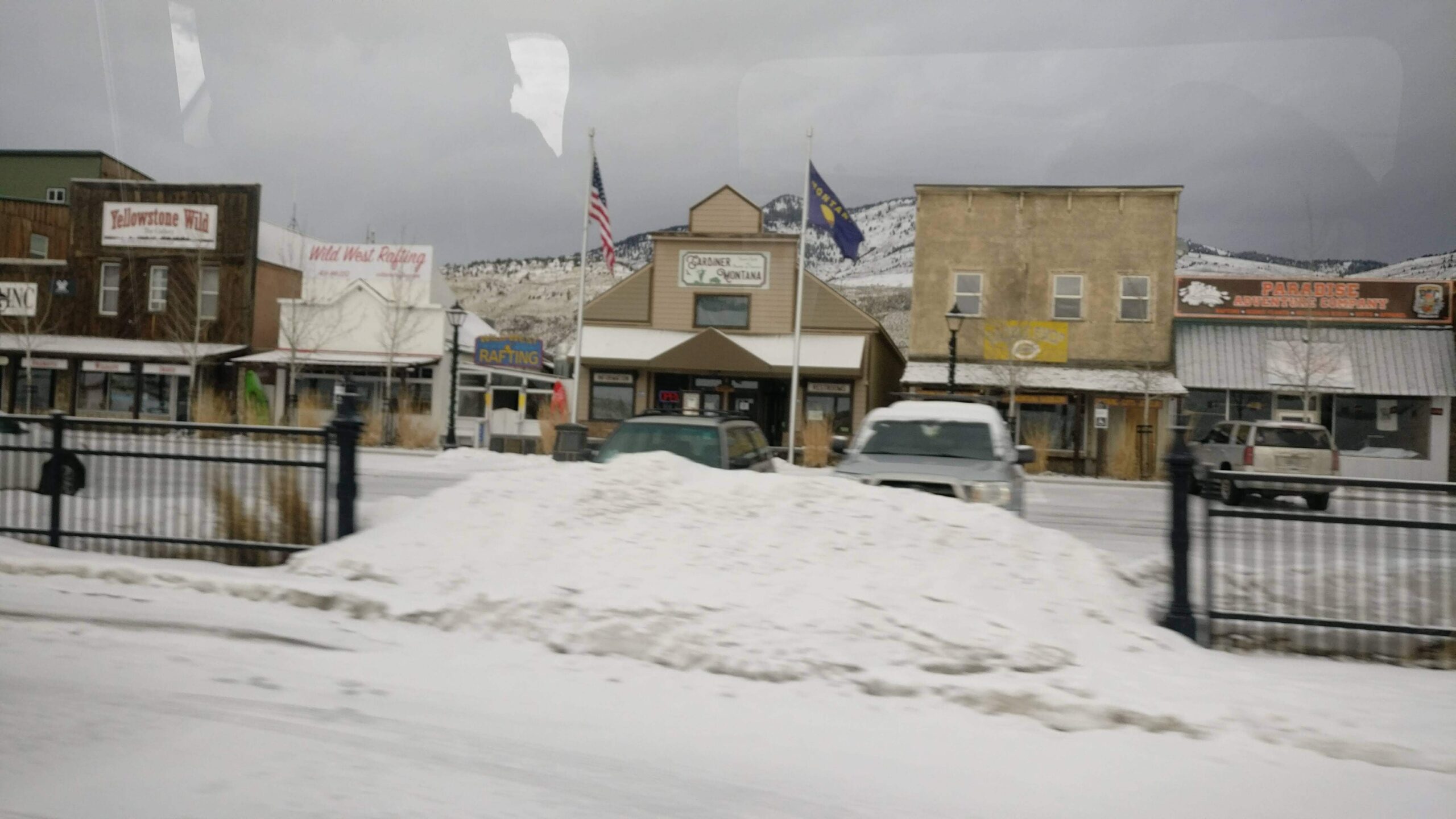
Picture-postcard Gardiner is the first town we would pitch our camp at for the ensuing two nights. Created in 1872, now with a population of 900-odd, it guards the North entrance.
Roosevelt Arch looms imposing as we are about to enter the Park. In 1903, President Roosevelt laid down the cornerstone of the grand triumphal structure rising 50 feet when the railway came to Gardiner, making the arch a part of the station ensemble. Construction dates back to the time the US Army administered the Park.
Hell’s Caldera
For early visitors, it was a descent into hell, no less, when they chanced upon Yellowstone. Angry geysers spout, flamboyant bacteria-filled boiling pools deceitfully beckon, fumaroles hiss fiendishly, and winters are unforgiving.
This active super-volcano is one of the last and largest nearly unbroken natural ecosystems on the planet. Though no longer spurned as the devil’s dwelling, it inspires awe. Some of the most diverse wildlife roaming free turns a trip to Yellowstone into a unique safari.
Residents of Yellowstone
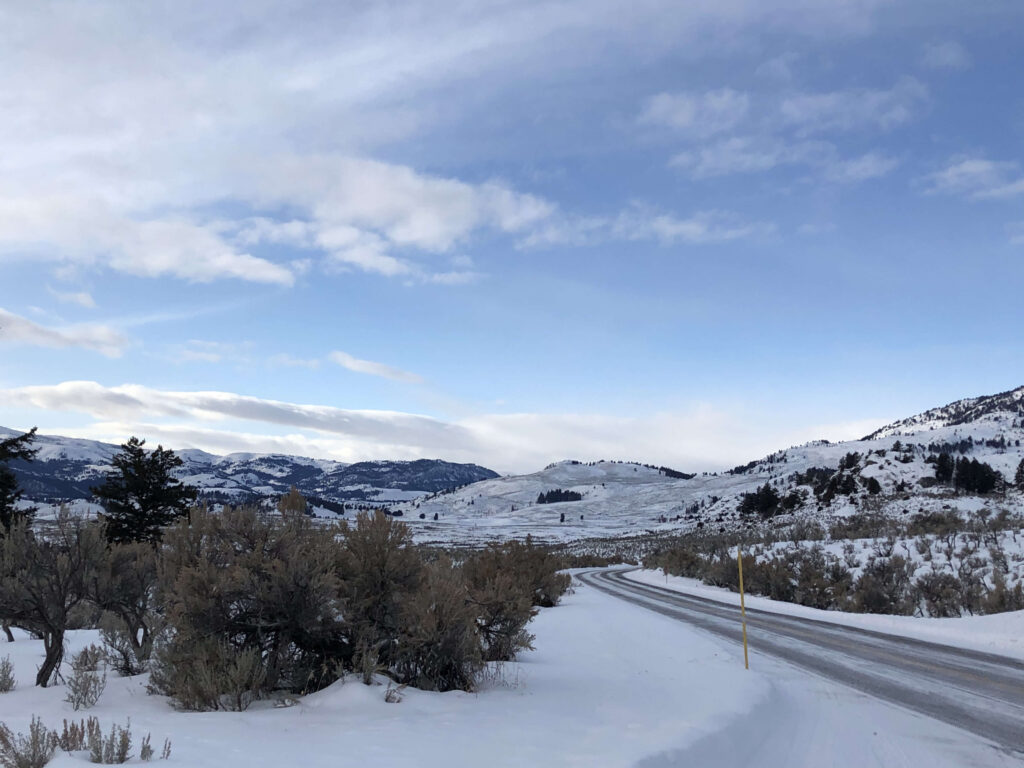
Elks are the most abundant large mammals in Yellowstone, prehistoric-looking bison are the largest, and pronghorns are the fastest. Bighorn sheep, mountain goats, coyotes, red foxes, cougars, bobcats and most famously, packs of grey wolves share the Park. Grizzly bears had long lumbered into hibernation, since winter had come calling much before we did.
Something stirred in the snow-dusted brush on the roadside. Wolf-like but smaller, a lone coyote fixes its appraising glance upon us. Proverbially known as the prairie ghost, they get their nickname due to their stealthy nature and ability to largely go unseen, even when they are present in an area.
Lone hunters, they startle with their agility and are considered more dangerous for humans than wolves. Lingering uncertainly for a while, the spectral creature scampers off, suspiciously looking back over its left shoulder. Navajo sheepherders call them God’s dogs, and perhaps they are, having stubbornly thrived, despite a century of persecution.
Sorcery of Geology
Some iconic sights force us to defer our pursuit of wolves just yet. Old Faithful, the infinitely famous cone geyser, erupts about 20 times daily, with unfailing reliability, never wanting for an audience, even in the most punishing winters. Eager crowds at the viewing area waiting for the next eruption bear testimony to its never-waning pull.
Fountain Paint Pot showcases spewing mud pots, spitting geysers and whooshing hot springs, emitting an overbearing smell of rotten eggs. Needle-ice formed by groundwater pulled to the surface via capillary action and frozen into thin, sharp columns, fencing off the fringes.
Yellow squash, orange carrots and pumpkins, red shrimp, pink flamingos, orange-pink salmon and the Grand Prismatic Spring are colour-cousins. Their colour comes from carotenoids that are used to harvest light energy by phototrophic bacteria! The varying temperatures nurturing different types of bacteria lend chameleon colours to the angry lake, its temper highest at the red-hot scalding centre, cooling off towards the blue-green edges.
We reach our motel before sundown to tuck in for the night.
Of Wolf and Men
Once the most widely found land mammal on earth, wolves got caught between the fault lines of history, culture and human rapacity. Stories from children’s tales of the big, bad wolf in Red Riding Hood to the werewolf legends of shapeshifting created a reputation of malevolence, cunning and gluttony, tying them to themes of darkness across cultures.
In North America, they were reviled by ranchers, hunters and gun lobbyists and consequently trapped, poisoned and hunted to protect livestock and for their valuable pelts. Guns decimated the last wolves born in Yellowstone in 1926.
Seventy years later, in the winter of 1995, Yellowstone was repopulated with a dozen or so wolves from Canada. It was certainly not possible for the most polarising animal in the West to quietly step back into Yellowstone. Still, having done so against numerous odds, it became, on the one hand, one of the greatest wildlife conservation success stories of the last 50 years, while on the other, one of the most controversial ones, igniting intense multi-decade conflicts that still rage on.
Their survival was brutally tested. Politicians lent their voices, some in favour and some against reintroduction, depending on the interests of their constituencies. Environmentalists fought valiantly. The destiny of the wolves merrily seesawed along with the dominant trend. They were listed as endangered or merely taken off the list, depending on whether politics or science prevailed.
Yellowstone celebrated the 30th anniversary of their return in 2025.
The Park boasts of a hundred odd wolves, divided into 10 packs. The survival rate of pups is low. Adults are lost to fierce inter-pack rivalries. Only about half of all wolf hunts result in success. The kills are guarded zealously against, or lost to, marauding bears, sly coyotes, persistent ravens and keen-eyed bald eagles, all desperate for a place at the table once it is set.
Elusive Wolves
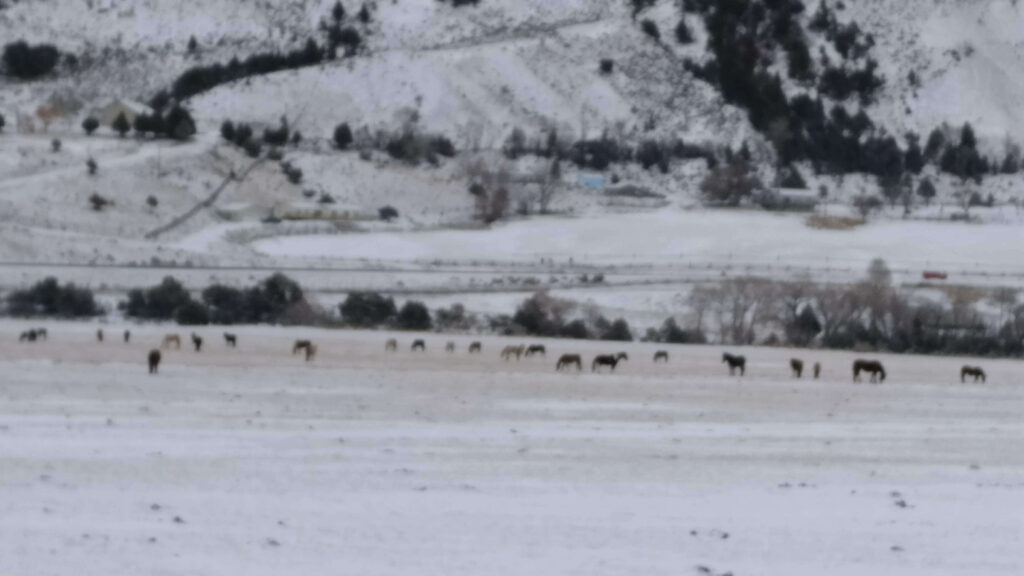
The volcanic plateau is a beauty served cold. Valleys, creeks and canyons hide under dollops of double whipped cream. Beyond are high mountain ranges. Packs are scattered over the enormous expanse. They are free to roam out of the Park into the greater Yellowstone area too, a twenty-million-acre expanse. Tracks on the ground and scat are used for tracking, but falling snow conspires to cover these up, double quick.
Herds of snow-encrusted bison, noses to the ground, hooves ankle-deep in snow, struggle stoically, persevering to graze, heavily browsing for sagebrush through the frost-hardened ground. Elk wander on the higher slopes, skittish at the slightest flicker of threat. Rocky mountain Juniper provides some colour in the bleakness.
Humans are allowed to cosy up to wolves in Yellowstone, maintaining a distance of at least 100 metres. Vehicles are equipped with spotting scopes, which are tripod-mounted telescopes, to help draw the wolves, once sighted, closer. Radios communicate wolf locations that are continuously tracked by guides and park officials. Our driver-guide Clint Parkhill is ever alert to incoming signals, and the moment he picks up a hopeful one, he diligently halts and sets up his scope.
During one of these halts, a gorgeous red fox, fluffed up in its luxurious winter party coat with a magnificent bushy tail, makes a quick, curious appearance to dazzle us and then is gone in a flash.
During our two days at Gardiner, wolves play truant! Clint keeps us from despairing. He promises luck as we proceed to the northern part of the Park on our second leg. He also promises an encounter with Rick McIntyre, the famed champion of wolves, resident at Yellowstone, for the last quarter century.
A retired National Park ranger with a history of having watched wolves in America’s National parks for forty years, Rick interacts with visitors and explains what they see. McIntyre arrived in Yellowstone just about the time the reintroduced wolves did. He has watched, chronicled and dedicated his life to the wolves with unflinching perseverance.
He never misses a day in the Park. His records of 100,000 sightings in Yellowstone, 12,000 pages of field notes written on his observations, and several bestselling books make him one of the foremost experts on wolf behaviour.
No matter how elusive the wolves, with him in the Park, sightings are a matter of time – we are assured!
Photos by the author

Sudarshana Talapatra relishes weaving stories. A career in bureaucracy facilitated extensive travel. People, places, and words excite her. At present, it is unclear whether her travels inspire her to write or whether her love of writing enthuses her to travel. An avid reader, scrabbler, wordler, music lover and occasional dabbler in arts and crafts, she hopes to continue to travel to create memories for herself and joy for her readers by spinning tales.
 By

 By
 By

 By