
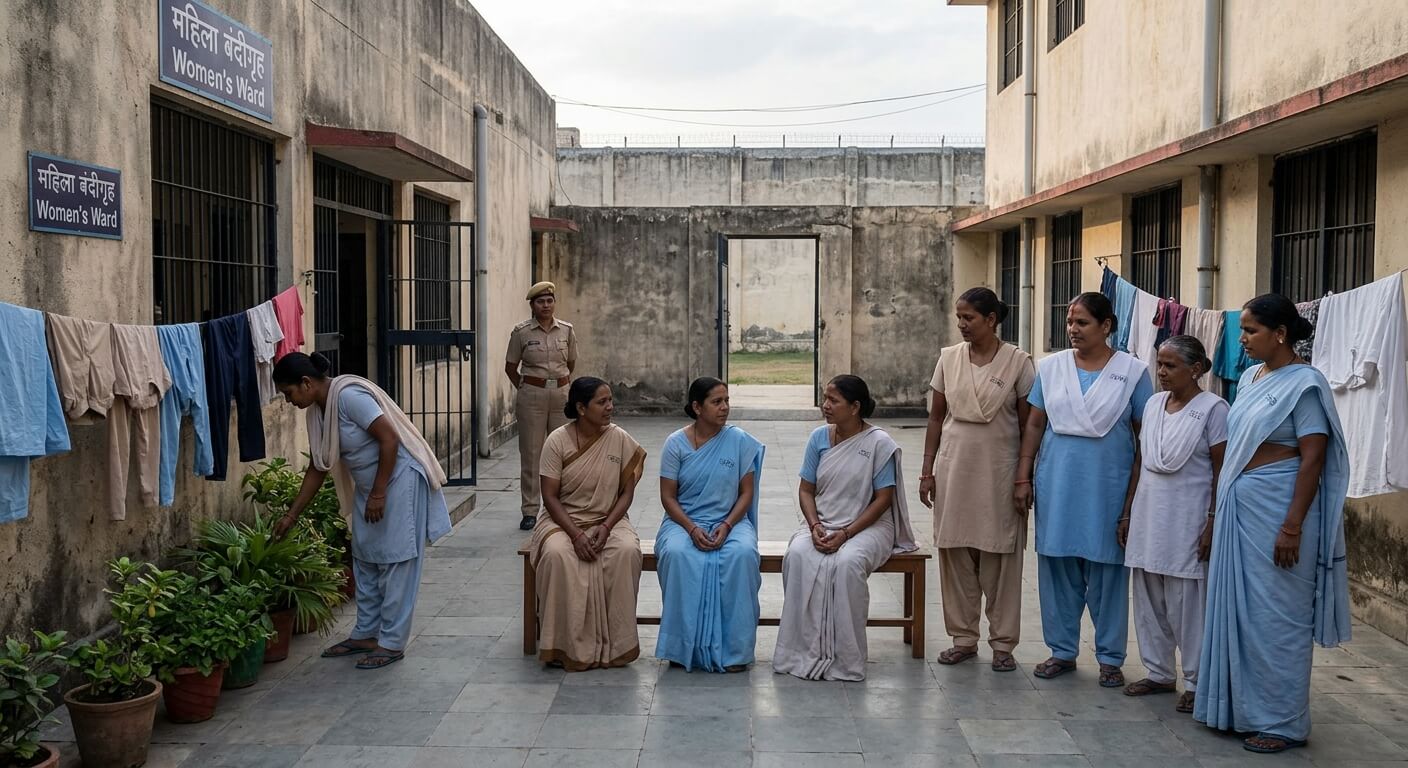
Explore the harsh realities of female incarceration in India with Dr Tinku on DifferentTruths.com, highlighting systemic flaws and human rights challenges.
Summary:
This article examines the plight of female prisoners in India through an empirical lens, highlighting systemic challenges such as illiteracy, poverty, and inadequate legal representation. Women face “double-deviance” by breaking both legal and gender norms, resulting in severe social branding and exclusion post-release. The study advocates for comprehensive reform, better legal aid, and gender-sensitive rehabilitation programmes.
Key Takeaways
- Systemic Vulnerability: A significant majority of incarcerated women are illiterate, impoverished, and lack access to timely legal representation.
- Social Stigmatisation: Released women face severe ostracism, leading to anonymous lives, homelessness, or potential relapses into crime.
- Reformative Imperative: Effective rehabilitation requires specialised counselling, vocational training, legal aid, and gender-sensitive prison administration.
Individuals are born into the womb of the society of which they become natural members by birth. The formation of social institutions transforms individuals into institutionalised members of society, subjecting them to the rules and norms developed by that society for all its members. The terminology “human rights”, though a modern term, has its basic principle imbibed in humanity. Certainly, rights and freedoms are fundamental to human existence. They are intrinsic entitlements that accrue upon birth as a human and are founded on respect for the dignity and worth of each person. In our frame of analysis, rights are universal for all ages and across countries, communities, genders, and ages.
Introduction
Understanding the historical perspective is essential to grasp the situation of women in the context of crime and subsequent incarceration. Historically, female criminals have been cast as a “double deviant”. On the one hand, she violated conduct or law; on the other hand, she violated and challenged the narrow moral strictures of the designated female role within society. Society has clear demarcations for characterising good and bad women. But women as such do not constitute a homogeneous category. The rigidity of caste and multiple hierarchies of class embedded in society show reflections both positively and negatively. Culturally, women have been considered the foundation stone of family and society. Given the construed gender roles in the patriarchal Indian society, women have been considered preservers of social norms, traditions, customs, morality and family cohesiveness.
Women facing incarceration for violation of socially constructed laws and rules not only suffer from imprisonment and its constraints but also face social exclusion. The positioning of women in imprisonment creates a clear bias against them. They are branded and labelled as bad women deserving hatred, rejection and maltreatment. And without any established rules and laws functioning at ground level, they are totally dependent on and at the mercy of prison officials. Empirical evidence reveals that most of these imprisoned women lack resources, education and legal know-how, which further worsens their condition. This article is an attempt to present before the world the condition of women prisoners in India in the context of their human rights.
Incarceration beyond Imprisonment: The Evils of Social Branding of Women
With the advent of the school of feminist criminology, there was a radical shift from the belief that most aggressive and violent crimes are committed by belligerent masculinity. Thus, multiple propositions about women in crime emerged. But this wave has not clearly percolated in Indian society. This phenomenon is the evil of the “social branding” of a woman released after imprisonment. The punishment for this doubly deviant woman, i.e., firstly for breaking the code of conduct as per legal norms and secondly for challenging the conventional gender norms, falls so heavily on her that, forced by intense social isolation and exclusion, she either chooses to restart her life anonymously or relapses into the vicious cycle of offence. The ostracism by relatives leads families to abandon women released from prison, all in the name of social honour. This exclusion also extends to her children, who face intense social judgement, and further aggravates homelessness and relapse into poverty, vulnerability and crime. Social branding and stigmatisation intensify after release from prison, as the removal of prison walls only heightens societal alienation.
Profile and Circumstances of Incarcerated Women: An Empirical Understanding
With a rising number of women in crime and thoughtless management, the condition of these women languishing in jails has deteriorated. It is important to research, given the facts, why women end up in jails. What are the driving factors? What are the judicial hurdles coupled with the compromises of forced incarceration in jails?
Traditionally, women have been bound to gender roles defined as pure, passive and dependent. Therefore, women in crime scenes or their involvement in offences has been traditionally considered one of the most androcentric research areas. Heidensohn’s (1992, 2000) male-biased control theory clearly defines and confines the gender role of women to the home, which consequentially delimits their opportunities for criminal activities. He clearly suggests that “a woman’s place is in the home”; therefore, a woman has fewer opportunities for criminal activity because the routine of domesticity keeps her in the home. In any event, women refrain from going out of the home after dark as they fear aggressive male behaviour. Further, the engagement of men at work involves supervisory or managerial roles, which creates an ambience wherein women in subordination refrain from committing major crimes.
The case of Pratusha is presented here, who ended up in jail due to consequential prompt defensive action as a trajectory to crime and a pathway to prison. Women who follow this trajectory are often first-time offenders resorting to extreme steps to save their dignity or their lives, or, in some cases, own the shared charge of the crime to save their family members. Such women commit crime to save themselves as a reactionary response to crime or violence inflicted on them. The consequence of crime follows an act of violence in the first instance.
Pratusha belonged to a very poor Chamaar family but was educated and computer literate. She had been linked to the very famous murder of an advocate. For several days, the news channels were filled with news of the advocate’s disappearance, but soon they cracked the case, and a young and beautiful Pratusha was found to be the mastermind and cause of the murder.
Pratusha had been the breadwinner for her low-income family. Due to her ailing brother, she started working in a private company, where she had to make frequent visits to Chaka village. Here, she met the advocate. They became friends, but later the advocate started blackmailing her and threatened to publish her obscene videos on social media. Though the advocate promised her a lucrative salary, he soon started leveraging her vulnerability.
Gathering courage, she decided to speak up. She even started denying favours to the advocate, which enraged him. The tiff ended up in a conspiracy, where the advocate was thrashed to death with lathis and bricks. Emptying all identification materials from his pocket along with cash and a pistol, Pratusha threw him and his bike into the deep waters of the Ganges. Later, she fled from the crime scene along with her brother on a bicycle. After a month of endless search based on the missing complaint, the police arrested the five-months-pregnant Pratusha with three cartridges, one pistol, blood-stained clothes and four mobiles. Here in prison, she is quiet and remains secluded in solitude. The appointed writers keep consoling her and counselling her. The sudden spurt of emotions that triggered her to commit this crime has now left her totally stranded with an unwanted pregnancy and an uncertain life ahead. She has made several suicide attempts.
This raises a critical question as to how correctional and reformative services can be effectively designed and implemented to address the complex psychological, emotional and social needs of women prisoners in such circumstances. The need for a proper reformative approach becomes particularly pertinent in such cases. In the absence of appropriate correctional and rehabilitative interventions, prisons may inadvertently become environments that reinforce criminal behaviour while exacerbating psychological distress, depression and vulnerability among inmates. Therefore, a comprehensive and gender-sensitive reformative framework is essential to address the underlying emotional, psychological and social factors affecting their rehabilitation and successful reintegration into society.
Case of Released Women Prisoners: Convergence of Roles – A “other”, “offender” and “woman”
The agony of social branding of women released from prison becomes even worse after release. In the absence of proper family and social support, she gets abandoned by her people and society at large. In such cases, rehabilitation becomes impossible, leading these women to either choose to end their lives or live an anonymous life. Revelations from empirical observations indicate that women prisoners who were released from jail faced tremendous social humiliation. They were not invited to social gatherings, festivals, or functions.
When women are housed in central jails where men and other hardcore offenders are also housed, it is difficult to introduce a wide range of vocational and skill-building initiatives for women prisoners. As such, with no capacity building or upgrading, rehabilitation of women, especially those who are illiterate and poor, becomes even more challenging. Thus, the initial vulnerability aggravated by social exclusion leaves women in prison entirely vulnerable. This situation leads to traceless rehabilitation. Women released from jail were traced to live anonymously in entirely different locales where their past experiences do not judge their existence. These women went traceless to hide from social humiliation. None of the women we interviewed was found at the addresses provided by the concerned police stations. Therefore, branding the released woman as a social evil heavily impedes her rehabilitation and reintegration with society. Society considers her as ‘doubly deviant’, not only for challenging the legal codes but also the socially construed gender norms. Therefore, the worst fears of these women emanate from ostracism by family, relatives and society.
Though the Prison Manual governs the basic functioning of the prisons, all prisoners need to be treated with the respect due to their inherent dignity and value as human beings. No discrimination on the grounds of race, colour, sex, language, religion, political or other opinion, national or social origin, property, birth or other status should be made. Further, there is no justification for aggravating the suffering already inherent in the process of incarceration.
In this light, the empirical observations reveal that the real problem concerned is not so much which human rights prisoners have, but what obligations rest on the authorities to ensure their rights. A prison administration bears both positive and negative obligations towards the imprisoned to ensure justice. The negative obligations, which are often clear in both understanding and practical application, include the obligation not to torture detainees, since imprisonment itself serves as punishment and rules out any further scope for torture. The positive obligations include authorities actively shaping the preconditions under which the prisoner can actually enjoy the right.
The prison system, at every level, instils fear, secrecy, and vulnerability, diminishing prisoners’ confidence and increasing their apprehensions. This is true for inmates, who appear to be the victims of this system, as well as for prison administration personnel at all levels of the hierarchy. This is evidently true not only in the relations between prison inmates and the prison administration, but also in the intra-prison relations among inmates. Those who are dominant (have good liaisons and social contacts and are physically aggressive and dominating) usually set rules for others to follow. Ultimately, it benefits those at the top of the hierarchy by keeping those below engaged in petty squabbles and preventing them from uniting against their oppressors. Thus, the wardresses extracted portions of the rations from the prisoners in return for small favours or for a guarantee of non-oppression. Medicines and special diets meant for sick and infirm or even pregnant women hardly reached them. There exists a nexus of bribery and hideous sanctions from top to bottom. The only sufferers are the inmates, of whom the dominant ones are silenced with special favours or sanctions.
Life of Women in Prison
Based on the observations and empirical evidence collected during the visit to the Central Jail women’s barrack, it is apt to assert that the very positioning of women in jails not only aggravates their trauma as a result of their punishment but also socially alienates them from their friends, family and society at large. To understand women’s relationships with family during imprisonment, we examine the cohort by age, education, crime, and economic background. The active demographic age group is responsible for the major crimes. Among the convicts, the age group of 35-45 years was most active, representing 33 per cent of the convict cohort.
Table 1: Distribution of Selected Women Prisoners by Categorised Age
| Status ofImprisonment | Categorised Age | Total | |||||||||||||
| 18-25 | 25-35 | 35-45 | 45-55 | 55-65 | 65-75 | 75 & more | |||||||||
| Convict | 0 | 0.0 | 5 | 16.7 | 10 | 33.3 | 5 | 16.7 | 6 | 20.0 | 3 | 10.0 | 1 | 3.3 | 30 |
| Under trial | 4 | 21.1 | 5 | 26.3 | 2 | 10.5 | 5 | 26.3 | 1 | 5.3 | 2 | 10.5 | 0 | 0.0 | 19 |
| Released | 1 | 20.0 | 0 | 0.0 | 1 | 20.0 | 0 | 0.0 | 2 | 40.0 | 1 | 20.0 | 0 | 0.0 | 5 |
| Total | 5 | 9.3 | 10 | 18.5 | 13 | 24.1 | 10 | 18.5 | 9 | 16.7 | 6 | 11.1 | 1 | 1.9 | 54 |
Source: Field Survey 2023
Distribution of women prisoners by educational status shows that 83 per cent of prisoners were illiterate. Further, of the total 30 convicted women prisoners in our cohort, 90 per cent were illiterate. There were educated women also in the sample, though it was nominal. Illiteracy breeds ignorance and hence aggravates the vulnerability of the women in prison.
Table 2: Distribution of Selected Women Prisoners by Educational Status
| Status ofImprisonment | Educational Status of the Prisoner | Total | |||||
| Illiterate | Literate | Educated | |||||
| No. | % | No. | % | No. | % | No. | |
| Convict | 27 | 90.0 | 1 | 3.3 | 2 | 6.7 | 30 |
| Undertrial | 13 | 68.4 | 2 | 10.5 | 4 | 21.1 | 19 |
| Released | 5 | 100.0 | 0 | 0.0 | 0 | 0.0 | 5 |
| Total | 45 | 83.3 | 3 | 5.6 | 6 | 11.1 | 54 |
Source: Field Survey 2023
The categorisation of women prisoners by economic categories was based on information shared by women during the survey on questions about ownership of house, land, etc. Based on their pre-confinement status of work and assets owned and their own perception of their economic category, they were classified. A majority of women prisoners were from very poor, non-agricultural backgrounds, engaged as fruit vendors, petty shop owners, etc. Some women (16.7%) worked as agricultural labourers for petty wages or for kind. 22 per cent of women also toiled hard as casual labourers, while a nominal proportion (3.7%) were students. Some women were actively engaged in the flesh trade (as kotha sanchalikas) in their pre-imprisonment status and were later booked under the law of the land.
Further, of the 42.6 per cent of women booked under Section 302 of the IPC for murder, most (65 per cent) were in the age group of 35-65 years. Of the 5 cases of murder of a child, 3 were within the age group of 35-55 years. This group was most active for the most heinous crimes because this was the category which was socially and/or economically most active and confronted the outside world. This age category committed 61 per cent of the crimes. (Table 3)
Table 3: Distribution of Women Prisoners by Age and Crime Categories
| Age Category(in yrs.) | Type of Crime Committed | Total | ||||||||||||||
| Murder | Child Murder | NDPS | Kidnap | POCSO | DPA | Prostitution | ||||||||||
| No. | % | No. | % | No. | % | No. | % | No. | % | No. | % | No. | % | No. | % | |
| 18-25 | 2 | 9 | 1 | 20 | 0 | 0 | 0 | 0 | 1 | 25 | 1 | 7 | 0 | 0 | 5 | 9.3 |
| 25-35 | 3 | 13 | 1 | 20 | 1 | 33 | 1 | 100 | 1 | 25 | 1 | 7 | 2 | 50 | 10 | 18.5 |
| 35-45 | 5 | 22 | 2 | 40 | 1 | 33 | 0 | 0 | 0 | 0 | 4 | 29 | 1 | 25 | 13 | 24.1 |
| 45-55 | 4 | 17 | 1 | 20 | 1 | 33 | 0 | 0 | 1 | 25 | 2 | 14 | 1 | 25 | 10 | 18.5 |
| 55-65 | 6 | 26 | 0 | 0 | 0 | 0 | 0 | 0 | 1 | 25 | 2 | 14 | 0 | 0 | 9 | 16.7 |
| 65-75 | 2 | 9 | 0 | 0 | 0 | 0 | 0 | 0 | 0 | 0 | 4 | 29 | 0 | 0 | 6 | 11.1 |
| 75 & more | 1 | 4 | 0 | 0 | 0 | 0 | 0 | 0 | 0 | 0 | 0 | 0 | 0 | 0 | 1 | 1.9 |
| Total | 23 | 42.6 | 5 | 9.3 | 3 | 5.6 | 1 | 1.9 | 4 | 7.4 | 14 | 25.9 | 4 | 7.4 | 54 | 100.0 |
Note: NDPS – Narcotic Drugs and Psychotropic Substances Act, 1985
DPA – Dowry Prohibition Act
POCSO – Protection of Children from Sexual Offences Act, 2012
Source: Field Survey 2023
Among the different crimes under which women prisoners were charged, committing murder (23 cases) and charges under the DPA (Dowry Prohibition Act) were major crimes. Most of the women charged under Section 302 were normal homemakers and first-time offenders. Another set of cohorts that were booked under Section 302 were petty agricultural labourers or daily-wage casual workers, comprising mostly the lowest cadre of economic strata.
Therefore, it may be safely indicated that liberation of women through economic emancipation and participation in the labour market has by far not been the prime reason for violence by women. Violence and non-accommodative conditions within the household may also lead to increased violence by women. Therefore, in the Indian context, both intra- and inter-household relations and equations need to be researched to understand the crimes committed by women.
Table 4: Distribution of Women Prisoners by Their Pre-Imprisonment Status & Crime
| Pre-Imprisonment Work Status | Crime Committed | |||||||
| Murder | Murder (of Child) | NDPS | Kidnapping | POCSO | DPA | Flesh Trade | Total | |
| Housewife | 11 | 3 | 2 | 0 | 0 | 8 | 0 | 24 |
| Agriculture | 4 | 0 | 0 | 0 | 0 | 5 | 0 | 9 |
| Prostitution/Flesh Trade | 0 | 0 | 0 | 0 | 0 | 0 | 4 | 4 |
| Service | 1 | 0 | 1 | 0 | 1 | 0 | 0 | 3 |
| Non-Agri-Labour | 6 | 1 | 0 | 1 | 3 | 1 | 0 | 12 |
| Student | 1 | 1 | 0 | 0 | 0 | 0 | 0 | 2 |
| Total | 23 | 5 | 3 | 1 | 4 | 14 | 4 | 54 |
Source: Field Survey 2023
Crime among women is highest among the lowest economic strata, with 50% being criminals, of whom 66.7% face serious charges like murder. These high proportions again need to be understood in the frame that their preconprecondition of poverty, vulnerability, inaccessibility and unaffordability of legal aid often lands them in jail. Another important clarification that is required to be made with respect to the high numbers of women in the upper middle class is that 24 per cent of these women prostitutes engaged in the flesh trade, 25.9 per cent of women prisoners were booked under the DPA, and this trend was visible in all economic categories.
Incarceration as treatment for crime fails to meet the standards when examined under the lens of the social status of the prisoners. Representation of SC in all crimes was high compared to other caste categories. Prolonged years of incarceration were high among Scheduled Caste women compared to other caste categories. 29.4 per cent of the SC women convicted and imprisoned for various crimes had served a sentence term of ‘more than 10 years’ in comparison to General and OBC caste women prisoners who had served a term of less than 10 years.
Table 5: Categorised Years in Jail by Educational Status of the Women Prisoners
| Education | Categorised Years in Jail | Total | |||||||
| 0-5 years | 5-10 years | 10-15 years | more than 15 years | ||||||
| No. | % | No. | % | No. | % | No. | % | No. | |
| Illiterate | 20 | 74.1 | 13 | 86.7 | 7 | 100.0 | 5 | 100.0 | 45 |
| Literate | 3 | 11.1 | 0 | 0.0 | 0 | 0.0 | 0 | 0.0 | 3 |
| Educated | 4 | 14.8 | 2 | 13.3 | 0 | 0.0 | 0 | 0.0 | 6 |
| Total | 27 | 50.0 | 15 | 27.8 | 7 | 13.0 | 5 | 9.3 | 54 |
Source: Field Survey 2023
There is a high correlation between the level of illiteracy and years of imprisonment. All the women in the sample jailed for over 10 years were illiterate. As the propensity to commit crime and vulnerability are high among the illiterate class, years of incarceration follow similar trends. Analysing the status of incarceration by different educational categories, we clearly understand that there was higher representation of illiterate women in all categories of incarceration (years spent in jail) or jail term. In absolute terms, 85 per cent of women incarcerated were illiterate. This further strengthens our concern that illiteracy and ignorance about the laws of the state fall in the category of ‘Misfit in the State Made Frame’.
Legal Status of Women in Prison
The legal status of most of the women showed that no legal proceedings had been initiated for 33 per cent of women in prison. They had no access to legal advocacy or legal proceedings. They were languishing in jail with no hope for future release. Most of these women were poor or from the lower middle class and could not afford bail or hefty lawyer fees. Of the 18 cases that did not go through any legal process, 72 per cent involved women who were poor and could not afford the cost of lawyers. The prison administration pursued another 13 per cent of cases. These were cases of women who had completed 14 years of their incarceration and had requested a mercy petition under Form 79. One per cent of women whose cases were pursued by lawyers and whose legal proceedings were ongoing belonged to the middle-class economic category (Table 6).
Table 6: Legal Status of the Women Prisoners by Economic Status
Economic Status | Legal Status of the Cases of Women Inmates | ||||||||||
| No Legal Process% | Legal Proceedings by Jail Administration % | Legal Proceedings Ongoing % | To Be Released After Completion of Fixed Term % | Released% | Total | ||||||
| No. | % | No. | % | No. | % | No. | % | No. | % | No. | |
| Poor | 13 | 52.0 | 5 | 20.0 | 4 | 16.0 | 1 | 4.0 | 4 | 16.0 | 27 |
| Lower Middle | 1 | 50.0 | 0 | 0.0 | 1 | 50.0 | 0 | 0.0 | 0 | 0.0 | 2 |
| Upper Middle | 0 | 0.0 | 0 | 0.0 | 2 | 66.7 | 1 | 33.3 | 0 | 0.0 | 3 |
| Middle | 4 | 19.0 | 2 | 9.5 | 12 | 57.1 | 2 | 9.5 | 1 | 4.8 | 21 |
| Well Off | 0 | 0.0 | 0 | 0.0 | 0 | 0.0 | 1 | 100.0 | 0 | 0.0 | 1 |
| Total | 18 | 33.3 | 7 | 13.0 | 19 | 35.2 | 5 | 9.3 | 5 | 9.3 | 54 |
Source: Field Survey 2023
It is noteworthy to state that confinement behind bars and without any hope aggravates the vulnerability and magnitude of problems of the women in prison. The drudgery of prison life, frequent assaults, no visits, and no hope of release often lead to situations where women lose their mental balance and fall either psychologically or physically ill. The trauma can be well understood in the following tables, where many such women accept incarceration as their fate and lead a hopeless life.
Due to the secondary positioning of the women in a male prison, they often remained confined to small wards inside male prisons. According to Dhawan [1], there is a dearth of women wardens, superintendents, assistant superintendents, doctors, and counsellors. The prison administration fails to meet the needs of women prisoners due to these huge gaps. There’s also a large gap in the range, level, and quality of vocational training given to women inmates as compared to men, says Vijay Raghavan, field director of Prayas, the Tata Institute of Social Sciences (TISS) field action project focused on prison reform. [2] “Options for women are scant because new initiatives require scale, and women’s jails are synonymous with lack of scalability.”
Women in our study mostly reported that their families had either renounced them or they had no family left. 42.6 per cent of women in our sample confirmed that their people did not visit them for various reasons. When we further delve to find the reasons for no visits, we learn that 70 per cent of these women were actually renounced by their family. There were also cases where the entire family of the woman was in jail. This phenomenon was mostly evident in the cases of the Dowry Prohibition Act. While 27 out of 54 women reported that their relatives visited them, there were four other women who received cluster visits. They were members of the same flesh trade racket and were jailed together.
Table 7: Visits Made by Friends & Relatives to Meet Women Prison Inmates
| Reasons for No Visits | Visits By Friends And Relatives In Jail | |||||||
| None | Relatives | Cluster Visits | Total | |||||
| NA (Visits Made) | 0 | 0.0 | 27 | 100.0 | 4 | 100.0 | 31 | 57.4 |
| Relatives in Jail | 6 | 26.1 | 0 | 0.0 | 0 | 0.0 | 6 | 11.1 |
| Renounced | 16 | 69.6 | 0 | 0.0 | 0 | 0.0 | 16 | 29.6 |
| Poor Family Can’t Afford | 1 | 4.3 | 0 | 0.0 | 0 | 0.0 | 1 | 1.9 |
| Total | 23 | 100.0 | 27 | 100.0 | 4 | 100.0 | 54 | 100.0 |
Source: Field Survey 2023
It is pertinent to state here that 74 per cent of these women (23 cases) whose family and relatives did not visit had no legal proceedings ongoing for their release and advocacy. Their cases were put in a cold box, as they could not afford legal advocacy. Thus, poverty, ignorance, and lack of family support render women prisoners in a deplorable state. The whopping costs of lawyers, coupled with lacunae in the judiciary and a lackadaisical attitude towards these prisoners, often discourage legal battles. As a result, these women languish in jails for unprecedented periods of time.
Reformation and Rehabilitation of Women Prisoners
The Supreme Court, in its judgements on various aspects of prison administration, has laid down three broad principles regarding imprisonment and custody. Firstly, a person in prison does not become a non-person. Secondly, a person in prison is entitled to all human rights within the limitations of imprisonment. Lastly, there is no justification for aggravating the suffering already inherent in the process of incarceration.
The prison system’s ignorance and societal apathy toward women undermine effective rehabilitation and reformation efforts. Further, women prisoners often lack awareness about their prison rights, rules and laws, which not only aggravates their prison life but also worsens it. In such circumstances, unless the state makes efforts to capacitate her to know legal proceedings for her release, she will languish in prison. Quoting Justice Amar Saran, “The Supreme Court does not give operative orders to the jailor; that has to come through executives.” Now, if someone knocks on the doors of the SC and its orders have failed at the execution level, then it may be addressed differently. By that time, years will have passed. Time has a killing impact on the ones languishing. Every 25-28 days, undertrials have to go to the court of trial; the process has become more of a routine exercise where prisoners are sacked in vans and taken to court just to put their thumb impression. Model Prison Manual 2016 provides that trials through video conferencing could be initiated, but none wants to shoulder the initial responsibilities. Now, in many cases, we find that the intervention of the police very much decides the responses of the undertrial. Because she is confined in prison, her very positioning makes her vulnerable to accepting the atrocities and excesses of the police officers. The whole system is against the poor, and the non-poor are made to believe that the poor are at fault” [3].
Thus, the political economy of poverty: poverty is an offence; if others cannot, then their rights are disturbed. Here, poverty implies poverty in all senses- economic poverty as well as non-economic poverty, which here in this context implies that one does not have access to power centres, i.e., centres where power vests, like the judges, lawyers, bureaucrats, etc. One has to take due cognisance of the institutional mechanism and political economy of the whole system.
So when we say ’cause’ and ‘consequence’, let us take the ’cause’ as a process, i.e., many conditions are concealed within a cause. What we understand as a consequence can occur at a specific point in time, such as at age 18, and then again at ages 25 or 35, depending on the changes in situations and conditions that shape these consequences. Therefore, often it is not a single consequence; rather, there could be multiple consequences over time. The legal frameworks and rules that were brought out to empower women ended up disempowering them instead, branding them as criminals. The Dowry Prohibition Act stands as a testimony to substantiate a cause-and-effect relationship.
Therefore, to address the issue of reformation and rehabilitation, it is important that a multi-pronged strategy be adopted that addresses not only measures to capacitate women in prison positively to open up better avenues for their post-release rehabilitation but also introduces gender sensitivity among prison officials.
· Counselling of women in prison along with their family members is important. It is important that the pathway to crime or prison is addressed meticulously before counselling. This will help women to go back to their families after release in a healthier manner.
Skill training and capacity building: The introduction of recreational and reformative measures for women in Central jails is constrained by high security concerns related to high-risk inmates, which limits the flexibility needed to run vocational and skill training programmes. Training tools may be misused as dangerous implements, posing contraband risks and requiring continuous monitoring by guards and trainers. The problems are further aggravated by the fact that hardcore criminals, first-time offenders, convicts, and undertrials are all housed in the same barrack. This situation makes it very difficult to segregate inmates for training.
Soft skills and beauty parlour training could be provided to the women, as these do not involve the use of instruments that could be used or modified for use as weapons.
Legal advocacy and free legal aid should be mandatorily made available to all women inmates. Though such services are available and functional on paper, they are often not implemented in practice.
· Corpus Fund for Helping Poor Prisoners who languish in jails due to the inability to ensure the surety amount for bail.
Follow speedy trials of the cases of women with UTs in fast courts: As per the latest recommendation, trials should be held in video conferencing. This would ensure that trials occur and prisoners are not merely taken to court to be harassed and falsely implicated under police pressure or merely put a thumb impression and returned.
· Government should better liaise with like-minded NGOs on various fronts and also provide financial support to voluntary organisations working on the rights, welfare and rehabilitation of the prisoners.
· Case-by-case legal follow-up: The cases of women jailed for more than 14 years should be advocated with priority and ensure speedy justice at all levels.
Records of women released from jail should be maintained. Follow-up of the released women’s cases and monitoring of their rehabilitation at least 1 year post-release should be ensured.
· Meditation, yoga centres and counselling practices should be provided to ensure positive mental health. Such centres could help open up women positively in improving self-regulation skills and control of emotions.
Vocational training, basic amenities, and facilities required for a decent standard of living do not achieve their intended results. Observations reveal that there was an acute shortage of living space per inmate in the dormitories assigned. Staff shortages, both at supervisory levels and down the line in the women’s barracks, inhibit the proper functioning of the prison. Common areas for recreation and socialisation, like the library, indoor sports, etc., are totally missing. Cooked dinner is provided at 5 p.m. to the women inmates, and after that, the doors of the prison are closed. Even routine cooking activities are absent. Though only one inmate had a child during the jail visit, there was no crèche facility. Most of the inmates who aspire for higher education are encouraged to opt for courses through IGNOU. No training or vocational classes were available to the women due to strict security concerns of the Central Jail.
In the absence of any constructive activity and productive engagement, women frequently resorted to quarrels or delinquent activities. Routine medical check-ups were available, but specialised medical attention, especially a gynaecologist, was not available. There was no kitchen garden within the barrack premises, but some women were sent to work on agricultural fields within the jail boundaries. There was no post-release record available in the jail. The only available record was from the police station where the women’s prison inmate was booked for the crime. The released women were thus living an anonymous life. Reformation and rehabilitation remain constrained only to the inscription on the primary entry gate of the prison.
References
A Report on the Condition of Women Inmates in Prisons: 2018. National Commission for Women, New Delhi. Alder, Freda. 1975: Sisters in Crime, New York: McGraw-Hill.
· Carlen, Pat. 1985: Criminal Women, Oxford: Blackwell, Polity Press.
· Chapman, Jane Roberts. 1980: Economic Realities and the Female Offender. Lexington, Mass.: Lexington Books.
· Chesney-Lind, M. 1984: “Women and Crime: A review of the recent literature on the female offender”. (Report no. 295. Honolulu: University of Hawaii, Youth Development and Research Centre.
· Dhawan, Rani. 2012: In Conflict and Custody: Therapeutic Counselling for Women. Sage Publications India Pvt. Ltd.
· Joanne, Belkna. 2001: The Invisible Woman: Gender, Crime and Justice. CA. Thomson Wadsworth Publishing Company.
Paul, Tink. 2015). Languishing Incarceration: Justice from a Gendered Perspective, Man and Development, CRRID, Chandigarh.
[1[1] [1] ] Monica D[1]], Director of retired IPS officer Kiran Bedi’s prison reform NGO, India Vision Foundation (IVF)
[2] https://www.hindustantimes.com/india-news/tales-from-former-inmates-what-life-is-like-in-a-women-s-jail-in-india/story-UBBSj0N5yz2VskZpqgGiLK.html
[3] Excerpts from an interview conducted by the author with Retd. Judge Justice Amar Saran
Picture design by AI

Dr. Tinku Paul is post-doctorate in Economics from the G.B. Pant Social Science Institute under the Indian Council for Social Science Research fellowship. A Ph. D. from the University of Allahabad, she has completed several research projects focused on social and economic justice. Her special interests are to look into and explore the feminist perspectives of socio-economic issues like work participation of women, feminism of agricultural, women empowerment and women prisoners and pathways to crime.
 By
By
 By
By
 By
By
 By
By